





Eye For Film >> Movies >> All Of A Sudden (2026) Film Review



Where Ryusuke Hamaguchi’s Drive My Car was steeped in literary allusion, from Chekhov’s Uncle Vanya to Joyce’s Ulysses, his new and even longer Cannes entry turns toward a more elemental subject: mortality. Loosely inspired by the correspondence between Makiko Miyano, a Japanese philosopher diagnosed with terminal cancer, and Maho Isono, a medical anthropologist, All Of A Sudden marks Hamaguchi’s first French-language feature.
Virginie Efira plays Marie-Lou, the director of a Paris nursing home trying to introduce Humanitude, a dementia-care method built around respect, touch, eye contact and human connection. Her efforts meet resistance from staff members and benefactors more concerned with efficiency and the bottom line. Against this institutional friction, Hamaguchi interweaves scenes of residents being cared for with softness and dignity, insisting that dementia does not erase intellect, personhood or humanity. As Marie-Lou puts it, they should not be washed like vegetables or fed like liquid being drained into a sink.
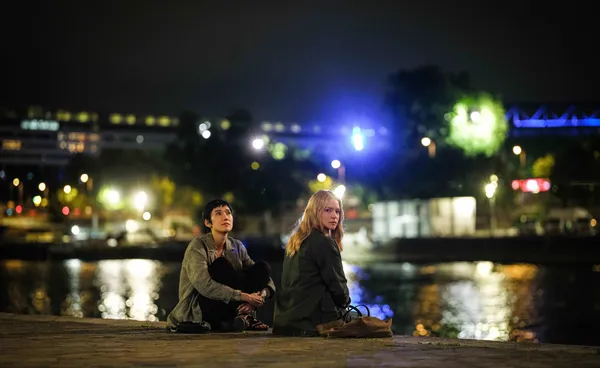
The film’s second axis arrives when Marie-Lou meets Mari (Tao Okamoto), a Japanese playwright and director with terminal cancer. Their names nearly rhyme, and so do their lives. Marie-Lou once studied social anthropology in Japan; Mari studied philosophy at the Sorbonne. Neither ended up quite where her education might have promised. What they find in each other is less romance than recognition: that rare, immediate gravity between two people who suddenly speak as if they have known each other for years.
Hamaguchi has always been drawn to these encounters, to the strange grace of strangers falling into conversation by chance and discovering an intimacy more charged than plot. Here, their connection unfolds over a month, punctuated by dated title cards, marking off days and stretches of time that might otherwise feel less sharply defined. From conversations by the Seine to a late-night philosophical discussion of capitalism, complete with diagrams on a whiteboard, All Of A Sudden stretches time around the sincerity of their bond.
When Mari’s condition worsens, Marie-Lou brings her to the Garden of Freedom, the nursing home she runs, where Mari begins something like an artistic residency. Crucially, Hamaguchi refuses to turn this into clean melodrama. He avoids the orchestrated-death artifice of The Room Next Door, but the film’s escape from melodrama leads it into a more unstable register of absurdism. As staff and residents embrace Humanitude, the atmosphere occasionally edges toward the cultish. Foot massages become communal rituals; care begins to look, from the outside, almost bizarre.
But that discomfort is exactly the point. All Of A Sudden asks why tenderness toward the elderly and disabled should appear strange to us at all. Able-bodied people tend to imagine ability as a permanent condition, when disability is, for most of us, an eventual state. Hamaguchi’s most pointed provocation is not that the nursing home becomes excessive in its care, but that ordinary neglect has trained us to see basic tenderness as excess. If the sight of staff and residents massaging one another’s feet in a chain feels culty, perhaps the problem is not the ritual. Perhaps it is us.
Reviewed on: 16 May 2026


