 |
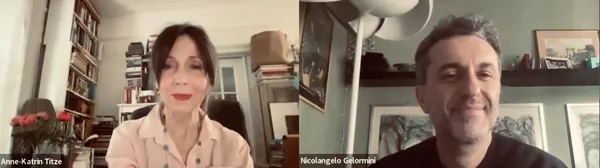
| Nicolangelo Gelormini with Anne-Katrin Titze:” When I think about La Gioia, I always think also about Michelangelo Antonioni and the way he treated the characters within the landscape and the urban place that they are in.” |
Nicolangelo Gelormini’s entrancing La Gioia (a highlight of Film at Lincoln Center and Cinecittà’s 25th anniversary edition of Open Roads: New Italian Cinema) stars the fantastically versatile Valeria Golino, who can be seen in no fewer than four impressive films in the programme (Elisa by Leonardo Di Costanzo, opposite Barbara Ronchi and Roschdy Zem; A Brief Affair/Breve Storia d’Amore by Ludovica Rampoldi; and Fuori by Mario Martone).
Other selections not to be missed include Massimiliano Camaiti’s Agnus Dei, a documentary about two little lambs (chosen each year and cared for by nuns in accordance to ancient tradition to provide wool for the Pope’s sacred garments presented at the liturgical Feast of Saints Peter and Paul to new metropolitan archbishops); Andrea De Sica’s The Eyes Of Others / Gli Occhi Degli Altri (starring Jasmine Trinca and Filippo Timi), a supremely unholy story of ruthlessness among the scrupulously wealthy (a Rules Of The Game set in the Sixties with the 2020s in mind), and My Tennis Maestro / Il Maestro by Andrea Di Stefano (The Last Night Of Amore) which stars the ever delightful Pierfrancesco Favino at his charmingly forlorn best as an aging tennis coach traveling along the Italian coast in the 1980s with his prodigy.
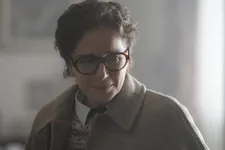 |
| Valeria Golino as Gioia |
In celebration of the 120th birthday of Roberto Rossellini, the master of Italian cinema is honoured with a new documentary, Roberto Rossellini, Living Without A Script by Ilaria de Laurentiis, Raffaele Brunetti, Andrea Paolo Massara and a special tribute screening of Paisan.
Gelormini’s La Gioia presents to us the extraordinary relationship between two people trying to figure out how to keep body and soul together and find joy on our ever so manipulative, greedy world. Gioia (Golino at her pensive best) is a high school French teacher in her fifties who still lives at home with her parents.
Mom treats her like a little girl, her room holds dolls and a banner of the family’s favourite soccer club. Her mind is beholden to the classics of French literature and a special pop song from her teenage years. Alessio (Saul Nanni) a new student at the high school works as a hustler on the side and is 'managed' by the local hairdresser (Francesco Colella), a friend of his mother’s (Trinca) who works as a cashier in a supermarket.
From Naples Nicolangelo Gelormini joined me on Zoom for an in-depth conversation on La Gioia.
Anne-Katrin Titze: Hello! Good to see you! I thought your film was the most layered, the most detailed, and the most heartbreaking of the films in this program I have seen. I was very impressed.
Nicolangelo Gelormini: Thank you, Anne-Katrin, thank you so much. Call me every day!
AKT: I liked the beginning of your film. The old woman on the roof fixing a satellite dish reminded me of my grandmother, who was living in her house alone at over 90 years old, and she would do things like cleaning out the drain on the roof.
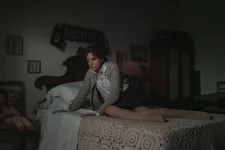 |
| Nicolangelo Gelormini on Gioia: “In this double age, she's, very young inside, she never had a relationship.” |
NG: The drain! Wow!
AKT: On a ladder! So you had me hooked from the very first moment.
NG: It was something in my imagination, but now that I know that there's something real in your memories, I feel very surprised about that, because it's very uncommon to see an old lady on the roof.
AKT: Well, my grandmother was very active and unique. How did you come to pick this for the beginning? I think it's a wonderful way to get us into the movie.
NG: It was a way for me to describe from the beginning the connection between this mother and this child. The main character, Gioia, the lady in her 50s, and the idea that the mother is on top of the house is the geography of the human relationship of that family and shows the connection between a mother and a daughter. To me, it was a clear image of where this mother in the life of this daughter is positioned.
AKT: I didn't think of that. The mother treats her like a like a little girl.
NG: Yes, like, she was a very little girl, but she's 50, and she's not a little girl anymore.
AKT: Valeria Golino’s performance is fantastic. She is both a little girl and a woman older than her age, as if she skipped everything in between. And then, Jasmine Trinca gets to play a variant of the in-between that’s missing.
NG: I always think about Gioia in a way that she is not only a shy girl, a shy woman, or an expressive woman. But I also think that she's, how to say in English, she's so “sfrontata” in Italian.
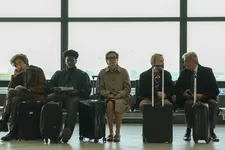 |
| Nicolangelo Gelormini on his costume designer Antonella Cannarozzi: ‘’The idea was to give to Gioia something that you can really check in her closet, the idea that this lady put on herself a narration of her dream.’’ |
AKT: Bold?
NG: Unscrupulous. Reckless. And uninhibited also. I also think about joy. In this double age, she's, very young inside, she never had a relationship. She never gets herself in a sentimental relationship or a sexual relationship with someone else. But at the same time she's fearless.
AKT: Fearless as little girls can be. I think there's something that is allowed, a kind of fearlessness, that is allowed to little girls.
NG: Yes, sure.
AKT: It stops at a point when you…
NG: She's uninhibited like a very young girl, but she… at the same time, she's a teacher, she's a 50 year-old woman, so she's always wise. When we thought about the character with Valeria, we always talked about how she knows about this relationship with Alessio, how she's wise about this relationship with Alessio. How much is not conscious about this relationship? And to me, she's almost not conscious. Probably she asked herself to not have so many questions about this, but to go on. It's the first time in her life that she can feel this feeling of joy. Joy is the English translation of Gioia.
AKT: Yes, that is very telling.
NG: The Italian title of the movie, and that is also the name of the character.
AKT: Right. And the infatuation starts with the glasses being pushed up. It is such a perfectly honed gesture. It's so true. You know it immediately. It’s these little things that produce the spark of joy, no? The scene when he comes to her house for the first time, for the lesson, her mother opens the door, lets him in. I think this is right after the Dreams Are My Reality pop song moment?
NG: Yes.
AKT: She tells her daughter that there's a boy outside.
NG: A teenager is outside the house. The mother knows. The feeling of the mother in that moment, she's afraid about him, because she felt that there is a dangerous guy in front of her. Probably because she knows she feels her daughter is like a teenager, too.
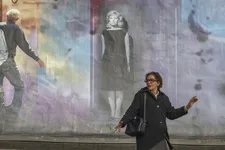 |
| Nicolangelo Gelormini on Valeria Golino in front of the mural: ”When I put my characters inside this place, in this beautiful architecture, that Antonioni feeling came to us, and the sign of that was that we found this image of Monica Vitti, the biggest muse for Michelangelo Antonioni.“ |
AKT: The moment she feared her whole life. The suitor outside the door. It also resembles a fairy tale. It's the wolf outside the door. The mother sees it. Or it could be an Edith Wharton or Henry James suitor waiting at the door, or Mickey Rooney taking Judy Garland to a dance. You know, here's the boy who's taking her to the ball.
NG: Out to the ball, yes, okay. We don't have a ball like that in Italy. Yes, yes, but it makes you remember that.
AKT: You leave room for a lot of associations. Monica Vitti at the racetrack! That's another great moment! What were your thoughts behind that moment?
NG: I remember that that day on the set was a very great day for us. This movie talks about, you know, the outer parts of the city, not the central ones of the city. And many directors made this kind of narration in their cinema. When I think about La Gioia, I always think also about Michelangelo Antonioni and the way he treated the characters within the landscape and the urban place that they are in.
When we shoot in Turin I was very fascinated about this architecture. The name of it is Lingotto. It’s a building that was built for cars to race. Today it is an exhibition space. And, when I put my characters inside this place, in this beautiful architecture, that Antonioni feeling came to us, and the sign of that was that we found this image of Monica Vitti, the biggest muse for Michelangelo Antonioni. We found this beautiful image of Monica Vitti from La Notte. I don't want to make a citation of Michelangelo Antonioni, but in that moment, we felt that he was very close, that kind of atmosphere.
Valeria Golino never acted with Monica Vitti in her career. And seeing her in the same frame with Monica Vitti, for me, was something very exciting and full of inspiration. The architecture is very important in my movies. I was so happy to put this architectural Lingotto inside this story.
AKT: It's beautiful, a great place. I loved what you did with the costumes. In lesser hands, they could have been so cliché, and in your film there's nothing cliché. I mean, she's wearing really beautiful, well-made jackets at times. So there's also maybe that Monica Vitti spirit, as distant as it may seem. Vitti is, of course, always fabulously dressed in the Antonioni films.
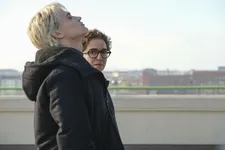 |
| Nicolangelo Gelormini on Gioia and Alessio and Kierkegaard’s Aut Aut:” It's very close to the idea of this movie about love. And it's exactly what Alessio and Gioia feel at a moment in this movie.” |
Despite the dowdiness, the presumed invisibility, Gioia is not really invisible. I actually found what she is wearing more inspiring than the costumes in most films out there, because there's, again, something playful, something reckless about that old lady look she sports [not out of place on a MIU MIU runway]. She dresses a bit like her mother but not quite. Please tell me about the inspired costume design!
NG: She tried to not be invisible anymore after she met Alessio. And Antonella Cannarozzi is the brilliant costume designer of this movie. The idea was to give to Gioia something that you can really check in her closet, the idea that this lady put on herself a narration of her dream. Because if you look into her fantastic pullover, you can see a landscape, or you can see rabbits, or you can see the hearts, houses. Inside she's very sentimental, because in her heart and her imagination, feeling like love was felt in a very romantic way, because she learned and she knew that kind of feeling through books. Through the reading of French classics, like Flaubert, like Verlaine, like Rimbaud.
AKT: She even knows where Rimbaud and Verlaine met when the mother wants to know that for a quiz show on TV.
NG: Yes.
AKT: And, of course Madame Bovary plays a big part. Gioia’s éducation sentimentale.
NG: Yes, the imagination of Gioia is very powerful in her world, and she can imprint her imagination also on her clothes.
AKT: The scarf comes back in the end, the one with the pink dots. The love story links to Kierkegaard, who comes up in the school context. He describes two kinds of love. There is the love for the perfect object. You love something or someone because they're so perfect, they're so great. And then there's the perfection of love itself, that's the Christian idea of love thy neighbour.
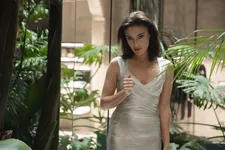 |
| Jasmine Trinca as the mother of Alessio: “He grew up with a mother that gives you an aesthetic and capitalistic way to use feelings.” |
NG: Kierkegaard is mentioned during a lesson Alessio hears. And the professor talks about the Aut Aut of Kierkegaard in that occasion, and it's exactly where the story of Alessio goes in this movie, between the Aesthetic and the Ethical. The idea to choose a substantial and a different way of life, to choose to be in love with someone when you really see someone and someone really sees you. The idea of love in this movie is exactly the idea that I have about love, probably. And that is when you become better in the meeting of someone else. The feeling that you improve in the relationship with someone else. It's very close to the idea of this movie about love. And it's exactly what Alessio and Gioia feel at a moment in this movie. This love gives Gioia the opportunity to improve herself more and more and more and more, and so to follow Alessio more and more and more.
And instead, for Alessio it is a way to escape from this feeling, because probably in his life, he never had this kind of an idea of love, a sane idea of love. Probably because he grew up with a mother that gives you an aesthetic and capitalistic way to use feelings. Alessio escapes from this kind of feeling that is very close to love to me. And from then on, the story has this different plot, and it is the reason why I chose to do this movie. My intention was to talk about the sentimental education.
I was talking about the sentimental education, or to say it better, the sentimental miseducation. Even today. Everywhere. So, I know, most of us, most people, don’t recognise if that feeling that we call love is really love. And is not manipulation, or is not a kind of abuse. This sentimental miseducation is basically the reason why I chose to do this movie.
AKT: There's a real-life case behind your movie. Was the case first, or the idea of sentimental miseducation that you just described? Or did they emerge together?
NG: To me came first the first screenplay of this movie. I wrote with a co-writer the second version of the movie and that became the movie that you see. And only during the process of rewriting with the screenwriter, I put myself into the real recognition of the real facts, the real facts that inspire this movie. And my intention was from the start not to give to the audience only the reconstruction of that real fact that happened in Italy seven, eight years ago. But to understand the theme and the feeling that is kept inside a story like that. To put the story into a different, a universal narration. A way to talk about sentimental miseducation, about Aut Aut, and everything we talked about now in this conversation with you. Not only to tell people the real fact of that story like a newspaper, or like television does. It's important that newspapers and television do that, but cinema is called to give another kind of reading of reality, no?
AKT: “Like a dream”, to quote your film. Another memorable scene. He puts lipstick on her. And the lipstick turns into stigmata on her hands.
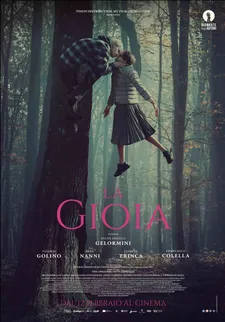 |
| La Gioia poster |
NG: Yes. In many parts of the film, there are these double layers of love, no? The lipstick is an erotic feeling. At the same time it became stigmata. An image that gives you another interpretation. And at the same time, the kiss scene is a kiss in which you have also a rope.
AKT: Around the neck. That tree kiss scene is also on the poster, right?
NG: It’s the archetypes of this movie, the Eros and Thanatos archetypes.
AKT: A word about the ending. The hole is supremely devastating. From archetypes back to architecture again. The spirit of place. Is this what happened to the real woman?
NG: Yes, that part is close to reality, yes.
AKT: And that is a sinkhole that makes her disappear into the canals?
NG: Into the earth, into the earth. A hole into the earth.
AKT: It's very intense, and at the same time it goes back to the stigmata, to the Christ-like figure she also may be? Is the religious component of importance to you?
NG: No, but there's something Catholic in La Gioia. Gioia is Catholic, and she says also a Catholic phrase to the mother of Alessio, and she lives in a punitive way. The Catholic religion punishes sex outside of marriage. And probably this idea of the sacrifice is a catholic influence that the movie has.
AKT: Thank you for this! See you in New York!
NG: Yes! Thank you, Anne-Katrin! Beautiful interview, thank you so much.
Film at Lincoln Center and Cinecittà’s 25th anniversary edition of Open Roads: New Italian Cinema takes place at Film at Lincoln Center from May 28 through June 4 2026.