





Eye For Film >> Movies >> Hen (2025) Film Review


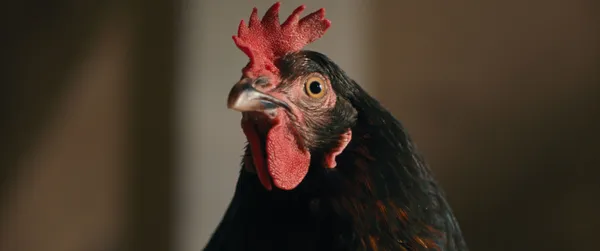

The fable-like story of a little black hen who just wants a peaceful spot to lay her eggs is blended with the altogether more docu-real tale of European human trafficking in the latest genre-bending feature from Hungarian director György Pálfi. An offbeat drama that manages to balance its more serious themes with Chicken Run-style humour, you’re unlikely to see anything quite like it any time soon. It is, however, part of an intended trilogy, which will definitely be worth looking out for.
The hen (played by eight chickens through the course of the film, which uses only minimal technical trickery) begins her life in a huge Greek battery farming factory – a little punk rocker of black fluff in the middle of a sea of yellow. Our plucky protagonist escapes the industrial complex but that is just the start of the dangers that she’s going to encounter. Throughout, Pálfi, writing with his partner on and off-screen Zsófia Ruttkay, observes the action from the chicken’s point of view, which allows us a ground level look at the seedier side of Europe, while still retaining an element of innocence. Praise is definitely due for the chicken-height work achieved by Giorgos Karvelas but he and Palfi also include elegant aerial work that offers a different perspective.

We quickly become invested in the hen’s fight for survival, as she encounters a hungry fox and briefly ends up in the jaws of a dog before being rescued and plonked in a chicken coop by elderly restaurant owner Giorgos (Yannis Kokiasmenos). The restaurant is more or less shuttered, and the unpleasant partner (Argyris Pandazaras) of his daughter (Maria Diakopanayotou) is using it as a hideout for a smuggling operation, which is about to scale up from white goods and cigarettes to humans.
As the smuggling starts, the parallels with the battery farm are clear, with the humans pushed into a tiny space with little to eat or drink, where they are viewed as a collective source of money rather than individuals. The chicken’s striving for freedom is at once a melancholic reflection of those fleeing their former lives in the search of something better but also a quirky, self-contained tale in itself. The hen has plenty of personality, particularly well articulated in one beautiful set-piece, as her pursuit of escape to lay her egg in peace is set to an a cappella version of Ravel’s Bolero. The music, from Szabolcs Szõke, is a huge part of why this film works. It has a Peter And The Wolf expressivity, its various moods fitting the animals like hand in glove.
Pálfi doesn’t shy away from the dark greed and carelessness of humanity but somehow in the middle of tragedy, he still pecks away at a little bit of hope.
Reviewed on: 24 May 2026


Director: György Pálfi
Starring: Yannis Kokiasmenos, Maria Diakopanagioti, Argyris Pantazaras
Year: 2025
Runtime: 96 minutes
Country: Germany, Greece, Hungary
Search database:
