





Eye For Film >> Movies >> Frida Kahlo (2026) Film Review



An extended version of Exhibition on Screen’s previous treatment of the iconic Mexican artist, this film ends wth an all-new ten minute segment exploring the Museum of Fine Arts in Houston and Tate Modern in London’s 2026 exhibition Frida: The Making of an Icon. The larger part of it, first released in 2020, focuses on biography and the development of Kahlo’s work. There have been few other artists for whom these two elements are so closely interwoven.
There have also been few artists who have loomed quite as large in the public consciousness as Kahlo, who can recognised by ordinary people all over the world despite living outwith the most famous artistic centres and holding only three solo exhibitions during her lifetime. She appears on popular posters, in novels and songs, and has previously been celebrated in a number of films. What this does that’s new is bring an expert understanding to the direct analysis of her work. It touches on her overtly political activity (and affair with Leon Trotsky) but is much more interested in the revolutionary aspects of her creative work.
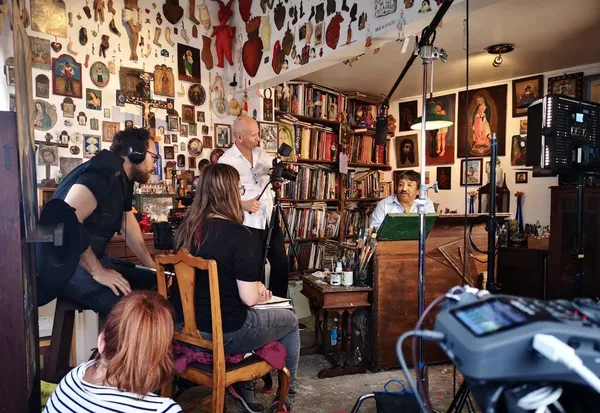
Today, the visually striking Casa Azul in which Kahlo grew up serves as a museum dedicated to that work, and it’s there that we begin, exploring her studio, looking at her carefully arranged paints and brushes. Intercut are images of her paintings, immediately establishing their very personal nature. With other artists, self-portraiture is often dismissed as self-indulgence or vanity, but Kahlo’s symbolism and fierce scrutiny render such interpretations unthinkable. Her portraits, rejecting then conventional depictions of women in multiple ways, repeatedly challenge taboos. They are contextually charged, and furthermore, they reject the notion of woman as a thing to be observed. The impression one gets is much more one of being made to look at all the difficult experiences one might otherwise reject; or of being looked at.
Beginning in Kahlo’s childhood gives the film the opportunity to build up a strong disability narrative, beginning the Kahlo’s bout of polio and the effect on her character of building up her physical strength afterwards, in an era when other girls of her class were being taught to be delicate. Her education at the National Preparatory School positions her as a gender outsider right from the start (very few girls being admitted there), but also highlights the scientific and medical knowledge involved in preparing her to become a doctor, which would inform her later paintings and her understanding of her own body.
Subsequently we take in the life-changing bus crash which gave her multiple fractures and dislocations (and renewed her early interest in art); her miscarriages (and bodly innovative Henry Ford Hospital painting); the physical difficulties she faced in creating art, and the various techniques she used to work around them. The film addresses her multiple surgeries in the 1940s (one participant’s suggestion that these may have stemmed from a desire for attention is unlikely to go down well with viewers who endure chronic health problems themselves); and the way she managed pain, both physical and psychological, using alcohol and morphine, which contributed to her early death. The Broken Column, with its orthopedic corset, piercing nails and desert landscape, speaks to her conscious embodiment, perhaps a factor in her ability to escape conventional narratives.
It would be impossible to address Kahlo’s life without taking in her turbulent romance with Diego Rivera, but here this is addressed primarily in relation to its impact on her work. Material from her letters and diaries (one of which is glimpsed here in all its creative splendour) is used to inform the narration by Díana Bermudez, herself a South American woman with indigenous heritage. This situates her more firmly in relation to the influence of the Mexican revolution and subsequent cultural boom, the move towards engagement with pre-Spanish culture, and her later travels with Rivera.
There are interesting diversions along the way, with examinations of some of her more cryptic paintings. My Nurse And I is looked at from a biographical perspective but also as a take on the Madonna and child, taking in the audacity of Kahlo depicting herself as Jesus. There’s a look at her love of retablos (traditional devotional paintings which tell stories), at the increasing andogyny of her self-portraits towards the end of her life, and at her relationships with animals like dogs and spider monkeys. It’s a shame to hear these creatures described as potentially substitute children, a reductive approach beneath Exhibition on Screen’s usual standards, but overall this is as impressive a work as we have come to expect from them. “Painting has completed my life,” she said at the end, and this film will enrich yours.
Reviewed on: 19 May 2026


