





Eye For Film >> Movies >> La Gioia (2025) Film Review


Worlds existing side by side collide and explode in unforeseen ways. Nicolangelo Gelormini transforms the tragic events of an actual news story into a subtle study of human frailty and desire, survival and choice and the impossibilities within.
Gelormini’s entrancing La Gioia (a highlight in Film at Lincoln Center and Cinecittà’s 25th anniversary edition of Open Roads: New Italian Cinema) stars the fantastically versatile Valeria Golino and presents the extraordinary relationship between two people trying to figure out how to keep body and soul together and find joy on our ever so manipulative, greedy world. Gioia (Golino at her pensive best) is a high school French teacher in her fifties who still lives at home with her parents - a domineering mother and a father in decline from Alzheimer’s.
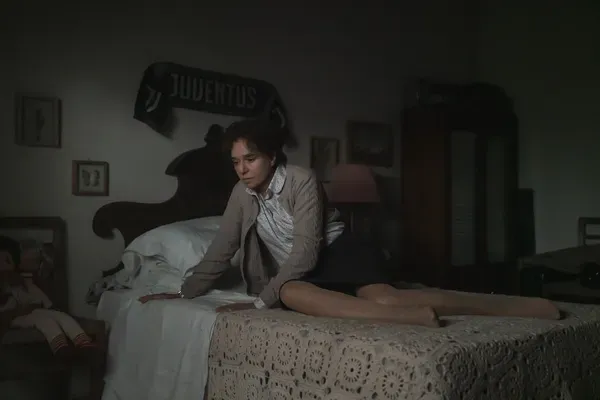
Mom treats her like a little girl, her room holds dolls and a banner of the family’s favorite soccer club. Her mind is beholden to the classics of French literature and a special pop song from her teenage years.
Gioia’s clothing style may resemble her mother’s in its modesty, but Golino (with a seemingly make-up less face) gives some otherwise impossibly dowdy garments a special flair. The costume design by Antonella Cannarozzi (of Saverio Costanzo’s series My Brilliant Friend and Oscar nominated for her work on Luca Guadagnino’s I Am Love) is the most precise, whimsical, and creative I have seen in a long time and Gelormini incorporates the clothes (equally at home on a 70-year-old Turin neighbor and the MIU MIU runway) deeply into the alluring visuals of the movie.
The characters unfold in front of our eyes. They are placed into spaces that simultaneously resemble dreamlands and hold all the markings of quotidian reality. In other words, each shot represents a state of mind. Some harm cannot be undone, some injurious programming cannot be reversed for good. Alessio (Saul Nanni) a new student at the high school works as a hustler on the side and is “managed” by the local hairdresser (Francesco Colella), a friend of the teenager’s mother’s (Jasmine Trinca) who works as a cashier in a supermarket.
This is a movie layered with meaning. A lipstick smudge turns into stigmata, a kiss can make you float and strangle you at the same time, and a gentle push on a pair of glasses may elevate and doom a life.
Turin’s Lingotto, a former Fiat factory turned multipurpose center by architect Renzo Piano, makes for a formidable setting, and when Gioia and Alessio during an outing there stumble upon a mural of Monica Vitti, the film more than winks at Antonioni, it catches some of the unfading mood.
Ultimately wisdoms of the past, which include in this case Flaubert and Kierkegaard, don’t stand a chance when they are so far outnumbered by influences that don’t have a youth’s best interest at heart.
Gioia’s reckless decision is a matter of now or never, and she takes the risk, because it adds to her life a poisonous elixir unknown to her before.
When Gelormini’s carefully constructed double trajectories cross and open up for the characters the possibility of delight for a brief moment in time, an emotional truth is revealed that stays with you long after the devastating note on which the movie ends.
Reviewed on: 25 May 2026


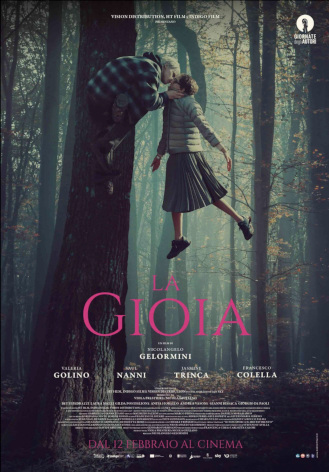
Director: Nicolangelo Gelormini
Writer: Benedetta Mori, Giuliano Scarpinato
Starring: Valeria Golino, Jasmine Trinca, Saul Nanni, Francesco Colella, Betty Pedrazzi, Giovanni Bissaca, Anita Fiorello, Laura Mazzi
Year: 2025
Runtime: 109 minutes
Country: Italy
Search database:
