




 |
| Erupcja |
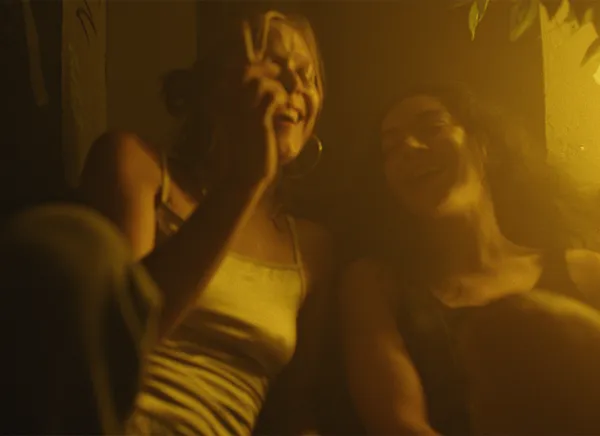
In American filmmaker Pete Ohs’ anti-romantic comedy Erupcja, co-written by his cast, Bethany (Charli XCX) and her boyfriend Rob’s (Will Madden) romantic vacation is thrown into chaos when an erupting volcano grounds them in Warsaw, Poland. In spite of suspecting that Rob was going to propose, Bethany decides to visit Nel (Lena Góra), a childhood friend and former lover. It’s a decision that will lay bare the anxieties of romance.
While Ohs' films typically fit into different genres, a common thread or recurring motif is human connection. His previous films include the sci-fi drama Everything Beautiful Is Far Away, about a search for a mythical lake on a desert planet, the witness protection comedy Youngstown, that centres on a character incapable of lying, and the thriller Jethica, about a woman trying to get rid of her stalker. Then there’s Love And Work, set in a world where employment is illegal, and The True Beauty Of Being Bitten By A Tick, in which friends getting together in the countryside takes a sinister turn.
Speaking with Eye For Film, Ohs discussed the emotional undercurrents of the filmmaking process, seeing the characters through an empathetic lens, seeking a conversation with his audience, and more.
The following has been edited for clarity.
Paul Risker: What was it that made you want to be a filmmaker?
Pete Ohs: There were two things. The first was the TV show Mr. Rogers, with the Land of Make-Believe. The show would be educational, which was nice, but every time they entered the Land of Make-Believe, I was excited to find out what was going on with Lady Elaine and Daniel Tiger and that whole world. So, that was a seed that was planted early on.
And then, video cameras started becoming more accessible when I was a teenager. It wasn't that I was a kid who wanted to be like Spielberg or wanted to be a filmmaker, but getting a camera and getting together with a group of friends on the weekend to make videos was my favourite thing to do. If I was maybe 15 years younger, I would have been putting those on YouTube, but instead, they were just videos that we would watch in the basement on the VCR. And that activity and that feeling is basically what I'm always chasing with every film that I make.
PR: As a writer, happening upon a sentence, phrase or idea is a pleasure that’s difficult to articulate — it’s more of a feeling. Does this translate to the filmmaking experience for you?
PO: It happens a lot, and at different stages of the process. Even when there's just that initial idea, spark, or little seed, that moment of inspiration is a drug. To have this thing that didn't exist somehow present itself to me and my collaborators is one of my favourite parts of the process. And then, I love how much of the process requires interacting and engaging with other people to creatively solve problems. But that activity also solves so many problems within my own existence. It gives me a purpose, and it gives me a human connection. And when we arrive at something that feels like lightning in a bottle, that only exists because we showed up together on that day, that is another one of those amazing feelings I’m chasing, which keeps me going.
PR: Do you think there's a genuine spontaneity or even a serendipity to filmmaking, where you can never film the scene the same way on two different days?
PO: I think that's true, and if you don't respect that fact, then you are disrespecting life and the creative process. To think that you're in control of anything is a delusion. You really are in the moment, and when you’re filming on the set, you might appear to control everything, but there’s still going to be some variable that will influence what actually happens in that moment. And that's what's so beautiful. It is proof that a human existed and expressed something.
PR: That’s true of the audience too. Whatever emotional baggage and unconscious bias they bring to a film, will affect how they receive it.
PO: Absolutely, and filmmaking is about trying to have a conversation and have a connection with other humans. It's going to meet them where they are, in terms of what's going on in their life. That's going to directly influence the conversation that we have.
Many a time I've seen a movie and, because of where I was at, I did or didn't like it. And then I watch it again later, and I'm a different person, and I'm ready for it, or I'm no longer ready for it, and it becomes something different. That is a beautiful part of making something, putting it out into the world and seeing how, when and where it meets people.
And the way we make these movies, I do think they’re very alive and very present. It's also collaborative because these actors are helping me to write the movie. So, we are putting so much of our souls into these things and because of that, we do bring a lot of empathy for each of these characters, who we're not painting as black and white. We're not saying this person's the hero and this person's the villain. What that ends up doing is people get to project onto it when they watch the movie, and the people that side with Bethany, you get to learn what kind of people they are. And the same with those that side with Rob.
It’s also going to be connected to what’s going on in the audience’s lives. Did they recently find themselves on one side of the coin or the other? And that is where the potential for conversation comes from. It’s where there is nuance and there is a lived truth that allows us to examine and talk about it. So, it isn't something that's dogmatic and just says this is the way it is. Instead, it’s more of an exploration; it’s more of a question.
PR: The characters might be making instinctive choices. For example, Bethany is drawn to Nell. It encourages the audience to consider how sometimes we are like an unmanned boat, and the course is determined by the wind in the sails. So, we should be cautious about judging these characters.
PO: Even in my own life, I don't always know why I'm doing whatever it is that I'm doing — it’s not controlled. And when something is written, it can sometimes be that the screenwriters and the filmmakers are exerting too much control, where the characters are not really existing the way that we exist — in this very alive way, that is unclear and is just moving towards the unknown. And making a film the way I do synchs with how life feels because we are making the movie the way we live our lives.
PR: Do you think there's a presence of fate or destiny in Erupcja, and while we might not like the characters’ choices, they end up where they're meant to end up?
PO: I love the quote from Princess Mononoke. She says, “You cannot change your fate. However, you can rise to meet it if you choose.” I love moving through the world and being open to magic, where I see these coincidences and let that tell me if I'm on the right path. Then, it’s about trying to find that balance of how special I let that make me feel, and how much I let that influence the choices I'm going to make.
That can make life fun and the idea that magic is real makes me happier to be alive. I want to live in a world where there is magic, and even though I know there isn't, in some ways there is. And that's a beautiful thing to observe and to honour.
PR: Erupcja’s cinematography is tonally varied, sometimes noticeably stylised and other times more controlled. What was your thought process behind the film’s visual language?
PO: First, there are some practical elements that will influence some of the stylistic choices, which are both internal and external. The previous few films I've made have been quite controlled, where the camera's been on a tripod and a slider. So, I was excited to try something different and do more handheld.
At the same time, we were doing a movie in a city where we're getting on and off of trams, we're going up and down stairs. For the sake of my own back and energy, I was not going to want to have to carry tripods around. But then, knowing that I am telling a story that should have a youthful, chaotic and unpredictable energy, a handheld camera would provide that.
Within the cinematography’s storytelling, I'm also the editor. So, I'm trying to watch the movie in my head, to anticipate where the edits are, and to be conscious of my storytelling choices with the shot selection and where I put the camera. And because the director, the cinematographer and the editor are all in my own mind, it means that those conversations can happen very quickly. Hopefully, I arrive at ideas that support the journey that the characters are going on. A big part of that is also being able to respond to the environment by identifying where we can shoot that will feel connected to the story.
The last piece of the puzzle is that we're shooting the movie in order. So, I'm physically aware of the shots I've been doing and haven't been doing. That can once again inform the choices I’ll be making, to ensure I'm doing things differently and keeping things interesting. It’s also about challenging myself to put the camera somewhere I haven't before, which is all able to happen intuitively.
PR: Whilst Erupcja is a story with a kinetic energy, the eruption of the volcano that strands Bethany and her boyfriend signals a contradiction. The characters are trapped in a moment of time, and in a sense, their movement is restricted.
PO: These characters are trapped physically in this place, and they are also trapped emotionally and psychologically at this stage of their lives. This tension within them is felt in the tension of the handheld camera, which is not sitting still but also isn't moving that much. I do like it when the stylistic choices can also support the content or the substance of the movie that is being made.
PR: How would you reflect on where Erupcja sits in your filmography?
PO: Each film I make is quite personal, and even when I'm making a genre movie about a ghost, there are very personal things about where I'm at in my life that are finding their way into the story.
Much of the last five movies I've made have been about giving myself over to chance, over to the universe, and over to the movie gods. And in this one, I put that into the story.
There’s a concept within therapy, which is, once you have the awareness you can't go back — that's the first step. With each film, by spending all the many hours processing this theme and this concept, it raises my awareness level such that now I am on the other side of that threshold and there is certainly no going back.
Erupcja opened in New York and Los Angeles on 17 April.