





 |
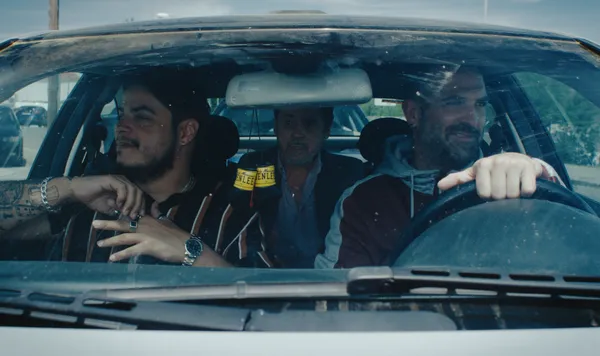
| David Sainz and Mario Mayo in Luger |
Just as last year’s Fantastic Fest was coming to an end, and when it was far too late to fit in any more interviews, I came across a little Spanish film called Luger which blew me away. The story of two petty criminals who get caught up with people who will do anything to own a very particular gun, it has great dialogue, unexpectedly moving performances and some cracking action scenes, all delivered with standout style. When I saw that it had been picked up by Fantaspoa, I immediately reached out for an interview, and was delighted when director Bruno Martín and writer Santiago Taboada agreed to meet.
Luger is all the more remarkable because it’s Santiago’s first feature and the first one that Bruno has directed for 16 years.
“This is my first serious film,” says Bruno. “Santi and I start to work on it in September of 2021.”
“Bruno has participated in web series,” says Santiago. “And in my case, I participated in the screenplay of Gotas, a short film in the anthology for a little horror movie, Nightmare Radio. But it was a short film more than a feature, so this was our first feature for both of us. And we got together in September 2021. That's when everything started.” Luger is unusual in its choice of protagonists, I note. Rafa (David Sainz) and Toni (Mario Mayo) may be criminals, but they’re not the glamorous sort; they’re just two guys who get hired to beat people up from time to time.
“Those two guys would be the bad guys of another film,” says Bruno.
“But our film, it's a story of two thugs, or stray cats, right?” Santi adds. “They fight to survive in this cruel world.”
“A world without love,” says Bruno.
“Exactly.”
But there's a lot of love between the two characters as we get to know them. They have a very close bond. Was that important to making us sympathise with each one of them, to focus on their friendship?
Bruno nods. “This is a story of redemption, of forgiving and friendship. The luger is the McGuffin of the film, but the less important thing in the film, because the film is a friendship story.”
Some Texan journalists described it as a bromance, he says.
“Yes, exactly,” says Santiago. “When Bruno and I were writing the movie, we thought about the kind of movies that we love to watch. The problem nowadays is that there are many impressive movies with a lot of special effects and action scenes, but you don't care about the characters anymore. So when were writing, I told Bruno ‘We need to make the audience care about these characters. And for you to feel bonded to these characters, then these characters must feel a bond between them.’ You empathise with the things that you can identify from your normal life. So that's why we started building it from a base which was our friendship and people we know.
“From them, we started building this kind of relationship between these characters which makes them human. So you care about both of them and you care about what's going to happen to them, which makes you get inside the movie instantly when it starts.”
Is that why there is so much focus on their casual conversation about the little things in their lives?
“Yes, exactly. Like the Australia thing. And this casual conversation makes their bond deeper and makes the audience feel closer to them, like they are talking about things that the audience can relate to, their normal lives.”
I mention that I loved the way that even the minor characters all seem to have personalities and stories which are bigger than the film.
“The secret of the movie is that it's not very original, the story,” says Bruno. “But Santi and I worked on that screenplay for two years because nobody was waiting for it.”
“We thought through every idea,” says Santiago. “It was a long process because we were thinking a lot about what we wanted to include in the movie so the mood, the story was at the best it could be. Somebody in our crew said that every character in this movie could have a spin-off and you would love to watch that.”
“We have a prequel and a sequel we are working on,” says Bruno. “It's a future project, but it is a reality, the spin-off of some characters from Luger.”
I liked the character of Fede, I tell them, because he is just a psychopath, but he's very sweet in a certain way. He seems quite innocent.
They both laugh. “That is the first story on our minds, Fede’s story,” says Bruno. “He is a lovely actor and a lovely person. But yes, like you say, he's a psychopath in the film.”
“That was our first spin off idea,” Santiago confirms. “How a normal guy could become such a psychopath. The beginning was how he started and how he ends in, you know, as the character that he became. So, you know, it's funny that you said that.”
Bruno says that he thinks of that project as a bit like the story of the Joker.
“When we started to write the movie, I had four or five actors in my mind that I liked to play the roles,” he recalls. “The first was David Sainz, the frontman, and Mario Mayo, who plays Toni, and Ángel Acero, who plays Juan, the poor businessman. Also Mauricio Morales, the Gypsy psychopath [Fede]. Then, when the production company started to work with us and Luger was going to be a reality, María Acero was our casting director and showed me the rest of the actors. And I know, for example, Ana Turpin, who plays Ángela, and Ramiro Alonso, who plays Jacinto Santamano, the bad guy with the boy, and the rest of the actors. I think it's one of the stronger points.”
“Yes, that was one of the best strengths of the movie,” says Santiago. “The lead characters are actually cast with the ones that Bruno and I wrote the characters for; but also, the ones that were added after that by the Maria, the casting director, every actor in this movie plays their role perfectly. So, you know, you believe in them and there's no bad acting in the whole movie, which was good for us.”
It’s often said that films come to life more effectively when writers are able to be on set during the shoot.
“I live in Villalba, near Bruno, and 95% of the movie was shot in Villalba,” he says. “So every day I was going to the shoot. I was just there, standing, seeing how they work. It was very interesting to see how my screenplay was translated to the big screen. Because, you know, there are many things that they change during the shooting. So many. I know so many writers that are mad or angry when they see the final cut of the movie and they say, like, ‘Okay, but that was not what was supposed to happen in my screenplay.’
“In my case, I like to learn. In my first short films, I did the same. I was at the shoot and I learned from all the changes that they got. They have to made in the movie because sometimes there's not enough budget, there's not enough time. And I learned from every one of these changes and I know why they made them. So I was very involved in the shoot – not participating, but standing there. But there is one sequence at the beginning of the movie that you can see me doing a cameo. In the first bar, I'm just drinking a coffee.”
“He's at a table, taking a coffee,” says Bruno. “Santi, like he said to you, lives near that industrial area and always when he came to his home from work, he was around there. He always gave me a big hug and looked at me and said ‘I'm very happy for this.’”
There are some very energetic action sequences in the film. That's something that's quite hard to do for a less experienced director. Did Bruno have any help with that, or did he have a clear sense of what he wanted to do from the outset?
“We had chief of stuntmen, Joaquín Ortega, who helped me to do the choreography,” says Bruno. “I directed my own action sequences. If you see, in the film, it’s like Tarantino films. There are not many action sequences, just five or six, distributed all around the movie. Every action sequence in Luger is not very long. It's not very hard to do for a indie movie like Luger. Santi and I had to reduce the action sequences.”
“When were writing the first versions of the script, the action sequences were longer,” Santiago explains. But there was something that Bruno and I agreed on exactly. They were very expensive. But Bruno told me something while were writing and it was like, ‘I want the action sequence to be real crude, brutal and dirty.’ When you fight, you don't spend five minutes fighting and doing choreography against a guy. You just fight for ten seconds and everybody is hurt, you know?”
“You can’t even use your hands. Your hands hurts. You are tired,” Bruno stresses.
“Yes, exactly. All the sequences were like that, but there was one that was more action and more choreography. That was the scene when they go, for the Luger, to the Nazi bar. And then there was a very big action sequence with, I don't know, seven, ten people involved, and a lot of blood – a very big action sequence. And the executive producer read the script and told us ‘Guys, let's be realistic. There's no money to do that, so you need to reduce this action sequence.’ Then we came with that idea and you know, it was the best because the the scene now in the movie is perfect like that. There's no need for an action sequence at that moment.”
There's a very distinct sense of style to the film as well. It isn't always very visually attractive, but it’s always interesting.
Explaining how this came about is beyond Bruno’s skills in English, so he goes over it in Spanish and Santiago translates.
“Bruno said the industrial area was particularly attractive, especially for this movie. So when were started writing, we agreed on a law, you know, a non written law, but we agreed, both of us, that the characters cannot put outside this industrial area. So for Bruno's mission as a director, he was just scouting for the dirtiest locations in this industrial area, in order to get the perfect locations for our characters and this story.”
How do they feel about having the film at Fantaspoa?
Again, Bruno responds in Spanish.
“Bruno first wants to thank the festival for inviting us,” says Santiago. “He was the producer of a movie named Os Reviento [known in English as I’ll Crush Y’All] two years ago, and that movie was actually screening also in Fantaspoa. He would have loved to go to Brazil. Actually we both love the country and we would like to go, but this time wasn't possible either. So we hope to next time. We just hope the Brazilian audience will enjoy the movie because it's an action thriller, which is kind of an international language, but it also has a lot of things about our culture.
“He wants to know how the gags and all this Spanish tradition will impact in the Brazilian audience and if they will get everything and if they will follow and they will enjoy this: a movie that is a thriller, an international movie, but also a very Spanish movie.”
Maybe they'll go back with one of the spin-off films, I suggest.
“Yes, that would be amazing, right? I hope.”