





Eye For Film >> Movies >> The Wizard Of The Kremlin (2025) Film Review


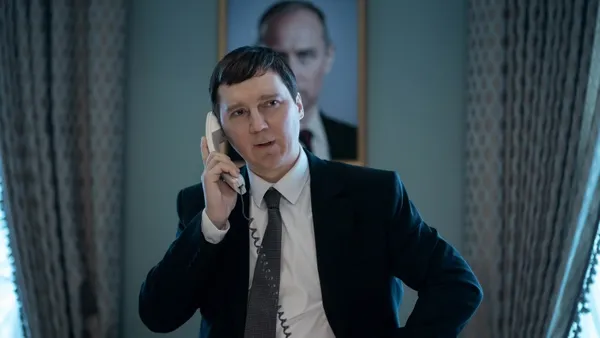

In the West, says Vadim Baranov (Paul Dano), status comes from money. In Russia it’s all about proximity to power. But what constitutes power, and can it change? These are the ideas and questions at the heart of Giuliano da Empoli’s highly acclaimed novel, adapted for the screen (and English speakers) by Olivier Assayas. But is there room to address them properly, explore the character of a haunted man and do justice to all the important events of Vladimir Putin’s political career in just two and a half hours?
The man in question is Baranov himself, a fictional character who has much in common with businessman and sometime presidential aide Vladislav Surkov, to whom Dano bears a passing resemblance. The bulk of the film takes the form of him recounting his life story to author Rowland (Jeffrey Wright) in his elegant, snowbound country home. This might be considered a confession, though it’s not clear that Baranov can really connect his intellectual understanding of morality with anything emotional or personally motivating. This may be why Dano has chosen to use the same flat vocal expression throughout, a technique well suited to satire which might have worked if only the rest of the film had been a bit more lively.
Rowland and Baranov initially bond over a mutual love of the work of Yevgeny Zamyatin, which sets a high bar for the film to live up to, and immediately evokes the idea of scrutiny, whose absence underlines not only the error made by Boris Berezovsky (Will Keen) in the film’s pivotal scene, but also some of the film’s own failings. Assayas seems to have set out to make a film in the long tradition of Cold War thrillers, and he does it elegantly, but that doesn’t wash in an age when Russia is no longer as much of a mystery to the West. The early scenes where we plunge into early Nineties Moscow nightlife are a case in point. Although later party scenes can pretty much do their own thing because they belong to an elite world which is both more eclectic and less visible, here the costuming fails to capture the highly distinctive blend of styles found in that time and place, and the cultural peculiarities that accompanied them are missing too. A single fur coat does not make it feel Russian.
Throughout, there is a strange blend of trying too hard and not really bothering. The accents are all over the place, as if nobody coordinated the actors’ preparation at all. Though most of the film is in English, Russian names (for people and places) come up and are sometimes badly mispronounced. The biggest problem, however, is that the film is constantly rushing from one event to another as if more concerned with checking off items on a list than with showing us why these things matter or really letting us get to know the characters.
There’s quite a bit of name-dropping, though not quite as much as in the book. This is fair enough in the circumstances and adds colour to some scenes. Only a handful of characters really come across strongly, however. Alicia Vikander can stand out in any film (though it’s probably easier when there are as few women present as here), and plays Ksenia, the woman Baranov loves, who drifts in and out of his life across the course of the story, out for her own interests and generally finding other men to be more lucrative prospects (in spite of what we have been told about money not mattering). Keen brings an interesting fragility to Berezovsky, who becomes Baranov’s mentor but finds himself quickly shut out of the machine he has created.
That machine, of course, centres on Putin, the film’s most interesting character, who benefits from its most interesting performance. When Berezovsky first picks him out, looking for a malleable political figure who doesn’t have too many ideas or too much personality of his own, it does not seem to occur to him that this demure, apparently inconsequential civil servant might have carefully crafted himself to appear precisely that way. Law lets just enough flickers of intelligence show through as he appraises his new allies to let us see the trap. He’s insightful in ways he wasn’t expected to be, and after things fall into place, it’s only a matter of time until he and Baranov are casually discussing what to do about Berezovsky.
Law, who does a remarkable job of taking on Putin’s facial characteristics but chooses to disregard his well known mannerisms, plays him primarily in behind-the-scenes mode, making him quiet and thoughtful, less prone to impulsive behaviour than his opponents but sometimes slow to act. This is a Putin whose power stems from his own internal confidence and his understanding that he has nothing to prove to anyone. It’s a little difficult to reconcile with the rash and somewhat desperate invasion of Ukraine - da Empoli himself has said he might not have written the book after that occurred – but Assayas chooses to end the film around that point.
Dano cannot compete with Law in this space – indeed, he struggles to keep up – but the script does just enough to let us understand why Putin continues to find Baranov useful over a prolonged period. There are comedic episodes around the effort to conceal Boris Yeltsin’s alcohol problems and, later, a scheme involving the adoption of ‘cool’ patriots in an attempt to monopolise not only support but also dissent. Even Putin gets his moment, looking through the line-up for an appearance towards the end of the film and asking in deadpan style “What is...Daft Punk?”
Woven into this are brief explorations of Baranov’s (Surkov’s) pet theories – the rather obvious historically-based observation that Russians prefer verticality to horizontality of power, and the soundbite philosophy of sovereign democracy. Nothing is addressed in much depth – not even the shallow man at the heart of it all, whose primary interest seems to be in the aesthetics of politics, in his ability to manipulate voter emotions as he might those of a theatre audience. Late scenes depicting his discovery, too late, of an alternative way of being, promise a private reckoning whose potency is cut short by an altered, reductive ending; again, the style of the Cold War thriller has triumphed over the much more interesting potential of realism. It’s an ending which Baranov himself might have chosen for maximum ratings appeal, regardless of the loss of real opportunity that it represents. We are left behind in the snowy world of Western clichés whilst Putin remains elusive behind his thin smile.
The Wizard Of The Kremlin screened as part of the Glasgow Film Festival Note: this review is based on the 150 minute cut. The version being released in the UK runs to 137 minutes.
Reviewed on: 06 Mar 2026


Director: Olivier Assayas
Writer: Olivier Assayas, Emmanuel Carrère, based on the novel by Giuliano Da Empoli
Starring: Paul Dano, Jude Law, Alicia Vikander
Year: 2025
Runtime: 150 minutes
Country: US
Festivals:
Venice 2025Toronto 2025
SSFF 2025
Black Nights 2025
Glasgow 2026
IFFR 2026
NY Rendez-vous 2026
Search database: