 |
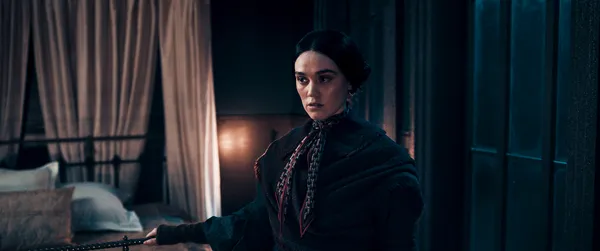
| Ariana Osborne in Mārama |
Now out in US cinemas, and recently enjoyed by Brazilian audiences at Fantaspoa, Taratoa Stappard’s Mārama continues to impress viewers. In the first part of our interview, Taratoa and I discussed the history of colonialism in Aotearoa/New Zealand, the experiences of some of his own ancestors, and the blending of the Māori supernatural with the English Gothic. In this part we go on to discuss the heroine’s relationship with another colonial subject, the influence of his Māori advisors, and the casting of Ariana Osborne in the main role.
Readers should be aware that what follows contains some spoilers, though the central mystery remains intact. It should ideally be read in between your first and second viewings, as it also contains clues to some hidden details.
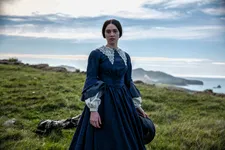 |
| Ariana Osborne in Mārama |
“I could look back into my past to perhaps try and make sense of a story. That's what writing the screenplay became. That and a lot of consultation and advice and steer and guidance from wahine Māori – from Māori women that I was connected with through my Māori producers, who were also fantastic wahine Māori women. They put me together with the right people so that I was never writing something that was bollocks, basically. I was never coming up with stuff. In fact, I was advised on certain things. ‘A woman would not have done that. Still wouldn't.’ You know, I needed to be told that.
“There was one saying I didn't know because I was ignorant. I’m a little less ignorant now about Māori culture. But there's one saying that Nathaniel Cole uses when they're dancing. Mārama asks ‘Who were my parents? Just tell me the truth.’ And what he says, literally translated, is ‘Go ask the pillars of the house.’ I often wonder what people are thinking. What does that mean? Ask the pillars of the house. It's a specific Maori saying that refers to how, in a marae or a wharenui, the big house of a mara, the central poupou, or pillar, will represent the spine of the body, which represents the hapū, the sub tribe, or the iwi, the tribe. And on that column will literally be carved a whakapapa, a genealogy or lineage.”
In context, he explains, this means that Nathaniel is taking the piss, but in a way that Mārama cannot yet understand.
“That was a suggested line by one of the script editors I worked with, great woman called Kath Akuhata-Brown, who's just made her own first feature. She literally said to me, he needs to say something like ‘Pate nga poupou to fare.’ I don't even know what that means. Kath explained it to me. I was like, ‘That's perfect.’ So I took any offer like that and put it in straight away. I'm always thankful to those people. Some of the input that some of those advisors or consultant script editors gave me was gold dust.”
We discuss Mārama’s relationship with Nathaniel’s servant, Peggy, a woman who initially resents the newcomer’s presence in the house. He tells me that some viewers have told him they thought Peggy was Māori, which surprises me, because she doesn’t look Māori at all.
“In my head, she's from the West Indies,” he says, pointing out that the actor, Umi Myers, is half Jamaican, half Scottish. “We talked a lot about who Peggy might be and Umi was able to tell me about where, credibly, a character like that might have fit into the history of Victorian England. Loads of domestics came from the colonies. The only idea that I had in my head about that character was that Peggy was like a substitute for the Māori that he hadn't quite got his hands on yet, in a horrific way.”
Viewers who look closely, he says, will notice a moko koa tattoo drawn on her chin with lipstick. The implication is that Nathaniel has demanded she do this prior to abusing her.
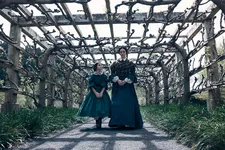 |
| Evelyn Towersey and Ariana Osborne in Mārama |
“Uma asked me ‘What do you think? What are you asking?’ She's defensive because she's aware that she's basically his sex slave. He's giving her coins and she can't turn down the money, but yeah, she's locked in that position and resents it. Of course she fucking resents it. It's a horrific position for her to be in.”
Her relationship with Mārama is a key aspect of the story, he says.
“I had more in various earlier versions of the script. And then it became a bit complicated and it was like, ‘Why are you trying to tell that story about a nascent love affair between them? This isn't the right film for that.’ I mean, whether or not people take it away from the story, but I see them as a couple at the end of the film. There they are in New Zealand, clearly years later. For anyone that's looking carefully, by now Mārama has a moko koa herself.
“I think they were holding hands, but I didn't make a big deal of it, to be honest. There was a kiss scene. It didn't feel right, and so it had to go. But I think it will be something in part two, Anahira.”
It’s the first time he has hinted at a sequel. I’m intrigued. But he goes on to tell me how his female producers advised him to keep the romance in the background, and as the project developed, he realised they were right.
“They called me out on what might have been perceived as a clunky male gaze. There's enough going on in the story as is. The advice that I took was to leave it as more of a sisterly or just more of a supportive relationship that they have. They're locked in a horrific situation together and they help each other get out of it. Just leave it at that.”
It also strikes me as important that they have different status. The governess is always a character who's not quite a servant. And in the Gothic, traditionally the governess is there because that’s the route through which an educated young woman can come into the house and be, potentially, a suitable romantic object for the hero. That's then twisted in this film.
“Exactly. And I think Peggy perhaps rightfully resented that. ‘Don't come judging me with your questions about “Isn't it a bit weird here?” Fuck you. You're the one in the nice bedroom. You're the one with the job of just hanging out with an eight-year-old girl. Don't be judging my situation.’ Obviously at that stage Mārama doesn't realise what Peggy's situation is yet.”
How did he find his incredible star, Ariana Osborne?
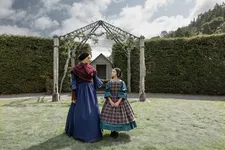 |
| Evelyn Towersey and Ariana Osborne in Mārama |
“She's the spine of the film,” he says. “Oh my God. She makes the film, I think, personally and in terms of casting. I was still in the UK when my fabulous Māori Auckland-based casting director was sending me first rehearsal tapes. MP4s, anyway. We saw some really great young Māori actors, and they did a few scenes and I was just looking at people, some of whom I'd known from casting and auditioning for my previous short film, and some of whom were completely new to me. Ariana was completely new to me and I know it sounds a bit hokey – the old ‘From the first tape I knew’ – I'm not saying I knew, but there was definitely something very specific about what Ariana was doing in her first tape.
“Maybe I'm post-analysing this but whatever. I do think I remember at the time feeling like what's special about what she did in her first audition tape was how little she did. She had the confidence and the self belief to almost do nothing, you know? And okay, on a very clunky basic level it helps that she's a striking-looking woman and it helped me for my conception of the part that she didn't necessarily immediately look Māori. But that felt credible to me. It was that basic on an appearance level.
“But forget appearance for a second, just the way that she had the confidence to do so little was strong. And then once I met her and started auditioning – because we went through multiple rounds – and heard more about who she was and what her background was, it turns out her father is a very well known New Zealand All Black. And as you know about rugby, it's like New Zealand's religion. He's a well known man and an exceptionally gifted athlete. And so is Ariana.
“It turns out she played rugby for New Zealand, so she has this background as this top sports person. I think she gave up when she was 15 or 16, but then she turned to dance, so she channeled that physical intensity into that. And then she came to acting. I have worked with some actors before who have a background that's physical. They were either top gymnasts or a ballet dancer, and they bring something quite specific. There's a real focused physical intensity or physical confidence of being, and it's interesting.
“Ariana, as well as being a terrific actor who thought a lot and prepared brilliantly and asked lots and lots of questions, just on a pure level of how does she move, how does she fit in this space, I liked it because I kept coming back to this idea of 1859. You know, you're a person of colour, you're female and you're in Victorian England. Fuck. The odds are stacked badly. You're going to be very, very repressed, I think, and on guard. And Ariana conveyed that beautifully in her auditions.
“We shot for 24 days in the end and she was there for 23 of them, so it was important that we had someone who was going to last the distance. And she hadn't starred in any films, but she'd done sufficient good TV and some roles in films that you think ‘Okay, cool, she's got experience,’ but I mean, there aren't that many young Māori women who have starred in a film yet.”
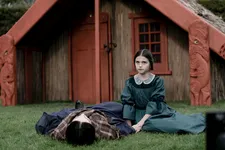 |
| Evelyn Towersey and Ariana Osborne in Mārama |
How does he feel about the success of the film?
“It's definitely exceeded my expectations,” he says. “My wildest dreams. My God, I'm so happy. What have we done – about 25 festivals now? After a première at TIFF, in the Discovery section. You know, whenever I say this, ‘Oh, yeah, we premièred at TIFF.’ ‘Oh, what, in the Midnight Madness section?’ ‘No, actually in the Discovery section.’ There's all these levels of hierarchy that you come to understand.
“I've been there myself because I've made short films, and a lot of them, and I've been to short film festivals, which are actually even more brutal. Suddenly, with a feature, you realise ‘Oh, this is what it's like up in first class.’ But no, I know what it's like to try to knock my head against the wall endlessly trying to get my film into festivals. And now finally to have my first feature getting this kind of recognition is affirming.
“I think I'll just say this other thing about the festival circuit: I think it's been massive that at whatever stage of the game it was, I decided actually this is a Māori Gothic horror. I'm going to call it a horror. It's just opened up so much. Whereas if I said ‘This is a Māori Gothic drama...’”
I would still have seen it, I tell him, and he laughs.