





Eye For Film >> Movies >> Rose Of Nevada (2025) Film Review



In the day to day, most of us track the passage of time through rituals and routine, through the people we see on different days, the passage of community life. On a fishing boat, far out at sea, all those rhythms change. The captain may have his almanacs, but as the climate changes, old patterns break down. The crew have no such guide. Even the structure of days is lost, with storms bringing darkness thick as night. They get used to catching sleep in short bursts, whenever they can; to waking abruptly and finding that circumstances have changed. Until they return to shore, time has little meaning.
Mark Jenkin’s unique directorial style, further refined here after Bait and Enys Men, is always anchored in the present, in the current moment. When first we drift into town with the battered Rose of Nevada, we are greeted with images of rust and tangled nets on shingle; weeds growing in abandoned wooden boats; weeds sprouting from cracks in the walls of centuries-old houses; broken shingles; a telephone box with no glass left; discarded matchboxes; careless graffiti. The windows of the community food bank are boarded over. Inside, a red billiard table, a hand around a pint. An elderly woman stands outside in the rain, confused.

Two of the town’s other older residents regard the rusted boat with wary eyes. It’s hard, says the man, but they have to decide what to do.
Exactly what that means will take a while to become apparent, but that’s the case with many things here. Jenkin’s style, impressionistic when it comes to places, is particular in regard to objects, the real anchors of our lives. Often the camera focuses directly on what characters are looking at, which is as often an object as somebody’s face. A bright red washing up bowl. A tea towel. A chocolate bar. A doll. A crack in a ceiling. A stain on the floor. Red flowers laid on a headland in silent tribute to one lost. Some of these objects we will see more than once, in altered circumstances, and they have stories to tell.
An inscription, too, at the side of a bunk aboard the Rose of Nevada. Chiseled hard into the wood, it reads Get off the boat now.
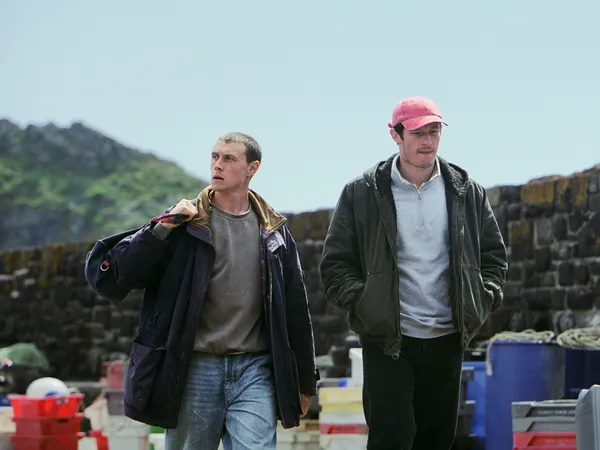
Of course, Nick (George MacKay) pays it no heed. He and Liam (Callum Turner) have no experience of crewing boats, so everything there is a mystery, but when the good folk of the town decide that the Rose of Nevada must sail again, they are offered good money. Nick says goodbye to his partner and little girl. It’ll only be for a few days, he figures. The captain says that once the storage hole is full of fish, they can go home.
The sea is rough, the work is is hard, but they adjust. Through fierce waves and strange mists they make their way. But when they reach the town again, something is wrong. It has never looked this alive. Through an accumulation of small gestures and a tumult of denial, of furious assertions that this must be a joke, Nick comes to the realisation that this in 1993, and that the two of them appear, to everyone around them, to be the twp members of the ship’s original crew.
The mystery that follows is as much psychological as temporal. Jenkin has a fine line-up of supporting actors (including regular muse Mary Woodvine in a key role) and MacKay is dependable as ever, keeping the whole thing grounded in simple human feeling. Meanwhile, the crisis that he gradually moves towards is an echo of many real tragedies in fishing towns, with the film, despite its fabulous aspect, sometimes edging close to documentary, as the director’s previous works have done.
Nothing makes sense here and yet everything does. Fisherfolk are prone to superstition, to notions of destiny and inescapable fate. It’s one way of coping. We have always tended to imagine the past as better than the future and yet, Rose Of Nevada reminds us, for this generation that might be true. A short trip of 30 years and everything is cleaner brighter. There is a sense of hope, and plenty of fish in the sea. What would you give, in our present, to brighten the future of someone for whom it is already past? And is there still time?
Reviewed on: 24 Apr 2026


Director: Mark Jenkin
Writer: Mark Jenkin
Starring: George MacKay, Callum Turner, Rosalind Eleazar, Francis Magee, Mary Woodvine
Year: 2025
Runtime: 114 minutes
Country: UK
Search database:
