 |
| Jude Law in The Wizard Of The Kremlin |
I recently spoke with French director Olivier Assayas about the satirical thriller and black comedy, The Wizard Of The Kremlin, based on Giuliano da Empoli’s bestselling novel of the same name.
In post-Soviet Russia in the early 1990s, artist and reality TV producer Vadim Baranov (Paul Dano) emerges as a spin doctor for a man that will take autocratic control of Russian politics — Vladimir Putin (Jude Law). As Baranov wields his growing power, blurring the lines between truth and lies, he finds there is one person that might be immune to his manipulations — his girlfriend Ksenia (Alicia Vikander).
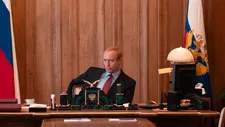 |
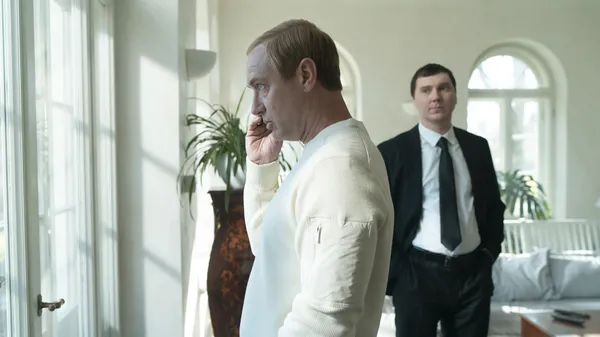
| Jude Law as Vladimir Putin in The Wizard Of The Kremlin |
The Wizard Of The Kremlin is a look back through the eyes of a man complicit in Russia’s present-day quagmire, who reveals the dark truths behind the creation of Putin’s regime.
Assayas made his feature debut in 1986 with Disorder (Désordre), about a post-punk band with blood on their hands after they kill the clerk at the music shop they rob. In the decades since, he has directed Irma Vep, in which Maggie Cheung (playing herself) is cast in a remake of a classic silent era vampire film that becomes a reflection on the filmmaking process. He later adapted this into a TV miniseries with Alicia Vikander in the lead role.
Demonlover, which revolves around a corporate battle for the rights to a manga pornography studio, is one of his most provocative works, alongside the true crime miniseries and feature film Carlos, about the real-life Venezuelan terrorist.
He has also directed Juliette Binoche in Clouds Of Sils Maria. The veteran actress stars as a middle-aged actress who accepts the invitation to revive the character that first launched her career in a new staged production, only to find herself haunted by her own memories. Assayas followed this with the ghost story Personal Shopper, starring Kristen Stewart, who plays a woman trying to make contact with the spirit of her dead brother.
In conversation with Eye For Film, Assayas discussed the adaptation process being simpler than expected, the importance of minor characters, how movies help us make sense of what we already know, and why he likes giving up control.
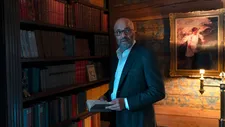 |
| Jeffrey Wright in The Wizard Of The Kremlin |
The following has been edited for clarity.
Paul Risker: You’re a filmmaker that is able or willing to pitch your audience the proverbial curveball, finding ways to play around with themes and ideas in different and surprising ways. How do you perceive the place of The Wizard Of The Kremlin within your broader filmography?
Olivier Assayas: I’ve loved making all my French, intimate indie movies — that’s where I come from, and that's where I go back to from time to time. But once in a while, I need to open the door or the windows to let some fresh air in and have a sense that I am not totally cut off from contemporary reality. And so, once in a while, I like to make movies that deal with modern history.
I’ve done that with Carlos, Wasp Network, and ultimately, now with The Wizard Of The Kremlin. It is part of that family of films, and weirdly, the one movie of mine that I had in mind when I was making The Wizard Of The Kremlin was Demonlover, because it was a distant, slightly dystopian, avant-garde type of work. And it's the only one that I made in that style. But to me, it was like the world of Demonlover had invaded the whole world, and what was an undercurrent had turned into modern reality.
PR: In your director’s statement you said that it was a struggle to know how to adapt the source material. How did you resolve this conundrum?
OA: I thought it was going to be extremely difficult, but it turned out to be a lot easier than expected. For instance, the book has a first part or chapter that deals with Vadim Baranov’s youth, his grandfather and father. We dropped all that. We started when he was in the process of transforming himself and becoming a grown up. That was pretty easy and obvious. We also transformed a lot of what was mostly a monologue into a dialogue and gave the narrator a more important part. And the narrator is not just the narrator. He's the guy who asks the tough questions. He's the one who doesn't let Baranov get away with his half-truths and half lies, and he's not manipulated the way he was in the novel. So, the constant questioning of the narrative creates a specific dynamic.
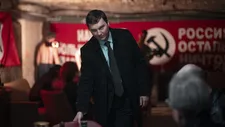 |
| Paul Dano in The Wizard Of The Kremlin |
One important element was developing the character of Ksenia, who is a minor character. She's a shadow, she's Baranov's girlfriend, but not much more than that. We placed an importance on her story, and she became to me the embodiment of what was stolen from Russian youth by Vladimir Putin’s totalitarian regime.
I'm certainly not that knowledgeable about modern Russian politics. I was in Russia in 1991 or 1992, and I remember meeting young actors and filmmakers. And I remember the energy, the hope, and the faith they had in the future. They were so emboldened by a sense of freedom that their parents and grandparents had never known, and the saddest thing is that this was stolen and destroyed by the regime. So, I wanted someone who embodied those hopes and that sense of freedom, and who somehow lived the kind of life that would have been open to young Russians of that generation. And Ksenia always comes back to haunt Vadim Baranov, as the ghost of his young self.
PR: Picking up on your point about Ksenia being a minor character, the amount of screen time for an actor and whether they’re playing a minor or major character isn’t significant. There are plenty of examples where supporting actors steal a film from the leads, and while films are sometimes built around stars or big names, it can be in the shadows where a more lasting impression is made.
OA: That's the way I feel, and it's the reason why I always consider the casting director to be a co-writer, because it's the one person that I have a dialogue with, in terms of the genuine meaning of the film. They understand the weird magic of mixing elements with one another, and for some reason, some combinations work and others don't.
For instance, I was very happy to meet Will Keen on this film, whose work I was not aware of because I’m not British. It was a genuine pleasure to work with him, and he has only four important scenes, but he's one of the central characters and possibly the most human.
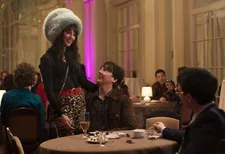 |
| Alicia Vikander and Paul Dano in The Wizard Of The Kremlin |
PR: Where we are right now, Putin has been in control for so long that it’s easy to forget about his rise to power. It’s similar with other leaders that have clung on. The interesting thing about time is how our attention is focused on specific timeframes, and as our perception narrows, learning from history becomes increasingly difficult.
OA: It's about the news cycle. Something happens in the world and for two days it’s the most important thing. Then on the third day, something else happens, and the whole circus moves on to the next town. And then, three months later, something will happen that relates to that earlier event, but you've forgotten the beginning of the story, even if you’re vaguely reminded of what you need to remember so you can understand what's happening now.
It's the way we get our information nowadays. The most interesting thing you can do when you're making movies about modern history, like I'm trying to do once in a while, is to stitch the elements together and recreate the continuity because, all of a sudden, it's like a jigsaw. And when you put all the bits and pieces together, a completely different picture appears in front of you.
That gives a lot of space to movies dealing with contemporary history to work in, because we are fed so much information that we don't know how to articulate those elements. Movies and other forms of fiction can help us make sense of what we already know but can’t process the right way because elements are missing.
PR: The mainstream news media talks at you, and worse, is prone to being personality-centred, which is unashamedly biased. Cinema, while subjective, offers another way to learn about history and the world we live in. To use your analogy, our information can be pieced together from different sources to create a fuller understanding.
OA: It's my reference point. What reminds me that it can be done, and it can create great works of art is that William Shakespeare did that a lot. He invented the genre and when I was making Carlos or The Wizard Of The Kremlin, I said, “Okay, ultimately William Shakespeare got it right when he wrote his historical plays.”
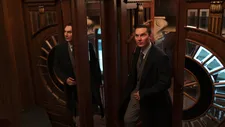 |
| Paul Dano in The Wizard Of The Kremlin |
There may be something there that connects with the way we absorb information and understand the world we live in. Those characters, they live in the same world you do. And they ask themselves questions that are very similar to what you are asking yourself.
PR: Returning to our earlier conversation about the casting director being a co-writer, what did the film’s cast teach you about the film that you weren’t aware of when writing the screenplay?
OA: There are filmmakers that believe in control and filmmakers that believe in losing control — I like to lose control. I don't direct actors. I work with and collaborate with them. And I don't like to hear the actors say my lines. I want to hear the actors appropriate what I’ve written and make them theirs, because making the film is the process of how I understand what I wrote.
A screenplay is musical in the sense that it's slower then faster, and there are beats. So, it's similar to music. It’s not about real life, and it’s not about flesh and blood, until all of a sudden, you have actors that are flesh and blood. The way you look at them is not the same way you look at characters when you're reading a novel. The actors make the characters come to life, so they are stronger and deeper than in the screenplay.
Whatever I have written, and I had in the back of my mind, must be contradicted by the actors. They are going to bring a whole new world, a whole new dimension to what I initially had in mind. So, once in a while, I will say, "You’re going a little bit off track” or “You're in the wild, let’s go back to reality.” But very rarely. I give space for the actors to reinvent the characters and usually, if you don't try to direct them, and you go with the flow, and if you believe in the energies that they are channeling, then you’ll usually get to an interesting place. And that’s what I’m trying to do in my films.
The Wizard Of The Kremlin is in UK and Irish cinemas from Friday 17th April.