





Eye For Film >> Movies >> Ben-Hur (1959) Film Review



It's a rainy bank holiday Monday. Everything is closed and there is nothing to do. You could go outside and kick a ball about in the afternoon drizzle, but that's no fun. Turn on the TV. Some epic film will be on: Khartoum, Battle Of Britain, The Magnificent Seven, A Bridge Too Far or maybe the one at Remagen or the River Kwai. Now it's a Easter Monday; will it be The Greatest Story Ever Told, Quo Vadis, or vague disappointment Ben Hur? It's not a bad film, it's just not as good as it's cracked up to be. Somewhat fitting for a left over day.
The film opens not with titles or an opening scene but with an image of Michelangelo's Creation Of Adam. Not the whole fresco: just the part where the fingers touch. Not the original but a recreation with fake cracks in the plaster work. Atop this, one word: OVERTURE. And for over six minutes, music from the film plays. It is indicative of the movie's major flaw, time wasting. If only the music were actually good rather than functional. In a thousand years of religiously themed music by Pérotin to György Ligeti there are many pieces that I would gladly sit through. The music from Ben Hur isn't one of them. It serves a purpose within the film but outside of that it isn't anything special. The big dramatic chords encapsulating dissonance at their interchange, themes and motifs are meaningful within the context of the film but don't, on their own, support a narrative or evoke feeling or memory. When compared to other epics of its time, the music isn't particularly memorable. I can, for instance, easily call to memory the Maurice Jarre score to David Lean's Lawrence Of Arabia.
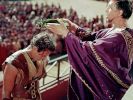
The titles roll and are followed by some scenes of three wise men and the nativity. This is extraneous to the narrative of the movie. It is part of the Jesus story that is universally known. In ten minutes time we will find out about John the Baptist and a wandering preacher, the son of a carpenter. This section of the film was actually cut from the original cinematic release.
After 15 minutes of faff, Ben Hur starts to do what it's good at: being a epic. It becomes bigger, bolder, with huge sets and thousands of extras. A massive column of legionnaires snakes its way through a Mediterranean landscape. They bring the new Roman governor of Judea, Valerius Gratus (Mino Doro). Along with him comes Messala (Stephen Boyd), his second in command.
Messala receives a visitor from his past, his boyhood friend Juda Ben Hur (Charlton Heston). Messala and Juda, now a wealthy noble, reunite in the gatehouse of the governor's residence. They reminisce and in acts of masculine bonding throw spears and drink wine with arms intertwined. The queer subtext here is hard to ignore. Later in the film there will be plenty of ripped, oiled roman bodies on display. Gore Vidal, one of the screen writers that worked on the film, made it pretty clear that that was how the film should be read. Charlton Heston on the other hand, after his political lurch to the right, was adamant that the subtext was nonexistent. He and Vidal had a bit of a spat about it.
The plot takes on an epic sweep. Messala and Juda fall out over political differences, not helped by masculine stubbornness. Juda is falsely accused and sentenced to slavery, his family imprisoned. After a brief encounter with Jesus he's off to be a galley slave. Whips and more male flesh. In a twist of fate he saves the Roman Consul Quintus Arrius (Jack Hawkins) from drowning during a sea battle. Arrius takes him as a slave, making him a charioteer in the arena. Now all Ben Hur has to do is win his freedom, return to his homeland, avenge himself and free his family. All before Jesus' crucifixion.
This could be a fast paced ripping yarn with a thumping, driving narrative, but it is slow. Every minutia of plot is shown, expounded and then announced with a musical motif just to make sure that you, the audience, didn't miss it. This overstatement can make parts of the film really drag.
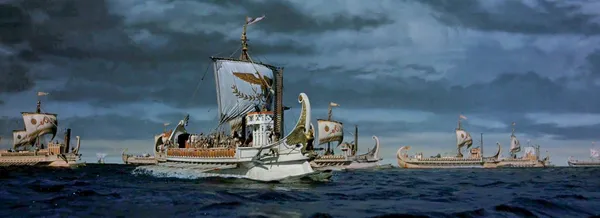
Where it does pick up the pace is with the large set piece action sequences such as the naval battle or the chariot race for which Ben Hur was famous. The film uses an unusually wide aspect ratio: 2.76:1, which accentuates the stillness of the fleets approaching before the screen erupts in the chaos of battle. The eye has to work to take it all in.
What is happening onscreen is confusing, flame and fighting across the panorama, yet Juda's narrative within the battle is never lost. From freeing the galley slaves from their chains, preventing them from drowning in a sinking ship, to rescuing Quintus Arrius, Juda's journey through the battle is clear, even if saving the Consul's life feels more like following the plot that following logic. The integration of model work, matte painting and live action is almost seamless and the stunt work is believable, not overblown.
The chariot race is almost as good but at over nine minutes it becomes repetitive towards the end. The work that went into it is truly impressive and it shows. With lashing whips, spinning blades and charging horses, it is an exciting piece of cinema.
The treatment of animals in film is concerning. One version of Ben Hur has a particularly bad reputation, with dozens of horses dying during the chariot race. That was the 1925 Fred Niblo version of the film. In this, the 1959 version, by most accounts the animals used in filming were well treated and no horses were badly injured.
When the action stops it leaves a hole. There is a considerable amount of redundant space in the film, maybe between an hour to an hour and a half (the version I'm watching clocks in at three hours 42 minutes). Whether it is repetition or overstatement, there is a lot that could be sliced out of this film. It isn't helped by Charlton Heston's lack of range as an actor. He is fine as a chisel-jawed hero. He pulls that off admirably in many of his films. Bad things can happen and the hero is back up on his feet, no sign of emotional damage, stubbornly back in the fight. Watch Planet Of The Apes (1968) or Soylent Green. Complex emotional engagement is not his forte. Finding out that your mum and childhood sweetheart are dying from leprosy should hit hard. The characters' feelings should be visible.
Ben Hur does some things right but between those things there isn't enough plot, emotion or artistry. The next bank holiday Monday, if it's Roman, maybe I'll hear the cry, "I'm Spartacus!"
Reviewed on: 20 Apr 2026


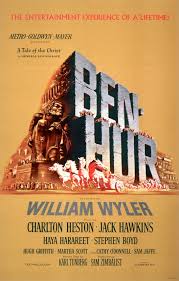
Director: William Wyler
Writer: Lew Wallace, Karl Tunberg, Maxwell Anderson, Christopher Fry, Gore Vidal
Starring: Charlton Heston, Jack Hawkins, Haya Harareet, Stephen Boyd, Hugh Griffith, Martha Scott, Cathy O'Donnell, Sam Jaffe, Finlay Currie, Frank Thring
Year: 1959
Runtime: 212 minutes
BBFC: 
Country: USA
Search database:
