 |
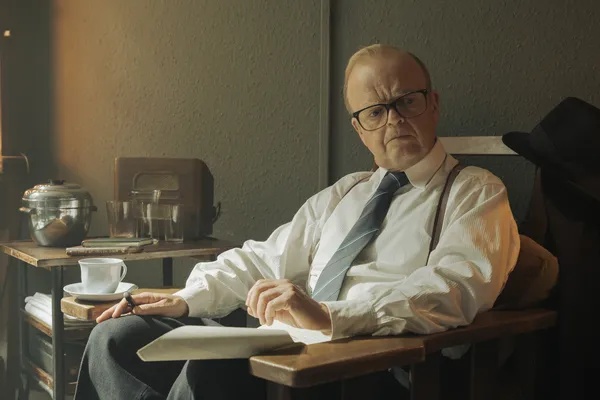
| Toby Jones as Mr. Burton |
A classically trained actor who has wowed audiences with his work on stage and screen since he was 26, Toby Jones has lent his talents to the likes of Orlando, The Painted Veil, Frost/Nixon, the Captain America films, Indiana Jones And The Dial Of Destiny, Berberian Sound Studio and Tinker, Tailor, Soldier, Spy. Recently he starred as the teacher who discovered and nurtured Richard Burton (then known as Richie Jenkins) in Marc Evans’ Mr. Burton.
A couple of months ago I spoke with Marc about another of his films, Effi O Blaenau, so I’m well aware of his talent and also what an interesting person he is. When Toby and I met, I asked him about his experience of working with Marc.
“As you say, he’s a very experienced director, a brilliant collaborator, one of those directors whose presence you don't really feel,” he says. “He's not imposing himself on the set. He quietly goes about his business and is very solicitous about our input. And keen – he seemed passionately interested in the emotional aspect of the story. As you already know, he's a passionate Welshman, so the story resonates with it. But also, I just found him just really great company. Very, very chilled out on the set.”
So how did Toby end up getting his role in Mr. Burton, not being Welsh himself?
“By fooling people I was Welsh with my surname.” He smiles. “Marc spoke to me about this film. It must be about six years ago now. We met and had a chat about it. To be honest, things are so tough in terms of getting independent films off the ground that I loved reading this and I loved the story but I thought it might struggle to find funding, only because it's quite a traditional, realist film. It's not shouting about itself, which isn't to say that it doesn't have a lot to say. It does, and it's surprisingly dark as a film. That's sort of what drew me to it. But I wondered at that time whether he was going to, you know.
“It goes on a route that so many independent films go on, where they have to find their funding from multiple sources. I kept checking in with him over the years because I really wanted to play the part and it resonated with me in so many different ways. Not least because the story of Richard Burton just only slightly predates the story of my own father, who was an actor and came from a mining community and escaped that world and found social mobility in a way that I think is quite historically interesting. You don't hear about it so much nowadays, and in fact, you hear actors complaining about how little social mobility there is in our profession, so it's kind of a fascinating story like that, because it's sort of what happened to Richard Jenkins and it's certainly what happened to my father, Freddie Jones.”
Mr. Burton himself is interesting in part because he's a real person, but he's not a public figure. We don't encounter many characters like that. How did that affect the research process?
“Well, as always with a real character, a lot of the work has been done by the scriptwriter, or in this case, script writers, because they've had to make choices about what aspects of that character you're going to see. And you're right, he wasn't a public figure – although I'm very proud to say that subsequent to this film, or rather parallel with this film, he's now got a blue plaque in Port Talbot. He was an extraordinary guy.
“The shape of the arc of this film seems to suggest that there was a kind of pathos about him because he seems to be a solitary figure living in a boarding house. Actually, he goes on after the events of this film to go and live in America, set up a drama school, be a lifelong friend of Burton – and Taylor – be a constant collaborator with them, lecture all around the world on Shakespeare, and come out successfully and live in Florida for most of his life. So he had not an unglamorous life after the events of this film.
“I suppose I was intrigued by that insofar as I think his belief in and his celebration of literature and drama and the voice that is fueled by those things, it's not an attitude that we're very familiar with now. We all long to have an inspirational figure in our life, either as a teacher or as some sort of guru, and in that sense I found him a fascinating character to work on because he has tremendous self possession and yet there's something about the chemistry between the two of them. There's a kind of dangerous chemistry that Richard Jenkins brings, I think. The explosion that happens in the film is in a way a misapprehension on Jenkins's part, and yet I think it's naivety on Burton's part – this very sophisticated guy – to underestimate that explosion and the impact of that upon him.”
He’s also interesting because, as we learn from his protective landlady, he’s a gay man, but his sexuality is a background thing. I ask Toby how he captured that yet kept it so subtle.
“Well, you know, I can only speculate. There's reference to an earlier pupil that he doted on who'd become an actor as well, and his relationship with him, but like I said earlier on, I don't think he had actually come out. I don't even think he had a clandestine sort of sexuality or whatever. He wasn't fully realised as such. Maybe it was sublimated in his love of poetry and his love of literature.
“I felt that there was something in the chaos of his emotions about Jenkins that was sort of shocking almost, to him, how much he cared for him, but I suspect it wasn't sexual. I'm not sure that he understood his feelings at that point. I think in a way that there's a self containment. There was no need to play any kind of queerness or anything like that, whatever that might mean in the sense of how one might play that. It was so below the surface.
“I played Truman Capote where his sexuality was much more manifest and much more realised and much more indulged in a way, and he understood himself much more, I think, than Philip Burton.”
It seemed like there was a lot of paternal feeling there as well, and something that maybe he didn't fully understand either.
“Yes, that's certainly what I love in playing a character. People who are subject to forces they don't fully understand and then they get a chance. Those forces get unleashed in ways that they regret or can't control. I enjoy playing that. I enjoy playing, the suppression of that energy.”
We discuss the opening scene of the film, in which we see Mr. Burton going about his morning routine, getting ready for work. It’s wonderfully detailed and particular.
“I think with any acting part, you're looking for actions, things where you don't have to speak, but you can begin to suggest a character by what you do rather than what you say,” says Toby. “Just that putting himself together, putting the mask of Philip Burton together, as we all do at the beginning of every day, that's a great gift to do that. But then, as you say, throughout the film, there are silent moments, which I just love, where you could begin to suggest emotion through the rhythm of an action rather than saying anything, or counterpoint the way something's being done with what is being said. That's kind of what I love about screen acting.”
There is some interesting stuff about what he says as well, though. I tell him that I love the part where he’s playing a Welshman playing an Englishman, trying to get the English accent right as he prepares his young protegé for the stage. Was that fun to play with?
“Yeah. I was a bit nervous about the accent because obviously he was Anglo-Welsh. For an actor, you begin to panic that people are going to go ‘He can't do a Welsh accent.’ And also there was a line in the script that was unhelpfully taken out, which explained that he was Anglo-Welsh, because actually he, as was the case at that time, aspired to speak in Received Pronunciation. That's just what actors aspired to and what Burton was taught.”
His other work has recently included playing Iago in Othello.
“It was just great.” He grins. “I've had a run of playing very good people, Alan Bates and Alan Rushbridger. To go and play Iago, who has not one redeeming quality – you know, no matter how much you look at it, over and over again, there is nothing to be said for him other than that his malevolence is entertaining – that was great, to play that. I didn't have to find any other side to him, or only insofar as he suggests other stuff as a way to manipulate people.”
What is it that he looks for in a role?
“I really look for contrast, Jennie. That's really the only thing. There are certain jobs you do because you want to work with a director or there's a play or a text that you want to work with because you studied it in your youth, or a writer you're enthusiastic about. But by and large, the only real criteria for me is: have I done it before? Is there a new way of doing this part, this character? Does it push me in new ways? And also, increasingly that I feel like I can't do anything.
“There's an odd feeling now where the whole basic contract of acting as you get older... How can I become someone else? It just feels so strange, the challenge of it. Far from feeling familiar, what feels familiar is the daunting task of it. It feels so strange. How could I become Philip Burton? It seems impossible.”
Is that because he’s more himself as he gets older?
“I think it's more because I understand the scale of the challenge. When I played Truman Capote 20 years ago, I think I studied the handwriting, studied how he held the pen, right down to all of that. And now I don't think it requires that. I realise that the characterisation doesn't require that much detail. I love detail, but I suppose I work on it in a very different way now. I'm a bit more looking for the salient points of a character.”
Since I wrote about Mr. Burton and have talking to people about it, there's been a tremendously positive response to it for a relatively small film. What does that kind of thing mean to him?
“I'm really thrilled by it,” he says. “I'm really thrilled about the response to Mr. Burton because, as I said to you, I think that there is a danger that a film that seems to be quite a straightforward, realist, chronological biopic might get overlooked because it's just another story. I think I'm thrilled that people have discovered the darkness and the strangeness of this relationship. It seems to belong to a different era, and it seems incredible that these things could happen in the politically correct world in which we lived in up until about two years ago. It seems extraordinary that those circumstances could have happened, particularly to a character whom we thought we knew so much about.”