 |
| Rose Of Nevada Photo: Steve Tanner, courtesy of Bosena |
British filmmaker Mark Jenkin, who was born and raised in Cornwall, has made the southwestern tip of the British Isles the setting for each of his three feature films. His début, Bait, was the tale of a Cornish fisherman without a boat, who, alongside other fishermen, is being displaced by tourists and second-home owners. His sophomore feature, the 1973-set folk horror Enys Men, is set off the Cornish coast, where a nature volunteer and sole inhabitant of the island, is troubled by intense nightmares. Jenkin’s third feature, Rose Of Nevada, sees the filmmaker continue to evolve, moving on from the subject of gentrification and folk horror, to time travel.
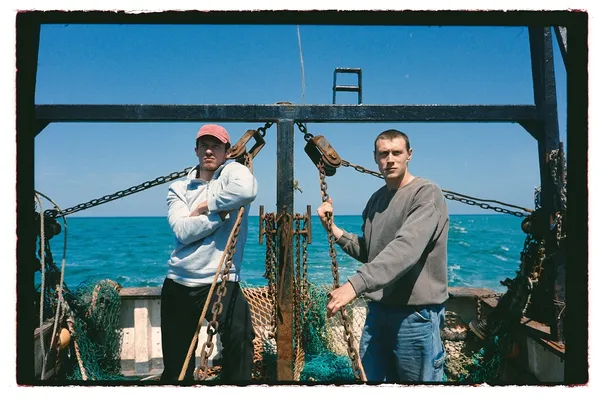
After mysteriously disappearing 30 years ago, the Rose of Nevada returns to the harbour in a small Cornish village. The disappearance of the fishing boat and her crew marked the beginning of misfortune for the community, who upon its return, decide it must be sent out to sea again. Nick (George MacKay), a young father, and Liam (Callum Turner), a stranger in town who might be running from something, volunteer to accompany Captain Murgey (Francis Magee). When they eventually return with the haul they have caught, Murgey, Nick and Liam are welcomed back as if they’re the boat’s original crew. Somehow, unbeknownst to the three men, they’ve been caught in a time slip, and the year is 1993.
In conversation with Eye For Film, Jenkin discussed the alleged death of cinema and calls for a celebration of short films. He also speaks about influencer culture and movie stars, changing trends, missing endings, and the hard part of writing Rose Of Nevada.
The following has been edited for clarity.
Paul Risker: How would you describe your relationship to cinema, personally and professionally?
Mark Jenkin: I was thinking about this last night, actually, because I did a preview at the Regal Picturehouse in Weybridge, North Cornwall. This is the cinema where I fell in love with films. It’s where I went during the sweet spot when you're aged 13 or 14, and you’ve got a bit of autonomy — before you've discovered the pub.
My mates and I used to go to that cinema every Friday evening. It didn't matter what we were going to see. It was just the act of going to the cinema that was important, which was culturally quite prevalent at that time. And so, my love of cinema was formulated in those years. But I was never really a cineaste at that age. I wasn't looking for anything other than what films were on, and at some point, I fell in love with the idea of making films.
So, to answer your question, my relationship as a viewer and as a filmmaker are in some ways quite separate. I still lament and kid myself that there's a culture where you just go to the cinema as an act of going to the cinema, and it doesn't matter what you're going to see. But then, on the other hand, I'm really exacting on the types of films that I make. We're at an interesting time with cinema because we’re told it's dead all the time. But for me, I'm more and more engaged with it. As far as I’m concerned, cinema becomes more important as time goes on, whereas I've constantly been told cinema is less important. And so, what do we mean by cinema? Do we mean the art form or the actual movie theatre?
PR: As much as I love the cinema space, I’ve always pushed back against the idea that it’s the only way to truly experience and appreciate a film. Maybe this is because I discovered Alfred Hitchcock and countless other filmmakers on VHS and DVD, on a tube television, and watching live or recorded films with the dreaded ghost effect. I’d contend that a huge part of the way we experience a film is what we bring to it emotionally and intellectually, meaning the movie theatre has its limitations.
MJ: Last night somebody asked me, “Do you think about whether people are going to be watching your films on small screens? Do you make allowances? I said, "No, I don't think about that at all.” I make my films formally for the big screen because if they work on the big screen, they're going to work on smaller screens. And then I went on to talk about the idea of what cinematic viewing is.
There's the idea that the cinema experience is about seeing it big and loud, or if you go a bit further, it’s about seeing it in a room that you can't be distracted, and you can't pause it and go make a cup of tea. That's part of the cinematic experience, but the most important part of the cinematic experience, for me personally, is the communal experience. And I would, in some ways, get more out of watching a film at home in a room full of people than I would going to the movie theatre and being sat there on my own. So, it’s difficult to define what the cinematic experience is.
VHS came of age when I was growing up, and watching stuff on tape was a huge thing for me. I have probably still seen more films on tape than on any other format. And in fact, the video shop in Weybridge was right next door to the Regal. So, I might go to the cinema to see a matinée with my dad on a Saturday, and then we'd go to the video shop and pick up a film to watch at home on the video recorder he’d borrowed from work for the weekend.
There was a huge difference between those two experiences. Looking back on it now, I still remember those films, and they are still highly influential, regardless how I was consuming them. So, as a filmmaker, I'll make it thinking about an audience seeing it on the big screen in terms of the picture and the sound, but if it works on the big screen, it'll work anywhere.
I do think the power is diminished if you're not watching in the cinema, but I fully understand that most people aren’t in that environment.
PR: Speaking with Ant Timpson, he suggests that YouTube has now overtaken cinema, which is really pushing shorter content. Unlike the literary, which has utilised the poem, the short story, and the novella, cinema has struggled to commercialise the shorter form. This is a concern, however, and it doesn’t get nearly enough attention. It might be hurting cinema’s ability to compete with other short-form entertainment.
MJ: Short films are so undervalued. There are so many short films and short film festivals, but for the people that are promoting shorts, it's a real uphill battle to get people to think of short films as an art form in their own right — they’re always thought of as a stepping stone.
I love short films and I make more shorts than I do feature films. And I'll always try and get to the festivals where my short films are being shown because they're just as important to me.
The shorts are unrelated [to the feature films], but sometimes I'll relate them in terms of the content. The latest short film I've done talks a lot about filmmaking in relation to my feature films, but it's a film in its own right. It's not a shortened version of a feature film. It could never be anything other than a short film. And yeah, we should really be celebrating that, but they're always thought of as inferior.
[…] I went to Karlovy Vary last summer for the world premiere of my short film, I Saw The Face Of God In The Jet Wash. It was just so exciting to be there with the film. There’s less pressure making the short films and there’s less pressure going out and promoting them. The thing is, it doesn't really matter because they don't need commercial success.
I'll always carry on making short films, not only formally, but in terms of the way I approach them — it’s no different to feature films.
PR: What do we need most from cinema at this moment in time? What purpose does cinema serve?
MJ: I’m not sure, because I'm in the eye of the storm. For me, cinema is everything. My whole sense of the world comes through cinema, including the sense of my own existence, because my work is a massive part of my life.
You have those moments where you stop and take stock, and I suppose one of the arbitrary ones is awards season. You look at what films were up for Best Picture this year and what won and what was in the mix was telling.
As I said, I hear cinema is becoming less important, and this is not representative of the greater scheme of things, but if you look at viewing figures for the Oscars ceremony in America, they were way down. But then, somebody pointed out the numbers of people watching clips on YouTube. The viewing habits have changed, and in terms of it being a commentary on where we are, I don't think anything's changed. It’s still an amazing form of mass communication for sharing ideas and reporting on the state of the world or reflecting it back at us. And it can still operate as pure escapism from the hell that you see every time you switch on the TV or look at the internet.
PR: The influencer culture is on the rise, which, compared to movie stars and actors, more readily invites audiences into their space. Is the influencer culture a reason for these changing trends, alongside the increase in online content?
MJ: There’s a bit of a paradox there. You look at a star that has made themselves more accessible through social media, but does that kick part of the enigma that was the attraction to stars in the first place? There are some heroes of mine whose names I will not mention, who suddenly got a profile on Twitter, when I was on Twitter or now on Instagram. And actually, the respect I've got for them has just nose dived as I've been able to interact with them, not through anything they've necessarily done, but just because the enigma has been destroyed.
I suppose I'm a little bit old-fashioned in that sense. If the influencers are more popular because of their visibility and accessibility, then it's a little bit depressing because I like the enigma. I like the stars to be stars and to be slightly out of reach.
PR: To pivot to a different subject, what does the gap or journey look like for you between films, specifically Enys Men and Rose Of Nevada? I ask because when I interviewed Australian director Zach Hilditch, he spoke about how he’d love to go from one film to the next, but unfortunately that hasn’t happened. A handful of directors have also told me that they miss the energy of the film set, and long to return to shooting another movie. But in an industry where it can take however many years it is on average to complete a film, the transition from one to the next can be slow.
MJ: I suppose I haven't had a conventional gap because it took 19 years to make Bait, and when it came out it blew up, relatively speaking. And then, we were riding a bit of a wave. It stayed in cinemas a lot longer than anybody expected it to. Then, when it won the BAFTA five to six months after it came out, it was back in cinemas again. And it was still on a certain number of screens when the cinemas closed in March 2020 because of the pandemic.
So, we had a weird gap there before Enys Men, which we were ready to shoot. We’d decided we were going to do another small film, similar in scale to Bait, right off the back of it coming out of cinemas. We were ready to go that spring, and then the pandemic put the schedule back a year, which was bad, but in some ways it was good, because I wrote Rose of Nevada in that time. And it wasn't a script I ever thought I'd write. So, when Enys Men had finished its run, we were ready to go with Rose of Nevada.
It was quite a painless journey from pitching the film to getting it financed by Film 4 and the BFI, but it still takes a long time and that's something I can't control. At the moment, I’m developing four different screenplays, some that I'm writing on my own, one of which is an adaptation, and two others with other writers. I just want to be in that position where I've got enough films ready to go, and the only delay will be in getting the financing and not in waiting for me to come up with something.
I haven't had a normal inter-film period yet, because between Bait and Enys Men, there was the pandemic, and after Enys Men we were working on Rose of Nevada, which I'd never intended to write.
It's a funny process because I do a lot of the work myself, especially in post production. I work with two or three people. I always work with Denzil Munk, the producer, and then there’s Ian Andrews, who I work with on the sound, and Michael Todd on the picture. But it’s quite a singular process.
Then we deliver the film and wait to find out where the world premiere is going to be. That's a horrible time because it has been an intensively creative process, and it suddenly stops. I'm just waiting, and normally, I’d emotionally go off the cliff once I delivered the film. This time, I made sure I went onto something straight away. So, the day that I delivered Rose of Nevada, I started the short film, I Saw The Face of God In The Jet Wash. There was no lull, and I worked on that intensively.
After getting back from Karlovy Vary in July of last year, we were beginning to prep to go to Venice. Afterwards, the film played Toronto, New York and London, and I've also just been writing other stuff. So, it doesn't feel like I've had that big of a gap this time and that's by design because I know what I was like, with Bait and Enys Men. I really did go off a cliff once I had delivered those films and was left waiting to find out what was going to happen to them. But I'm getting smarter with how I schedule my time now.
PR: The genesis of Rose of Nevada was the idea of a boat reappearing after disappearing 30 years ago. Knowing how the story begins, it was then about where it leads. I believe Steven Spielberg has spoken about the hardest part of making a film is finding the right ending. Was this the case with Rose Of Nevada?
MJ: Well, some people would argue that I don’t write endings, so it's not a problem I have to deal with. The thing with Rose Of Nevada was that I needed to come up with a script idea quite quickly because Enys Men was shut down. I needed to write something; I needed to pluck something out of the air. So, me and Mary, my partner, who's also in the film, batted around ideas for this opening scene of a boat returning 30 years after it was lost, along with the whole crew. We bashed out a story from that moment and came up with a beginning, a middle and an end. And not necessarily in that order, to quote a famous director.
The hardest thing was not necessarily working out what the story was with this film. Instead, it was time travel, because a film with a time travel element has a real impact on the characters. You can make a little change, and it has a huge knock-on effect, in a way that a linear script doesn't. It’s the same way that with time travel theory, if you change something in the past, it has a knock-on effect in a future that has, already, technically happened. We had those very real problems while writing the script, but I was really excited about writing a time travel movie. I loved doing it, but it was bloody difficult.
PR: One of the things about any time travel story is you get caught in the crosshairs of there not being a concrete science to it. There will therefore be different interpretations of how time travel works. The challenge for the audience is if the film contradicts their understanding, can they set that aside and stay the course with the film?
MJ: As far as we know, nobody's time traveled. And the people who do claim to have time travelled are all probably locked up. You have to establish your own rules and your own logic, and that's quite a difficult thing to do. Having established rules yourself, there’s always a temptation to bend them if you need to for the sake of character or a plot point. But it's really important once you've established those rules to stick to them, because the audience will always sniff out something that’s phoney. The audience is far too intelligent and sophisticated to let something slip past them. They'll know, or they’ll sniff it out if you bend your own logic for the sake of the story to work or a character to be believable in their actions. Writing the rules is the easy bit. It's resisting the temptation to bend them to make your life easier. That’s the hard bit.
Rose Of Nevada is released in cinemas on 24 April and on BFI Blu-ray and BFI Player this summer.