




 |
| Grace |
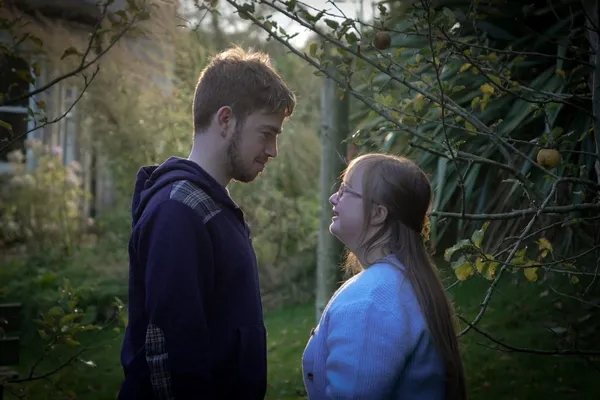
‘My body, my choice’ is one of those phrases that liberal-minded people like to apply right up until they encounter a case that makes them uncomfortable, and then all too often they’ll backtrack rapidly and struggle to come up with a logical reason why it’s obviously inappropriate. There are obvious issues around the ability to understand what’s at stake, which is why we don’t give young children as much autonomy as adults, but what about adults with intellectual disabilities? Anna Rodgers’ short film Grace explores these issues as it tells the story of a young woman with Down syndrome who wants to enjoy an intimate weekend away with her boyfriend Tommy. Anna and stars Fiadhnait Canning and Leca Malocco Mulville joined me to talk about the film.
“The idea for the film Grace came out of a piece of legislation, actually,” says Anna. “We have a newish piece of legislation called the Assisted Decision Making (Capacity) Act 2017, but actually only really came into effect in 2023. And even though it's there and people who work in the area know about it, it's not commonly really known about. Most people don't go looking up legislation very often, unless they're in trouble. We really wanted to highlight that Act because it's great law and it's there to protect the rights of people with intellectual disabilities. The guiding principle, basically, is to assume that someone has the capacity to make a decision.
“Unfortunately, because of culture and just generations of the way practice was, sometimes people with intellectual disabilities aren't included in decisions about their own lives. I made a documentary with my colleague Zlata Filipovic, who I run the company with, called Somebody To Love, back in 2012. That was about the fact that there was a law in place then that made it actually against the law to have sex if you had an intellectual disability. The effect of that meant that you couldn't even go for an ice cream or go to the cinema or go on a date or have a night away with your partner, even if you weren't going to have sex, because where was the line for people who were carers or parents or were working in the services in residential homes and things like that? So it had a kind of a chilling effect.
“I think the culture around that has remained. So the film, it's a love story. It's a story about breaking the rules. It's a story about pushing the boundaries. But the story is also there as a work of activism and social justice in a way, to make people stop and think ‘Hang on a second, are we doing this right?’ and ‘Should it be like this?’”
I ask Fiadhnait how she became involved with the film.
“It was by surprise, getting the role,” she says. “I didn't think I would. As part of the auditioning, I just did a few scenes with Luca and somehow there was a chemistry between me and Luca that we had somehow gotten from our characters, Grace and Tommy. Somehow it went really well and one word actually landed me the role. It was in one scene, and I said ‘dude’. It shows that she has like more of a voice than Tommy does because he's not so confident in himself. She's not afraid to push any walls down.”
“Yeah, you showed a bit of attitude in the audition,” says Anna, approvingly. “That reference to ‘dude’ was just Fiadhnait adding in her own lines and her own words and things like that. That showed a feistiness.”
Fiadhnait is impressive in the role, especially for someone with no prior acting experience.
“This is my first film. I have done one documentary, but I haven't done an actual film. The message is beautiful and our story fits in really well.”
“I used to be in grammar college,” Luca says, explaining his involvement. “Anna actually contacted one of the teachers of me. I was really happy that I got the role. Even what Fiadhnait said [about our] rehearsals and our auditions, they were quite nerve wracking but funny as well.”
“They were good fun, weren't they?” Anna recalls. “Yeah, because Fiadhnait was rehearsing sneaking out of her bedroom and sneaking into your bathroom and she was doing it like a little pink panther trotting down the hallway.” She holds out her hands in front of her, curved downwards, doing an impression, and they all laugh. “It was very funny. We had to remember things like chopping carrots and doing all sorts of independent activities so you felt confident doing them on screen. You were great.”
Fiadhnair acknowledges that she did have to develop some new skills for the film.
“I had to learn new things like peeling potatoes,” she says. “But thank God it wasn't onions.”
Anna invites Luca to talk about the love scenes in the film, which were a new thing for all of them.
“We had to do a few kiss scenes,” he says. “We had this person on set called an intimacy coordinator. They would help us and make us feel at ease and make sure that we were okay with doing those scenes. Because if he weren't okay with it, we would have had to work around it...We had to do a dance workshop that I took part in as well.”
Although it’s a short film, there are lots of scenes in different settings. I ask Fiadhnait if she found it interesting to do so many different things.
“Yeah,” she says. “It was quite tiring as well because I had to get up really early. The first day wasn't so bad because I got picked up at nine, but some other mornings I've had to get picked up at say eight, or half seven in the morning.”
So you were tired on set. So what did you think about your character, Luca? Was he an interesting person, do you think?
“Yeah. I thought, like Fiadhnait said, Tommy found it hard to stand up for himself. In certain parts of the film you thought ‘Oh God, what do I do In these situations?’ Or ‘Why am I doing this?’”
Fiadhnait explains that she likes the way her character learns to speak up and advocate for herself over the course of the film.
“One scene I liked is the point in the classroom when she's learning that voice, not knowing that she had that inside of her. It shows beautifully that she's a bit stronger, especially in the classroom scenes. It shows that she was a little quiet for some reason, but then she's not so quiet or shy anymore because she would not be walked over. She’s somebody who’s going to take it as it is and let everything else be.”
In the course of the film, Grace and Tommy find themselves out of their depth as a result of trying to take more control over their lives without proper guidance. Does she think that if they had had more advice and support, things would have worked out better for everyone?
“Most definitely. Some people forget those conversations and there are those who avoid them altogether. That's understandable. It is an uncomfortable, awkward conversation to have,but it is healthier and safer because that way you know for sure how to make proper use of them. But it shows that you are young adults and it’s giving you the right information the safe way. You want to learn more, not always being stuck with one part of your life.”
Is that part of people generally not understanding how much people like her can do if they have proper support?
“Exactly.”
It’s something that resonates with Luca.
“We were watching the film in my centre for the past few weeks because I'm doing a relationship class, and what we would do is we would pause each scene and talk about it. So in the bedroom scenes, we were watching Tommy, and they asked ‘Instead of Grace actually sneaking in, what do you think Tommy should have done instead?’ A lot of people said ‘Well, I think Tommy should have actually said to Grace “If you want to come into my room, maybe let the staff know or get protection. Not where you're just coming in and then without knowing...”’”
“It goes back to sex education, really,” says Anna. “I'm so glad to hear, Luca, that they are using the film for sex education.”
Does he think the film will help to make people more confident as well when they're watching it?
“Yeah,” he says. “I think a lot of people will look at it and see how like people can be in a relationship, even though it’s with their education.”
“Well, for sex education it is important to have those classrooms and have those icebreakers at first, maybe smooth them into that part because again it is an uncomfortable, awkward conversation to have,” says Fiadhnait. “But they are good-to-have conversations. This is how the real world works, believe it or not, and they are really are awkward with some people who don't know these things. But again I think it's most likely the more you educate yourself the more you're aware, because educating is the key to like any unlocking anything that you want to know. Of course I do believe that you should have been told about this stuff. It's what happens with your body, and so of course we are sexual beings.”
I ask if she feels that some people find it difficult because they think that anyone with an intellectual disability is more like a child.
“They’re sometimes being treated like a child but they're not,” she says firmly. “Despite other things, I'm old. You're not a child, you're just a young man or a young woman who wants an intimate moment together that's beautiful for the both of you, an experience for you both. For those who don't know about those things, educate yourself, making sure you have support, making sure you have all those things backed up before you have that intimate moment. The more you know about yourself, the more you're safe. It boils down to trusting each other then consenting to it, so it's a beautiful thing between you.”
“One of the things in the decision making act is the right to make mistakes or bad decisions,” Anna notes. “Because we all make mistakes and especially in love life, you don't have to have an intellectual disability to make a mistake. So the film is highlighting that a little bit as well. I mean, it's funny, Luca, you were saying that in your centre they were saying they should have gone and got permission. But the whole point is, I suppose, that maybe that permission wouldn't be forthcoming. It is complex, isn't it? Yeah. And the film's supposed to highlight that complexity.
“We didn't want to point the finger at anyone like the parents who want to protect them. The people who work in the residential home mean well and want to protect them and also want to play by the rules because they don't want to get in trouble. So it's kind of complicated, not straightforward to deal with.”
Grace has just had its festival screening, and Fiadhnait got to go along to represent Ireland and the film, thanks to Culture Ireland. She, Anna and Luca are now looking forward to the Royal Television Society Awards on 16 April 16, where it has been nominated for Best Short Film.