 |
| Alexis Manenti in Flesh And Fuel Photo: Festival de Cannes |
French actor Alexis Manenti’s star has continued to rise since he won the Most Promising Actor award at the Césars (the French equivalent of the Oscars) in 2020 after starring in, and co-writing Les Misérables with Ladj Ly. That premiered at the Cannes Film Festival in 2019, where it won the Jury Prize, and the star is back on the Croisette this year with two very different projects.
In Critics’ Week he can be seen in gay romance Flesh And Fuel, directed by Pierre Le Gall, where he stars as a gay trucker who embarks on a logistically tricky will-they/won’t-they relationship with a Polish freight driver (Julian Swiezewski). Meanwhile, over in Un Certain Regard, he stars as mentally fragile cop who ends up investigating a boar killing spree in rural France alongside a police psychiatrist (Ella Rumpf) in Sarah Arnold’s Too Many Beasts (L'Espèce explosive).
We caught up with him in Cannes ahead of the premieres to talk, with the help of a translator, about his approach to the work and his writing ambitions.
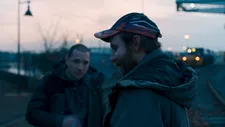 |
| Flesh And Fuel Photo: Festival de Cannes |
What research did you do for your trucker character in Flesh And Fuel because the film immerses us in the world of his work, were you familiar with it before?
Alexis Manentis: “I really discovered this world with the movie. First of all, the director sent me a lot of documentation that I read and also a documentary film about a Bulgarian trucker. Uh, but it's mostly my encounter with Jean-Sébastien Lefort. He’s a trucker and he’s gay and he kind of became a technical consultant on the movie. So we actually hit the road together for several days, so I got to understand what his world is about. He was mostly there during the whole shoot as well so we really got along and became quite close.
It’s an intimate drama and one of the scenes involves sex between the two men in the cabin of a lorry, how challenging was that to shoot because you need to be in the moment but the logistics must have been quite tricky?
AM: We had the help of a choreographer, Stephanie Chen, who was also our intimacy coordinator, and we rehearsed in a dance hall, where we recreated the tiny space that we would have for the shoot. So it was really rehearsed as choreography, like you would rehearse a stunt or a dance number. But, of course, then when you had like all the technical people – the camera, the sound and everything – it felt like really doing acrobatics. But we really laughed a lot and, I must say, that there was also the help of the really gentle gaze of Antoine Cormier, the DoP, who really managed to make us feel at ease.
Did you and Julian Swiezewski have much rehearsal time in general together because the chemistry is very important, especially as your characters aren’t sharing the screen for a lot of the time?
AM: We first met in Warsaw during the casting process and the chemistry between us was kind of immediate. Julian is a very professional actor and we did rehearse a lot with the choreographer/intimacy coordinator so we did a lot of exercises. There was a lot of playfulness in this. So in the end, you know, we were kind of at ease doing these things even if they would be really intimidating.
Your career really seems to be gathering pace now, and you have two films in Cannes, Flesh And Fuel and Too Many Beasts. That film sees you play a very different kind of character but he’s still a character with internal conflict. How do you approach a character where a lot of what is happening is going on on the inside rather than on the outside?
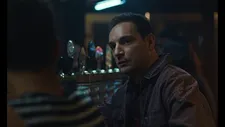 |
| Alexis Manenti in Too Many Beasts Photo: Festival de Cannes |
AM, laughing: Well, I'm kind of schizophrenic myself and I work on that every day. I must also say I'm fortunate and lucky to be offered screenplays where the roles are a lot about silence and secrets and what's not shown on screen.
In the case of Too Many Beasts there's a lot of humour too, so you need to deliver some absurdist comedy, which is very different from the mood of Flesh And Fuel. Do you have a preference for what sort of material you are tackling?
AM: No, I don't really have a preference. It was really fun on both but then on Too Many Beasts there was something that was really extremely enjoyable about the craziness. I think it’s punk.
A lot of the scenes in Flesh And Fuel are shot at night, does that present any challenges or make a difference to your performance?
Well, I like the work that happens on external shoots because somehow the authenticity of the real decor makes it more genuine and the night time shoots bring some sort of mystery too.
Some actors say that a prop or a costume can really help them channel a character, do you find that?
AM: This is one of the most important things for the characters that I play, and I like to discuss with the director and the costume heads about exactly what it’s going to be. I realised that, in the past, sometimes I don't put too much importance on this and I didn't feel completely at ease with my character.
That’s interesting and was there anything specific about either of the characters in these films that you used to help you?
AM: Well for Flesh And Fuel we tried some more urban-type gay outfits but that's something the director Pierre really didn't want and I think he was completely right about that. So in the end, it's more like an everyman uniform.
It’s an interesting portrayal of a gay man in general because it avoids stereotypes, not just the look but the fact that he is comfortable being gay and accepted within the trucker community with no issues as well. So was that something that attracted you to the role?
AM: Of course. There have been a lot of films about coming out and the difficulty of fitting in but this movie is just about love. It’s a romance.
You’re getting quite a full CV at this point but is there anything you’d like to have a go at that you would really like to do but haven’t had the chance yet?
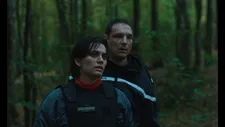 |
| Alexis Manenti and Ella Rumpf in Too Many Beasts Photo: Festival de Cannes |
AM: Batman! No, there's so many.
Would you genuinely like to have a go at a superhero? Because some actors say that they don’t particularly like it because there’s a lot of green screen work and CGI which means a lot of hanging about compared to getting straight into it on an indie film
AM: Well to be to be fair, I'm definitely more into auteur cinema but maybe I'll go on to action movies when I have to pay for a divorce and a second house.
When you’re choosing script, are you looking for these sorts of psychological elements to the characters?
AM: More than the screenplay itself, what matters is the encounter with the director. So how they talk about their movie and their character and what their overall vision is. And if there are not many cliches or prejudices.
Can you tell us about anything else that’s coming up for you
AM: Yes, there’s L’Étrangère by Gaya JiJi, who previously had My Favourite Fabric in Un Certain Regard at Cannes and it is with Zahra Amir Ebrahimi, who won the acting prize at Cannes for Holy Spider. It’s coming out on June 24 and it it I play a lawyer and it’s a really bourgeois film, so it’s a completely different world.
Now we are seeing a lot of actors writing and stepping behind the camera, do you have ambitions like that going forward?
AM: What I really love is writing. I don't consider myself a screenwriter but I can work together with many people. I co-wrote Les Misérables and I'm writing a script with a young director from Marseille. I'm also writing another one, which I may direct some day.
- Read our conversation with Julian Swiezewski on trucking, gay romance and the power of normality in Flesh And Fuel
- Read our conversation with director Pierre Le Gall on the themes of Flesh and Fuel