 |
| The Shepherd And The Bear |
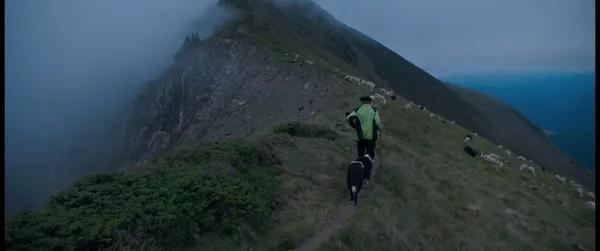
A tale of age old conflict reignited in the modern age, Max Keegan’s The Shepherd And The Bear is a treat for the senses. Filmed in and around Ariège in the Pyrenees, it explores the relationship between the local people and brown bears reintroduced as part of a rewilding initiative. In the process it throws up some complex ethical issues as well as exploring the reqional culture and its traditions more widely. Max was happy to tell me more about the project and the way that he reshaped his life to engage with it.
“I was staying at this intentional community in the west of England making a short film,” he begins. “Unfortunately it's now defunct. Whilst I was there, I was talking with this guy who's quite central in that community called Simon Farley. I guess he's an academic, but he's also a pig farmer and a writer and kind of left wing agitator. So we got on very well and were talking about rewilding. I was talking about the proposed rewilding projects in Scotland and saying it'd be an interesting subject for film, and he mentioned to me that there had been bears that had been released in France in the Nineties and that this was an interesting subject.
“I just started reading about it slowly from there and gradually became more and more obsessed with it, I think, really, because it was clear that there was kind of a conflict here that I could identify with both sides of, and I thought that was kind of interesting. And I didn't speak any French at the time, so at first I didn't really consider it a subject for a film that I could make. But as I went further and further into researching it seemed that it was. I needed to make that leap and learn how to speak the language, and take it on.
“I learned how to speak French with the people who are in the film. I didn't really make any distinction between normal French pronunciation and any of that, which was a big problem when I moved to Paris because no one could understand the words. I didn't realise, but I actually learned French with a thick southern accent.”
That might have been helpful, I suggest, because if he'd learned Parisian French first, they would have thought of him as an outsider and perhaps not been as accommodating.
“Totally,” he agrees. “I think being a Parisian filmmaker would be actually much tougher. I also think it was probably quite disarming to them. I mean, I'm now fully fluent in French, but I think people don't really question your intentions in the same way if you kind of present as stupid, which is how it was very much at the beginning. It was, I think, also helpful for them to see that I was serious about this subject and cared about it, because most people who turn up and film in that part of the world arrive, fly a drone up the hill, do a couple of interviews and leave – usually with whatever conclusions they came with.
“I think people are quite upset with how they've been treated journalistically on both sides of the debate, actually. So coming and sweating and carrying stuff up a mountain, saying that we were going to stay for a long time and learn the language, I think went a way to convince some people who usually wouldn't have accepted filmmakers into their lives or literally say no to journalists. And of course, we turn up and in that part of the world, with a camera, you are a journalist – even if I feel my job is slightly different from that. So, yeah, all of that was helpful for access.”
Did learning the language perhaps also mean that they saw him as there to learn about things generally and to listen, rather than just to impose thoughts he'd already formulated?
“Yeah, I think so. We did extend the shoot a bit, but we lived there for two years in the mountains with the community. Because the film, I mean, on the face of it it's about the reintroduction of bears, but it's also really about this community and it’s a way into this traditional way of life which is disappearing everywhere in Europe. I think also being there through all of the seasons and asking those questions and being curious about stuff that's unrelated to the more divisive topic, the bears - stuff like the fête de cochin, which is [the reason for] that pig sacrifice scene you see in the film. Things like what lambing's actually like, and asking questions about people's ancestors, and just being there to learn about them.”
I tell him that I wanted to ask about the pig sacrifice because that's quite a traumatic scene to watch. What was it like to film?
“We had quite a run up to it because we knew that this was going to happen, so I guess we had a bit of time to prepare. We were three people filming it. I knew that it was going to be quite hard to be there for the real thing, but I think it was always in my mind that this was going to be too much for an audience, to show everything. It was about trying to find a way of doing it sensitively, and cutting before we see anything too terrible happen. But, yeah, obviously, you don't have that choice when you're there in real life.
“On the one hand, I eat meat, and I think it's important to understand what that means. And this pig probably had a much happier life than much most of the animals that we eat. I don't think that things happening in an abattoir necessarily means that it's any less traumatising for the animal. So we came to it with all of that, but the noise that it made is massively dialed down in the finished film. It was really harrowing. The only thing I would say is I actually found it much easier to film it than when we stopped filming. Having the lens between me and it was a bit of a barrier. But ultimately, you know, this is what meat is.
“The thing that was really impressive for me about the way that they did this was that everyone got together for three days afterwards – everyone in the village, all their friends – and they made all of the sausage and the paté and everything that they'd eat for the next year. So I was actually eating that pig all through the next year. Just the attention to detail, the ritual of all of it and the fact that there was just nothing wasted, for me kind offset the violence of it. I guess we're just not used to being confronted with that.
Shortly afterwards, there’s a scene that involves chasing the rooster which becomes highly comedic. And those seem to balance out in some ways the different aspects of rural life.
“Yeah, absolutely. I think we just get to a point where there's so much intensity through that second act in the winter where we just needed something to lift the mood. And you know, that scene we could never have planned for. It happened entirely by accident. We just turned up. It's not me who filmed that, it's one of the team members, Clément. I was doing something else at the house with Valérie, the mum, and Clément went off with Cyril and his dad to look for this rooster that they'd seen escape. We had no idea we'd be filming that and Clément came back exhausted, but with the biggest smile on his face.
“Even if it didn't seem to fit into the story in an obvious way, tonally it was exciting and, yeah, it ended up being really key, I think, because otherwise the energy that you'd have coming into that next section of the film would just be so heavy. So we were really lucky to get it, I think.”
I reflect on the ancient struggle between these people’s ancestors and the bears whom they were no doubt delighted to drive away from their land, and how it’s fine for the rest of us to talk about rewilding as if it were an unalloyed good, but we forget that there are people at the sharp end like that. He agrees, but suggests that that’s just part of a bigger picture.
“The bear really is, I think, for both sides of the debate, more symbolic than real. I mean, you hardly see them when you're there, and I think that rural communities across Europe are struggling with the same issues that people in Ariège are, which is that it's economically impossible to do that kind of farming in the context of the global marketplace. The bear is taking on a lot of that stress. It's also taking on a lot of stress and anger people feel towards the government more generally. So it's coming to kind of represent a set of problems as well as posing its own problems.
“Something that I thought was particularly shocking to realise is if you go into a supermarket in that region and you buy some lamb, most of it comes from New Zealand, and it costs a third of what local lamb costs. And local lamb is already 50% subsidised by the government. So really, the real cost of the lamb that you can see being reared all around you, which has no industrial inputs whatsoever, is about six times the cost of imported lamb, which has come from as far away as you can imagine. I think all of those stresses and problems are kind of pushed over to the bear because this is a community that's already economically so tormented and can see that it has kind of run its course.
“People have been free ranging their sheep in the Pyrenees, as evidenced by cave paintings, for about 6,000 years. And it's just unbelievable that we'll probably see, I mean, not the end of it completely, but the end of it as the thing that supports life in that part of the world, in our lifetimes. If you go look around the rooms that Yves is in, most of those farmers, except for Lisa, are in their sixties or seventies. Some of them are in their eighties. And all of the young people are leaving, mainly for economic reasons.
“I think the bear takes on a lot of that. It's obviously not helpful in people continuing and wanting to stay, and obviously it was a big factor in Lisa deciding that she was going to leave. But even if you took away the bear, I think that this community would still be really struggling to pass on its traditions to a new generation.”
The film’s opening scene, in which a bear explodes out of a crate, is very impactful. How did they get that one?
“It's one of a couple of things that weren't filmed by the team,” he admits. “That was filmed in 2019, by the environmental police. And the reason that they started releasing the bears by helicopter – because they used to drive them up just in a van, and let them out back - it seems hilariously low tech when you look at the videos of it – but basically, local farmers started blockading. They'd get wind of that. There'd be a news release and they’d cut down trees and lay them across the road so the police couldn't get there to release them.
“So the reason that they're helicoptering them in is because they're worried that they won't be able to do it the way they used to, and also because they're worried that these bears might get shot if people know where they're being released, which has definitely been an issue in the past.”
I mention another scene that really adds to the sense that the bears can be scary, which has not got a bear in it, but it's jus sheep wandering around, and it's dark and it's misty, and they're pressing together as if they're very afraid of something lurking out there. Was that about trying to give a voice to the sheep and show their perspective on the situation?
“Yeah, absolutely,” he says. “The animals are characters in this film, as much as the people are. The dogs are so integral too. It was our desire that you could have a feeling for that. But the presence of the bear, I mean, it's really haunting, because you see them very infrequently. The first time that we saw a bear, we didn't really see it at all. Me and my co producer, Eleanore [Voisard] went to sleep in a tent near the herd on Yves’ mountain and woke up to the sound of the dogs barking and all the bells clanging. We came out and we shone our lights up the hill, and in the distance, we could just see a pair of eyes. We couldn't see anything. Just the eyes reflecting the light back, coming down the mountain.
“We shouted and screamed and told ourselves it probably wasn't that, but then the next day we saw there were these dinner plate sized footprints on the mountain, and it was a bear. And lots of the time you don't see anything. You know, you don't see any eyes. You just wake up in the morning and there's an animal that's spread out everywhere. It’s very gory when a bear attacks a sheep because they tend to disembowel them and you've not seen anything and you've not heard anything happen, and that's really creepy. You know, that feeling of hiking down through the forest in the early hours or the late hours, which I had to do by myself. You start singing. That's what a lot of local people do to try and scare anything away that might be there.
“It's just that constant kind of pressure that the farmers are responding to. Even if they themselves never see the bears, that presence is always there every time there's mist. Because we know they move around a lot in the mist. We know they move around a lot at night. And it's always weighing on you, even when you just go outside to get some more firewood or whatever it is you're doing in the night when you're brushing your teeth, there's always this uncomfortable kind of suspense.”
Still another scene sees a group of the locals watching a documentary about bears which says that bears are mostly vegetarian, and so on, and they're just laughing and laughing at what they see in it.
“That was a stroke of luck,” he says. “We turned up on a Sunday. On a Sunday all of the farmers come up around 6am to Yves’ lower cabin where they all have breakfast and then check the sheep, check their feet for any infections and look after any of them that aren't doing very well. We were about to go down the mountain, and then one of them said ‘Oh, do you not want to stay?’ Because on Sunday afternoon, I forgot the name of the programme, but it's this kind of weekly thing at 3 o' clock that’s about bears. And we thought that's great because, you know, because this is a vérité film, because it's an observational film, you can't really get any explanation or any documentary or anyone else's words into it. It seemed like a great opportunity to do that, just a great way for them to not be discussing it between themselves, but to react to it genuinely.
“What I also thought was interesting watching that was all of them were humming and gasping at the images of the bears that they saw, because they also think that they're beautiful. It's really easy just to imagine that the only relationship that these people have with these animals is negative. It's not, you know. Yves doesn't hate the bears. I think he probably hates the government that put them there, but he's a naturalist. He adores animals.”
We discuss the fact that efforts to develop a peaceful relationship with the bears are complicated by the fact that they’re smart animals.
“Do you remember that scene where they're firing rifles at night with the flares?” he asks. “So that evening the environmental police shot at this bear that was attacking a flock on a cliff face 20 times. And it didn't move. It wasn't scared at all. At first when they introduced them, the flares were incredibly effective because the bears had never seen anything like that before, but now they've learned that it doesn't mean very much. There are flares going off around them and will continue to attack livestock even when that's happening. I thought was incredible. And it was quite scary for the future of these bears and people in Ariège, because of course, when they do kill someone, which will happen at some point, I think things will change.
“Bears are like people. They’ve got personalities. We're pretty clear on which bears attack livestock and which bears don't. The risk-taking bears actually tend to be, like in humans, teenage males. Some of them are dangerous ones, but there are bears that never ever seem to predate sheep and coexist perfectly peacefully. There was a bear that was there whilst were there called Goyat, who subsequently disappeared. We assume he’s been killed somewhere that hasn't been detected for a long time. He was doing stuff like coming down into villages and breaking the doors to barns in the winter so he could help himself to sheep. And that's obviously very concerning. Goyat was an enormous bear. He was one of the biggest bears in the region. And he was under this protocol of ‘problem bear’ where they were going to try supposedly to do something about him, but it sounds like someone probably did something about him extrajudicially.
I tell him that reminds me of a short film that was in the running for the Oscars a couple of years ago called Nuisance Bear, which is about bears who were just wandering into this small Canadian town and taking things whenever they wanted to. Tourists would go out and actually stand near them and watch them as if they had no awareness that the bears could quite happily take them as well, as a snack.
He knows the film. “That's in Churchill, isn't it?”
I nod.
“Yeah. So we watched that. I guess that probably came out when were in post. But it was interesting to see this problem. I mean, it's not limited to bears. You can see the same with tigers and kind of some of the problems that they're causing. Also with elephants, which aren't a predator. We don't traditionally think of them as antagonistic to humans, but there are some issues with them raiding shops and things like that. And obviously, once they learn that this is something that's on the cards for them, they'll repeat that behaviour.
“I think what's clear is that you can't expect anything like this to work unless you engage the local population and give them a reason to get behind things. I mean, often ecologists from elsewhere talk about this like an education issue. I'm not kind of okay with that, really, because it seems to assume that people are ignorant and that's the reason that they've got an issue.
“I think that generally there'sa lack of respect towards the traditional community everywhere in Europe. The way we talk about them, the way that they're often discussed in French media is, you know, akin to rednecks. And I don't think that's fair when you look at the way that Yves lives. The funny thing about this whole conflict is this kind of farming has no industrial inputs whatsoever, and it's probably one of the most ecologically sound ways that we can produce meat. So it's kind of funny that there is this conflict even in the first place, in which people who are so intimately connected to nature and rely on it so strongly hate ecologists, and ecologists hate these people.
“As far as this issue goes, it is kind of intractable. I think this is an unhappy situation for the bears because the bears that are there are suffering with issues of inbreeding because there aren't actually enough bears. There's not enough genetic diversity. If you're going to have them, I think it's a shame. The local people are unhappy and the bears are unhappy, the ecologists are unhappy, and I think that, such is the pressure on both sides that neither can really win the debate. That just seems like a terrible shame.
“There's a reason the bears disappeared in the first place, which is that they kind of occupy the same space in the food chain as we do. I think that poses uncomfortable questions about who we are and what our relationship with nature is. I mean, wherever we turn up, big predators and most species tend to disappear. And that's been the case through all of our history. And similarly with other human species. There were eight human species to begin with, and we've wiped them all out.
“I would like for this to be something that's able to work, but, you know, maybe it is doomed and maybe our relationship with nature is doomed. I hope that this isn't true. I want it not to be true, but it is an antagonistic one, and that definitely seems to be the rule. Wherever we turn up, most other things tend to disappear.”
And yet he’s made a beautiful film, which is quite enchanting to watch. Did he want to seduce people into the film so they would pay attention to these other things?
“Yeah,” he says. “You know, obviously if you make films, you're interested in aesthetics. That was part of the reason even just to fall in love with the place in the first place, which definitely the whole team did. It's a love letter to these cultures as well. And I think, you know, they are disappearing. These things will have disappeared in our lifetimes. And I think that there is value to them. We are in the midst of a huge ecological disaster, and I think that there's a lot that traditional groups and traditional ways of life can teach us about how to live in more harmony with nature. So I guess that's a reason for doing it too.
“It's pretty hard to point the camera anywhere in the Pyrenees, particularly at people like Yves or like Cyril, and not come away with a beautiful image. I mean, it is just a stunning place to be in. Biblical too, I think, to be with livestock in that kind of landscape. And, you know, in the agricultural world, everything happens at sun-up and sundown, which is obviously helpful if you’re filming something.
“I'm glad that people are watching it. We've got our UK release starting on the 6th of February and it has been bought by Criterion in the US, which should help it reach a wider audience. We're really happy about that because at the moment, so many really beautiful and well made films that are in the same cohort as ours are getting bought and aren’t getting seen. I think increasingly, you know, with the consolidation that's happened in the documentary marketplace, only stuff that's incredibly safe or incredibly sanitised is making it to the audiences. Perversely – because it's happening for ‘economic’ reasons – this is going to have a real knock on effect in terms of the amount of people who are actually willing to watch documentaries.
“We shot this knowing we wanted it to be a cinematic experience. At several points in the edit we took it to a big screen to check that it was working in terms of timing at that scale as well. So we're delighted that people will actually be able to see it like that and that it's not just going to exist at festivals and never be seen again.”