 |
| Twinless |
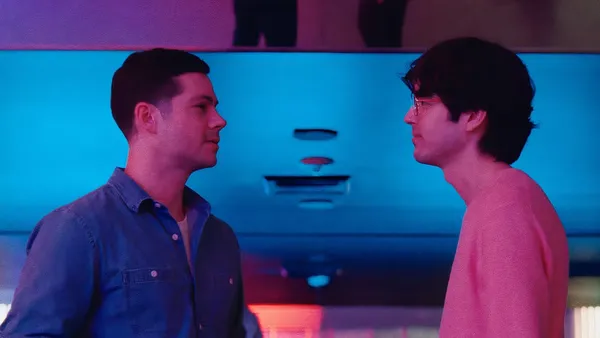
This week sees the arrival of the film Twinless in UK cinemas. Written and directed by James Sweeney, it centres on the bond that develops between two young men in a support group for people whose twins have died, and explores the complex emotions that can inspire. Losing a sibling is always hard, but twins often have a special bond which others find difficult to understand, and which can leave them facing a unique form of loneliness.
Annabel Southern lost her twin sister, Jo, 15 years ago, as a result of colon cancer. She agreed to speak with me about the experience because she hopes that the film will draw attention to what twins can go through, and feels it’s important to let those who have been bereaved know that there’s help out there from other twins who really do know what it’s like.
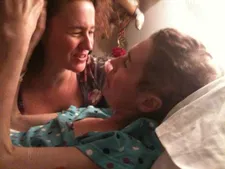 |
| Annabel and Jo in the hospice shortly before Jo's death Photo: courtesy of Annabel Southern |
Annabel and Jo lost their father when they were six and were subsequently sent to boarding school together, where their tremendous energy found an outlet, with lots of space for running around. Although Jo was dyslexic, they both did well. Annabel subsequently trained to become a book binder and Jo embarked on a career in art, but neither ended up where she had expected.
“I did my book binding course and never used it,” Annabel explains. “I ended up In Australia, chasing cattle around the outback. Jo ended up on Operation Raleigh, which is, I understand, called Raleigh International in Africa. So we had these parallel lives.”
They would later find themselves in the same profession.
“I went into nursing and I loved it. I'm still nursing, in fact. And Jo eventually started nursing. I've been nursing 14 years. She started nursing in 2000 and she qualified in 2009. She went out to Saudi Arabia with her husband, who just left the RAF. We were in our early forties. She ignored her bowel changes while she was out there. She didn't know a single thing about her bowel changes. It's stinking hot out there all the time. You know, the sun's up at three in the morning, they're knackered all the time. The kids didn't like it. Her kids were three and seven. And she didn't do anything about the change of bowel. So when she came back six months later, the bowel cancer gone round her system.
“I was in the hospital at the time when she had the urgent colonoscopy. She literally told me that morning, ‘Oh, Belly, I'm going to go have a colonoscopy, don't worry.’ I said ‘Well, I'll see you. I have a second break.’ When I came down to see her, she just looked at me and she said ‘It's not IBS, Belly. It's cancer.’ And I thought ‘Where the hell did that come from?’
“We chased it around her body for the next 18 months and she did a big line in denial and refusing to accept it, which is understandable. The NHS were brilliant. She died after 18 months and I went straight back to nursing and I couldn't grieve properly for the next nine years. I just threw myself at nursing. But the main thing was that it was to do with the guilt of her dying and me surviving. And that's what the complications were – it’s the fact that you feel so guilty.”
She ended up spending a lot of time with her sister’s children and developing a strong friendship with their father, whom she hadn’t really known before because the family was always travelling.
“He became a good mate to me. Tragically he died six years afterwards, of cancer. So we took on the kids for six years. They're at university and grown up now, so they're doing their own thing. But the twin thing is extremely...” She hesitates. “I can explain it now. I couldn't explain it if you spoke to me before 2000. It is about acceptance, the fact that you have to live without your twin. That was a big thing.
“When I went to see the undertakers after she died, I sat with her for two and a half hours. They were amazing actually and it was essential, but I had no idea about that because she wouldn't let me go. I just sat there with her hand in mine for the two and a half hours, talking to her.”
Despite Jo’s death, she says, she has never really experienced not being a twin.
“Every single day I do something which I know Jo would do. She qualified as a nurse. She kept asking her oncologist if he'd give her a job. She's having chemo, he's going ‘I would love to, Jo, I'd love to.’ He couldn't, obviously. And I know that we would be doing the same thing. I’m in palliative care now. Jo would want to be an oncology nurse.
“It was a lot of – in your brain you're going, ‘I've got to live. I've got to look after these two with my husband.’ And they became my priority. So you put your anger, your fear, your pain somewhere else and people forget about it. And that's another area which I'm interested in now: bereavement. Because I saw somebody the other day who I knew had lost his wife two years ago. I'd never met him, but I knew it instantly. He was a friend of my best friend. She took a while to introduce me because they were chatting. I thought I could see his pain.
“It's about what people don't know and how many people you walk along in the street with who are just buried by all sorts of stuff. But the twin thing is fascinating, especially through Lone Twin Network. We've all got different stories to tell and mine is as different to anybody else's. I was lucky that I had Jo for 43 years and I also had her children to look after for six years until they went off to university. That was an important time.”
She tells me about the time she met another woman whose twin sister was dying, and how her own experience helped her to answer questions and tell her what to expect. It’s a very subjective thing, she acknowledges, but she’s glad to be able to assist.
“It's very much about living your life with and without your twin, but still having that influence, without crushing your own character and personality. Because our personalities were different, but our characters were identical.
“When we were at school, they didn't even know what dyslexia was. Jo was dyslexic, so she treated her dyslexia by writing diaries. And she never stopped writing diaries. So when she got sick, she wrote 56,000 words in 18 months. I found out by reading that, how much she appreciated being a twin.
“When she found out she had metastatic spread, I knew she was going to die because I’d been a nurse for two decades by then. And her view was ‘I'm going to fight it.’ And she did. We were polar opposites in our emotional state just then, and she wrote about that. That's another thing about twins, is that we often keep things quiet to each other. We're on the same sort of level, but we won't necessarily discuss it unless we have to. She never said ‘I'm dying, Belly.’ She just told me that she wanted to be cremated. That was her way of doing it. But she wrote in her diaries ‘I had that conversation with Belly.’
“You're twin for life and I'll be a twin till I die, but I also live my life very much like I know Jo would with hers. She would have carried on nursing and I would have carried on nursing and we might have even gone to palliative care together. She was also incredibly spiritual. She was a Reiki master while she was trained to be a nurse. She didn't slow down. So she Reiki'd things and Reiki’d herself and Reiki'd other people.”
This included a Reiki session on the their last holiday, in Malta, she says. She was worried that it would use up all Jo’s energy when she was undergoing chemotherapy, but Jo wasn’t worried about it in the least.
“She Reiki'd me and it was amazing, that level of spiritual understanding. All the way through her palliation, I was internalising and fighting for her not to die, but I knew she would.”
Still, she feels that there are ways in which Jo is still with her.
“Every day. My husband's got identical twins, all grown up. My best friend's got identical twins and they're mirror imaged identical twins. I mean, that's not coincidence, is it? It's just radiation really. So, yeah, that's how it is. It's an element of having the honour of being born with two. I know that if she was here now, we'd just be chitter chattering away – it would be just picking up from 15 years ago in the last year of her life.
“I'm so pleased I'm a twin. As I said, it is a gift and it's an honour.”
She asks if Twinless was written by a twin, and when she learns that it wasn’t – Sweeney does have personal connections to twins but doesn’t consider himself an expert – she says “I bet he is now.”
There are not many twins in films in general, she notes, and she can’t think of anything else on this subject.
“Twins are novelties because you look at one, ‘Oh my God, she looks the same. Oh my God. Do they wear the same thing?’” She smiles. “I didn't know Jo was going to go into nursing 17 years after I went into nursing. I was delighted she did, but had she gone at the same time as me, would I have liked it? I don't know. I just know that I'm really lucky because actually I'm living an incredibly full life and living it just knowing that she would be there. But there's also things which set you off. Certain music, you go, you know...” She trails off, and for the first time in our conversation, needs a moment to settle her emotions.
“That still happens because it will,” she says. “I suppose I'm really lucky because my husband's a twin dad, so he's great. He understands that a little more.
“It gets a bit easier each year. It's a physical thing. The physical loss and longing gets bit easier, but you're never not a twin.”
I ask if it’s worth the pain, and she thinks for a moment.
“Let's not say pain. Let's say love. Is it worth the love? Because you'll see pain all the way through life. It's worth the love. Every scrap of it. Every cell.
“You do deal with it and you do make your life better because you can't die of it. You can't not live. We were always action people. But what I do remember is when Jo got sick, my energy matched hers. I was in the hospital at the time she had the surgery. All I could feel was this great, awful belly ache while she was having the surgery. And the energy loss lasted for a couple of years, really. So I've got the energy now, 15 years on, but yeah, you do match your energies.”
If you have lost a twin, you can find support through the Lone Twin Network.
Twinless is in UK & Irish cinemas now. For cinemas visit: https://bit.ly/m/twinlessfilm / Park Circus