|
| David Wilkinson in the British Museum: 'There is only one villain and that was Lord Elgin' Photo: Guerilla Distribution Limited 2025 |
David Wilkinson’s The Marbles has its world premiere at the Central Scotland Documentary Festival tomorrow night (Thursday, October 30). In it, he considers the case for the return of the Parthenon Marbles – frequently referred to as the Elgin Marbles in the UK, although you may think twice about that once you’ve heard the ins and outs of how they came to be the property of Thomas Bruce, the 7th Earl of Elgin, whose ‘ownership’ of them almost certainly isn’t worth the paper he claimed it was written on.
The choice of Scotland for the world premiere is particularly apt, since the film, which includes a contributions from Dundonian actor Brian Cox among others, also celebrates the fact that the country as been at the vanguard of returning stolen artefacts to their homelands, with examples including Kelvingrove Museum’s decision to return the Ghost Dance Shirt, taken from a Lakota Warrior after the Battle of Wounded Knee, to the Lakota nation. The film is a balanced consideration which, though firmly on the side of the return of the Marbles, acknowledges the tricky position the British Museum, where they are housed, finds itself in.
Wilkinson – no relation – who was diagnosed with stage 4 bowel cancer at the age of 69 despite displaying minimal symptoms, is also currently working on a documentary One In Two. It aims to raise awareness of the disease and the problems of doctors dismissing symptoms, especially of younger patients, because they wrongly believe bowel cancer to be an “old person’s disease”.
In a conversation about the films ahead of The Marbles premiere, we began by talking about why that film became a passion project for him.
“Once I found out the truth, it was very simple,” he says. “They were stolen and it's this thing that we do in this country is that we just lie and lie and lie. We hide behind a flimsy document, which is so suspect but it's taken as gospel. It's not that I have any love for Greece because I've never been, it just seems to me that it's extraordinarily unfair.”
He says he became more and more fascinated by why nobody else was making a film about the same subject. He said he had originally wanted to film around the world, in places including Italy, America, the Netherlands and Greece but ultimately didn’t have the money for that.
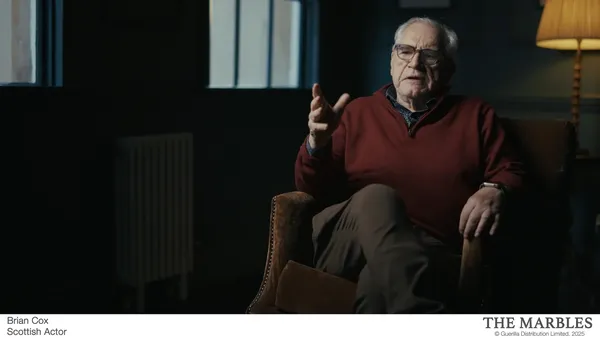 |
| David Nicholson on Brian Cox: 'As Brian Cox said, in Scotland people think differently' Photo: Guerilla Distribution Limited 2025 |
He adds: “When I realised I didn't have the budget to go to all those places I had to rethink. What it was I was doing and how. Then, out of the blue, came Scotland. And as Brian Cox said, in Scotland people think differently. And I just thought that was really fascinating, so Scotland became quite important in the way that they think differently from what is English exceptionalism wrapped around the Westminster government. So there is that pincer movement of playing Scotland off against England. And that then gave me a different way to go for the film, because I would film a bit, run out of money, do a little bit of editing then film a bit more and more money would come.
“I still had to get a lot of people to do favours and didn't charge anywhere near what they would normally charge. But in a strange way, that lack of money has made, I think, a better film than I would have made if I'd got all the money because things have unfolded as it's gone along.”
Wilkinson has been working on the film since 2008 and the length of time it took to make means you can see a shift happening in opinions about art and its return. He says he’s pleased he put on the record that Aberdeen was the first museum in the world to return something, as it has since been overshadowed by returns elsewhere. It’s notable that the director doesn’t seek to demonise the British Museum in the film – and the organisation also deserves credit for allowing him to film inside it, although Wilkinson is sorry that he couldn’t persuade a representative of the establishment to speak to him.
“I don't see the British museum as a villain,” he says. “There is only one villain and that was Lord Elgin.”
He adds: "People from the British Museum have seen it and one of them wrote with the most extraordinary complementary letter and was very pleased at the way that I had portrayed them and not demonised them.”
It was problematic that it took a long time to get permission to film in the museum itself.
“It was only when I became ill that all fell into place. At one stage, I was just going to have to have lots of people's photographs and say, ‘I'd love to be able to show you them but I can't but here's a photograph that Mrs. Smith has taken’. But they were very helpful to me, the British Museum and, as I say in the film, they went out of their way.
“I was extremely ill when I filmed that. My hands are in my pockets because they were cut to ribbons because of the chemotherapy and they were very painful to touch, and I was eight stone there and I'm normally 11.5st. But they really bent over backwards to help”
So, does he feel optimistic that they may be returned?
“It’s only going to happen under a Labour government,” he says. “If Nigel Farage gets in, then there’s absolutely no way that's going to happen. I think at the end of the day, the English establishment – I won't even call it the British establishment – don't like to be seen as bullies and, in our history, we were many times bullies. But we don't like to be seen as doing the wrong thing, all that sort of cricket talk about playing with a straight bat. When you get other countries and the Netherlands are starting to lead in this matter, and I would put Scotland ahead of them, then there becomes an embarrassment and it's, do you want to be the last person standing?”
Speaking about the Lakota Ghost Dance Shirt, he adds: “What Glasgow city council did really is a kind of blueprint. It's how everybody should approach these matters. So for me it's it's It's all to do with the real unfairness of it all. As I say in the film, Greece is our friend and with what we're all going through at the moment, we need our friends. The irony is the only time any part of the Parthenon Marbles has left the British Museum was to go to one of our enemies now, a Russian museum.”
Inevitably with a story like the Parthenon Marbles, which is still an ongoing one, it must be hard to know when to stop.
“Somebody who's my post-production supervisor/consultant editor. He said, ‘You know, the only conclusion for this film is when they’re returned.It’s not going to work otherwise’. And I thought about that. I disagreed with it but I could see what he was getting at. But it became my illness because when I was diagnosed, I was told an operation was totally out of the question and really to get my house in order. So I married Amy – we’ve lived together and have two children since 1983 – I made a will and I wanted to finish this film.
“When I filmed it, it didn't look as if I had long, I didn't ask anybody for any timeline or anything, but then the chemotherapy I was on was extraordinarily good because it did shrink the cancer in my liver so much I could have a liver ablation and it almost got rid of it in the peritoneum, which is the stomach lining, and that meant that it was possible that I could have an operation, a lot of Surgeons, turned it down, it was a really dangerous operation.
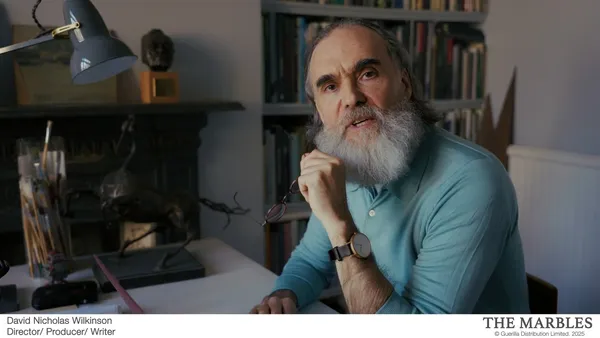 |
| David Wilkinson: 'In a strange way, that lack of money has made, I think, a better film than I would have made if I'd got all the money because things have unfolded as it's gone along' Photo: Guerilla Distribution Limited 2025 |
My oncologist said, ‘David, I'm going to fix you up to see the critical surgery team at Charring Cross hospital but you must write down everything they say about the operation and then you must discuss it with me and discuss it with other doctors and discuss it with everyone and don't make a decision until you've got all the facts.
“The surgeon was a woman and she started speaking and I said, ‘I don't wish to be rude, but where are you from?’ – It's like I’m suddenly Nigel Farage! – and she said, ‘I’m from Athens’. And I stood up and I said, ‘I am wearing the Greek flag because when I finish this, this is going to be the last day of filming… I’m making a film about why the Parthenon Marbles should go back’, at which point my wife pulled out the bag, a Greek flag and held it up.
And the surgeon just burst into tears. And she just said, ‘Thank you’. And I said, ‘I don't need to know anything else about this operation let's go ahead and do it’. It was that kind of serendipity, really of it all.So that gave me the ending because I didn't want anybody else to finish it.
“It was only. It's only been very recently. I found out that I very nearly died in the operation.
“Tthe film became my therapy. I mean, it got me through a really, really dark period. They say, if you're on chemotherapy, you need either a hobby to take it away or you need to keep working. And so that became the ending, just in case I didn't get there and that's why I have that little shot at the end as I walk outside the British museum and I just disappear. But as it happened, the operation gave me this nice six months where I haven't had any chemotherapy but now I'm back on it again.”
The Marbles may be finished and starting its journey in cinemas but Wilkinson’s work on One In Two is continuing.
“I'm nearly finished,” he says, “I concentrate on young people because at my age you expect to get something, you know you’re in the final part of your life. On my first day of chemotherapy there was a young man in the bed opposite, very fit and muscular in shorts and a T-shirt. Amy went over to talk to his wife and then when he left, I found out he was at that time 42 with two or three children. And I cried – I’ve only cried twice and I’ve never cried for myself. I just thought, ‘This is shocking, he’s got the same cancer I have and he was so young.’ And he was the inspiration for making the film.”
Wilkinson says he approached his doctor about three months ago to ask if it was possible to find out his name to film him only to find out that he had died three months after they had met.
Once the film is finished, he plans a cinema release in aid of charities, including Maggie’s, which he hopes will help raise awareness and point out flaws in the screening system. “They keep saying, ‘Only 8,000 people a year will fall through that gap’. I go, ‘But I’m one of those’. The difference between being diagnosed and not being diagnosed is paper thin.”