





|
|
The Witness
|
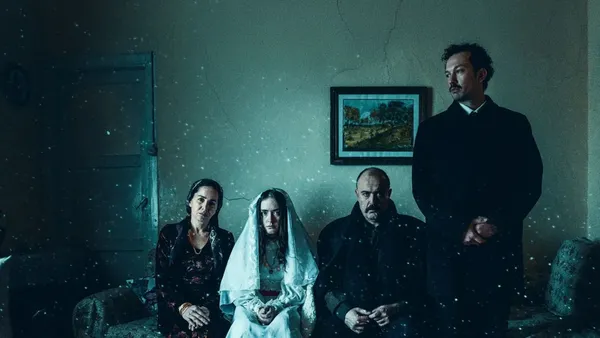
A young teacher arrives in a small Turkish village reay to join wedding celebrations, but what he finds is a house where men play music and women sit stony-faced, looking away from them. When he sees the age of the bride - not the older sister he expected, but the younger one - he understands why. This is Emir Kumova's Oscar-qualifying short film The Witness, which addresses issues around child marriage, the gap between the law and actual culturally-supported practice in parts of Türkiye, and the duty of people who witness moral transgressions. Emir and I were not able to find a time when we could meet, but he agreed to answer some questions about the film.
Jennie Kermode: Is child marriage something that you encountered in your own communities when you were still living in Türkiye?
Emir Kumova: Child marriage is not something I encountered first hand in the communities I grew up in. However I was aware of the situation through news or films and other media forms that addressed the subject. Like many other social issues, it exists within certain regions and communities but it would be misleading to generalise it to an entire country or society. It is also not an issue unique to Turkey, it exists in different parts of the world. I hadn’t experienced it myelf however it was something I heard or read about more than a few times.
JK: To what extent is poverty a driving factor in child marriage in Türkiye?
EK: I think poverty can be a signficant contributing factor, but I wouldnt say it is the only driving force behind child marriage in the country. Economic hardship can make families more vulnerable to decisions that they might otherwise not make, and in some cases, marriage may be seen as a way of reducing the financial burden on a household. But I think the issue goes beyond economics like social norms, traditions, family expectations, and a lack of education and etc. can all play a role. Even when economic circumstances are not the primary factor, the pressure of the community and the normalisation of some practices can make it difficult for people to challenge them. This is one of the aspects I wanted to explore in this film: that these situations are not necessarily driven by one individual or one particular circumstance, but by a wider social environment in which silence and conformity can allow injustice to continue.
JK: The teacher seems quite certain what what he is witnessing is wrong. Does this represent shifting social attitudes?
EK: I didn't necessarily approach the film from the perspective of shifting social attitudes. Ramazan is educated and he comes from outside the village. I think his reaction is partly a result of that. He sees the situation differently from the people around him, who seem to accept it as part of their normal lives. I wouldn't necessarily say that Ramazan represents a new way of thinking. I would think that there have always been people who considered these practices wrong. In that sense, his position isn't necessarily about a change in attitudes, but about a different perspective. Of course, education and exposure to different ways of life can influence how people perceive certain traditions. So if you look at it from that angle, I think there is a connection. Perhaps the women who become visibly upset during the wedding represent that shift more directly. They are part of that community, but they don't accept what is happening.
JK: All the women in the film look unhappy. Did you see them as compelled rather than complicit?
EK: Yes, most of them are compelled by the circumstances they find themselves in rather than being accepting of what is happening. Their expressions are quite intentional. Even though the wedding appears to be a celebration on the surface, there is a sense of discomfort and sadness among some of the women. Also if you think about it, it’s a wedding house, but also a funeral house at the same time too. I didn't want to show everyone having the same opinion or feeling about the situation. I think that's important. People can be part of a tradition or a community without necessarily agreeing with everything that happens in it. Sometimes they don't have the freedom or feel like they don't have the freedom to challenge it. I think it was important to show the women who visibly express their discomfort because they show that not everyone has accepted the situation, even within that environment.
JK: Why did you choose to have the bride be silent?
EK: I think silence is a very powerful element in film, as it is in real life sometimes. It can speak louder than an actual dialogue, depending on how you use it. My intention was to create a kind of a silent scream by having the character not speak. I think her facial expressions and behaviour is showing everything she is not saying and I think that’s way more powerful, than her telling what she feels. Other than the intentional choice of using silence cinematically, it also shows her place in the community or in the family, and how she is seen by others. She is at the centre of everything that is happening, yet she has very little control over it. She actually has one line in the entire film (when she says she is good when asked “How are you?”), where I wanted to show, she is almost allowed to speak only when she is addressed.
Her silence also reflects the environment she finds herself in. There are so many people around her, so much noise and celebration, but nobody is really listening to her. I thought that contrast was important. I also wanted the audience to experience the story through Ramazan's perspective. The film is about witnessing a situation that you know is wrong, and what you decide to do with that information. Rather than making the story entirely about the subject of child marraige. The story is really about witnessing, and child marriage is the moral conflict, to explore the idea of witnessing something you know is wrong.
JK: In the scene in which the bride is watching from a window as younger girls play in the snow, did you see her as looking at what she had lost or as not fully understanding that she would never be free to do that again?
I made that scene thinking she is fully aware of what she is losing. I see that scene as a moment where she is looking at a life that should still be hers, but one that has suddenly been taken away from her. The girls playing in the snow represent the freedom and innocence that should still be part of her life at that age. She is watching other girls do something that, under different circumstances, she would probably be doing herself. I wanted that contrast to speak for itself.
JK: The setting is wonderfully detailed and really does look like a family home. Can you tell me something about the location and production design?
I actually came across the village quite by chance. I was passing through on my way to somewhere else, and I immediately fell in love with how visually cinematic the place looked. There was something about the architecture, the landscape and the overall atmosphere that I found very cinematic. I remember wishing there to be a script or a story someday where that location would be useful.
The house where we shot the wedding was an actual family home in the village. We didn't build or recreate anything, and there was almost no production design involved in the interiors. Our production design team only added a few minor props to decorate the walls and some background, but most of what you see was already there. The house already had its own character and history, and we wanted to preserve that. Every location in the village was real and natural. Very minor production design was done for the purpose of the story, like the fresh soil in the cemetery, but every location you see in the film is part of the real lives of the local people.
JK: If the teacher tells the authorities, does he risk being forced out of the village, leaving other children without an education?
That's a very good and specific question, one I actually haven't been asked before. I didn't necessarily have that particular consequence in mind, at least not initially, when thinking about what Ramazan might lose if he confronted the situation. Being a teacher, he has a responsibility towards the children in that village, so that's definitely one of the things he might be considering. But he's also an outsider. He doesn't necessarily know what the consequences of speaking up would be or how the community would react.
When writing the film, I did have in mind that the social dynamics in these kinds of communities can be quite different. As an outsider, Ramazan might need the protection or acceptance of certain dominant families in the village in order to continue his work as a teacher. But I think the dilemma goes beyond whether he might lose his position or be forced to leave. It's about the conflict between doing what he believes is right and the possible consequences of taking action. I wanted the audience to put themselves in his position and think about what they would do in those circumstances.
JK: How do you feel about the film being Oscar-qualified?
Speaking on behalf of the entire team, we are very proud of this film and grateful for any recognition it has received. It is a very exciting milestone for all of us. More than anything we are grateful for the opportunity it gives the film to reach a wider audience and connect with people beyond the festivals and communities where it has already been screened. I hope it allows the story to travel further and find a larger audience.