





|
|
Ghost Town. Katharine Round: 'I wanted to explore what it meant to be in a place where you know you're not going to stay forever and you’re time-bound'
|
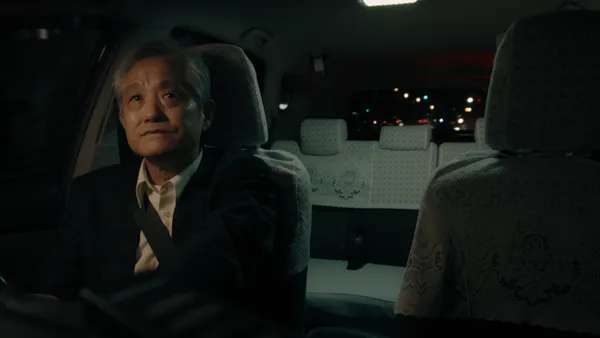
In her latest documentary, Ghost Town, which is out in UK cinemas this week, British director Katharine Round heads to the Japanese coastal city of Kamaishi, one of many places devastated by the 2011 Tōhoku earthquake and subsequent tsunami. There her cameras take a ride in taxis driven by Toru Konno, Yoshiji Iwasaki, Fumio Goto and Masaaki Koike, as a series of conversations with their passengers unfold. The free-ranging chats move from recollections of the tsunami to much more inconsequential moments, also taking in tales of premonition, ghosts and dreams. Key to the documentary is the presence of journalist journalist Shiori Ito (who has recently made her own highly personal film Black Box Diaries), who is described as “the visitor” and who also has conversations about the city. The film builds a picture of the present while also being a shared elegy to what has been lost. We caught up with Round ahead of the UK release to chat about it.
Were there any specific challenges involved as you were a complete outsider to this community and coming in there to make a documentary. I guess there could also be potential upsides to being slightly ‘exotic’ in that environment, in terms of persuading people to come on board.
Katharine Round: It was made over a very long time, partly my design and partly by circumstance. I’d always wanted to work very closely with the people of Kamaishi – I didn’t want to be one of those filmmakers who just rocks up and asks people questions. Certainly not with a subject matter like this. I thought it was really important from the beginning. It's one of the reasons I wanted to work with Shiori Ito, who you've seen in the film. I wanted to establish that cross-cultural, transnational dialogue from the very beginning. She was a really key part of that.
Our shoot was delayed by three years because of Covid. At the time, we wondered whether we'd ever manage to get over there. But what it meant in practice was that we were able to work much more extensively and closely, over a very long period of time. Shiho Dobashi was our researcher, and she's from Kamaishi. Essentially, we would meet every month or two, and she would be meeting the drivers. We'd do various things together, and she would share her memories and discoveries about the town and the people there.
So the film was made collaboratively from the very beginning. The idea was that it was something we were all making together. Shiho is in the film, Shiori is in the film – I would have been in the film if I could speak Japanese! In the beginning, I thought perhaps I'd be the person to go in the taxi, but my Japanese never quite got to that stage. There were advantages to having such a diverse crew. There were four of us on location: Shiho and Shiori, who were Japanese, although Shoi wasn't from Kamaishi; myself; and Jamie Quantrill, the photographer. Jamie and I were both outsiders, coming from the UK and Scotland.
Being an outsider was actually quite freeing. It meant there was less expectation about what we were supposed to know, or what people were supposed to say. I think people felt they could say anything.
The others on the team commented on this too. They felt that if it had been an entirely Japanese crew, it would have been much more difficult to make the film because of all the expectations surrounding it. So, although we made the film collaboratively, we also had this insider-outsider liminality that was present throughout which I do think helped.
Did you know Shiori before this project?
KR: No, we met and had a conversation in late 2019 about it, long before her own film had been made, or it was being made at the time, but I didn't know about it. She was working as a journalist and had been recommended to us. We had a chat and got on. I thought she'd be really interesting to work with. So, in essence, our relationship developed over the course of making this film.
I love that you mention the word “liminal” because it’s such an appropriate word for this film, which is liminal in so many ways, including using the liminal space of the cab to tell a story that itself is very much suspended between what is real and what might be imagined and the past and the future. Was that part of the design, that you thought of the cab as a liminal space when you were planning the film?

|
|
Katharine Round: 'Being an outsider was actually quite freeing'
|
KR: Yes, I think so. I'm fascinated by cars, not just cinematically but from a documentary point of view. I think they're such interesting spaces in which to meet people. You're time-bound and in motion, there's memory embedded in the journey because you're moving through space. You're having a very intimate exchange, but you're not looking at the other person.
I think that creates a strange and fascinating charge to the encounters we have with people in taxis. I didn't know exactly how it would play out, but that was what happened when we entered that space in this film.
I wanted to explore what it meant to be in a place where you know you're not going to stay forever and you’re time-bound. People in Kamaishi know one another. It's a very small place, and I think that gives the taxi journeys an interesting quality. If I stood in London, where I live, I'm not going to meet someone I know driving a cab. But in Kamaishi, that really happened. People would say things like, "Oh, your brother! I haven't seen him for a while."
That kind of exchange would happen quite naturally. So I thought it was quite an interesting space to meet. The idea for the film came from an urban myth – or at least I thought it was an urban myth when I read it, that taxi drivers were picking up passengers who would later vanish or disappear. It made me think about what it would mean to have absence and presence coexisting.
But I also think the taxis are very down to earth. Everything else in the film has a slightly charged, unreal quality to it. The landscapes can feel quite mysterious, whereas in the taxi we're very close to people and they're very human.
It's interesting that we also go home with the taxi drivers in the film. We see them outside that environment. At what point did you decide you wanted to see them beyond their working lives?
It's a question I wrestled with for a while. Part of me, in a completely purist sense, thought everything should happen in the taxi and we should never leave it. But I also felt there was value in understanding the wider context of the place. I started to see the town itself as another character in its own right that needed to come into the film alongside these rides.
We spend a lot of time in the taxis, so I felt we needed a bit of counterpoint. We didn't film lots of people at home, but I thought those moments were important in giving us a sense of their lives beyond the taxi.
I don't think you would understand quite so much about their lives if you didn’t see a glimpse of them. It wasn't about spending hours following people around and documenting everything they did. The moments were very targeted – when they went home after a shift, or just before, and the karaoke bar is very significant in the town, so we had to go there. The shrine was also important. These were places that stood out to me as somewhere we needed to spend moments in in order to understand the character of the place.
I didn't use all of that material in the early cuts. It came together over time, as I began to understand how it could all weave together. I realised the town itself could become a character in its own right. Eventually, those moments found their way into the film, and I was very happy with that.
There's a lot of night in the film, too. Did you decide to focus on the night from the beginning, or was it something you became drawn to as the edit came together?
KR: The night was always there from the beginning. We shot every day from 5pm until around midnight every day. It's a composite of all those nights. I liked that approach because of the different changes in weather were really amazing.
Night is an interesting space. Driving into darkness was something I found compelling from the beginning. When you're in the taxi space, you're really with people in the dark, trying to comprehend what's going on. We get glimpses of the outside world, and those are important.
But the darkness became increasingly important as the film progressed.
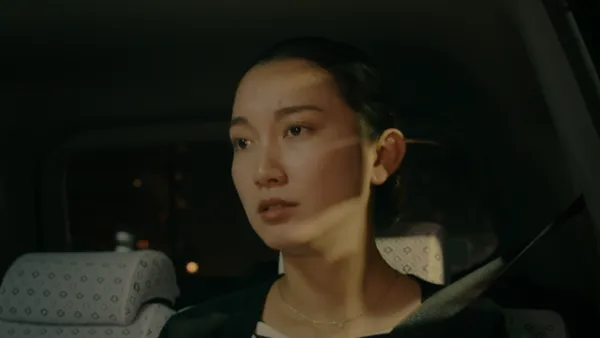
I didn't know what people were going to say. Quite early on, though, a young female passenger spoke about the black wall and the darkness. I began to realise that this wasn't simply about the evocative quality of night. The idea of blackness was much more significant.
|
|
Shiori Ito in Ghost Town. Katharine Round: 'I wanted the film to become a bit uncomfortable, with this enveloping darkness that seems to go on'
|
I wanted the film to become a bit uncomfortable, with this enveloping darkness that seems to go on. You don't quite know when you're going to come out of it. You are in suspension. You're constantly moving, but a lot of the time you lose your sense of where you are. I thought that was a very interesting emotion for us to explore. It’s not a ghost-story trick, I just thought the space of the night was fundamental to the film.
I also worked with a professor of anthropology at Tohoku University as part of the film's research. I would periodically send him material just to see how he responded.
I remember sending him the very first cut. We had a phone call, and he said, “I’m really pleased you shot every night because that's when things become real because during the day, people focus on rebuilding and on what can be seen. They focus on the acceptable thing to say”. But he added: “When I go to Kamaishi and walk around the streets at night, I feel the way thatt’s in the film.”
He thought that was a really important observation of what it means to be there – and a lot of it is emptiness.
I think the deer, which we see wandering all over the place, bring that home. The fact that all these wild animals are wandering around the place speaks to how few people there must be. Were you surprised when you first saw them?
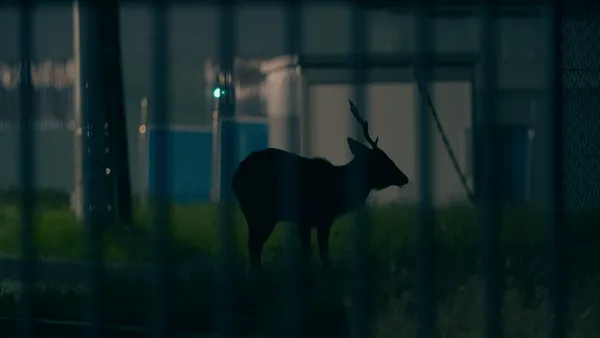
KR: The deer absolutely wrote themselves into the film. I’m completely astounded that we'd had three years of quite intense conversations about life in Kamaishi with people who lived there, yet nobody mentioned the vast numbers of deer wandering around the town because it’s just so normal.
That's one of the interesting things about arriving somewhere as an outsider. You can see things that people who live there have simply stopped noticing or have come to accept.
|
|
Katharine Round: 'The deer absolutely wrote themselves into the film'
|
It would be the same if someone came to where I live. They might notice something about my street or my everyday life that I've completely forgotten about because it seems so ordinary.
The deer really wanted to be in the film. Particularly during the early part of the shoot, we couldn't shoot anything without them making themselves felt. We'd be driving along and they'd be running in front of the taxi. We'd go into town to get some shots during the day, and there they'd be, around the shrines or wandering down the streets in the very centre of the city.
So where were you when all this was going on, because presumably as a director you want to be privy to these conversations?
Yes, we were a tight-knit small team, but it was still a big job. Jamie, my cinematographer, deserves a lot of credit. From very early on, we spent a lot of time thinking about how the car needed to be set up. To the degree that Jamie found the exact make and model of car somewhere in Leeds, and he drove it around testing different cameras.
We did so many tests because, once we were out there, we couldn't suddenly decide that a particular lens or camera position wasn't working. The whole concept needed to stay consistent.
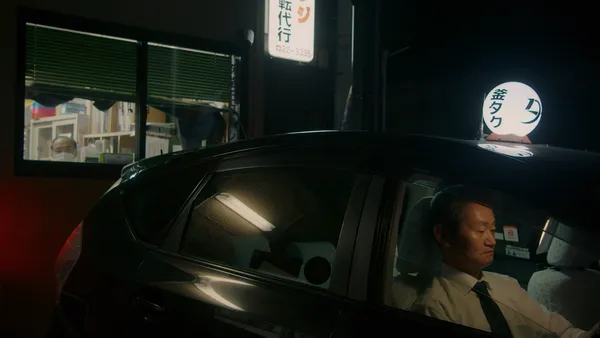
It took Jamie several hours every day to rig the car. We had a lot of fun developing that from the beginning. We sent a diagram to the taxi drivers so they could see what we were planning.
There were six microphones and two cameras. They were small, but they weren't hidden. You can't really hide a camera, even a tiny one.
Jamie put an enormous amount of care into the equipment, which we had to rig and de-rig every single day. Over time, he became part of the taxi company's furniture. People would even bring him hot coffee from the vending machine because he was spending so long putting everything together.
It was quite an intense setup. We also had a two-way talkback system between whichever cars we were using, and we had our own taxi. The controller, Matsuda, who is also in the film, often helped us with logistics. Sometimes he would drive us around; at other times, one of the other drivers would help. Everyone was mucking in.
I could see and hear everything. I would sit in the back while Shiho drove normally. Jamie was there, and I had headphones so I could hear what was happening, although I couldn’t understand because I don’t speak Japanese. Shiori would sit next to me and translate live. I would write it all down.
Then it was a question of holding your nerve for as long as possible. I didn't want the film to become overly directed or to feel like an interview. I wanted it to be as alive as possible, allowing people to bring whatever they wanted into that space. Often, when we were able to leave things, some of the more magical moments emerged.
Of course, we did intervene. We would throw ideas in, and sometimes things weren't quite clear, so we had to pick them up. There were also questions that, once asked in one situation, naturally found their way into others.
For example, quite early on, one of the drivers talked about his white horse dream. Dreams became a common thread because, once you'd talked about it with one passenger, he’d talk about it with another.
It became this strange, almost surrealist game, where everyone was mixing and sharing bits of stories with one another. I was trying to keep track of all the different dream stories and ghost stories that were coming out.
Alongside these were some incredibly powerful and moving recollections of the day of 3/11. We never asked anyone to talk about it, but of course it was very much on everyone's minds. Those memories became embedded in the conversations, alongside the really mundane conversations.
How did you begin to get to grips with all that material? Did you have notes from the taxi journeys that you could draw on? It sounds like the edit was a long process, partly because of the sheer volume of material.
KR: It was a long process, partly because of grappling with the material. There were several things to consider, particularly questions of sensitivity, but there was also the language component too.
Each day, we would send the audio to a bilingual colleague of mine in London. Because of the eight-hour time difference, he would work through the rough transcripts I'd done on the day, and by the following morning I'd have a complete set of translations of everything that had been said in the taxis the previous night.
That allowed me to keep track of the different conversations and themes, and helped us identify which taxi drivers and which ideas we were particularly interested in, should they come up.
|
|
Katharine Round on editing Ghost Town: 'There were several things to consider, particularly questions of sensitivity, but there was also the language component too'
|
When we returned to the UK, I had to get every single frame of the rushes translated. I'd put my rough translations onto the footage, and then someone would watch through and correct them, adding the proper timecodes. That was essential because, of course, you can't edit accurately without knowing exactly what's being said and when.
I worked with several editors along the way. In the early stages, I worked with an editor who spoke some Japanese and was able to do a huge amount of work with me on the dialogue edits. Unfortunately, she then had to move on to another project. In the later stages, I worked with John Mister, whom I'd previously worked with on my film The Divide. I also cut some bits of it myself, while he did a lot of the structural work.
It became an evolving, iterative process. Each time we made changes, I had to get someone to check the translations again. As the film approached its final cut, it was making sure we were staying true to what was being said in each scene and that I hadn't misunderstood anything. So, yes, it was definitely a challenge.
Given that this has been on the festival circuit before this UK release, are you now working on future projects? You’ve certainly proved you like a challenge but I you working on something closer to home?
KR: I do love a challenge! I like to say that my films find me. I'm not sure how much I actively choose them, although, of course, there is some choice along the way.
This one felt very serendipitous. When I came across the story, I was dealing with the death of a friend, and questions about how we make sense of grief had really stuck with me. I felt the film came to me at a moment when I was interested in asking and exploring these things. I'd love to make a film in the UK, if anyone were willing to support me in doing so. It's quite a difficult landscape here, although it's tough everywhere.
I'm actually working on another film in America, so it's not necessarily any nearer than Japan, although the language isn't quite the same issue. I've been working on it for quite a long time.
It's another film predominantly set in cars, and I think I actually started it before this one. It's a much more personal film about someone I know in the American criminal justice system, who I met while making my previous film The Divide.
That film’s been evolving through our correspondence and through various trips I've made to the States. It's really taken on a life of its own.
It's interesting to have this film being released now and to think about the relationship between the two projects. I wouldn't say I'm returning to the other film, because I feel they've both existed in parallel. It's really just a question of which one reaches its audience first. I'm still shooting the other one. I said I’m doing a trilogy of road movies so I have to stick to that and make a third one. I'd love to make a film about taxi drivers in London. Or perhaps something set in a car park somewhere.
Ghost Town is released in the UK on November 6. Details of screenings and how to book can be found on Katharine Round's website