





|
|
Littermates
|
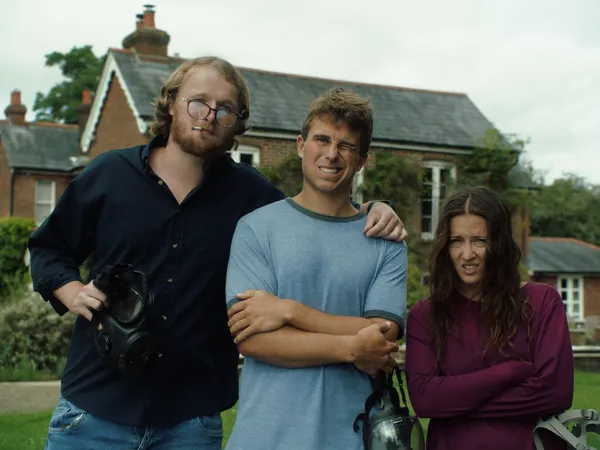
A post-apocalyptic scenario quite unlike any other, Littermates is the story of a man and woman who have lost their memories, their identities and much of their adult reasoning ability to bioweapons. Rescued by the enigmatic Chester (Oliver Woolf), they live in his large country house, where he attempts to re-educated them from infant level. What surprised me about the film, I explain to co-directors Michael Woloson and Scott Tinkham, is that despite the bleakness of the scenario it presents, it’s wonderfully gentle and full of confounding kindness. Was that something they did in order to make it distinctive, or did it simply emerge from the narrative?
“Yeah,” says Michael. “I think it emerged naturally out of the story because of the nature of the character dynamics. Scott and I are both products of siblinghood. We grew up with brothers and sisters and I think there's this natural warmth that comes with that type of relationship no matter what your dynamic is. The Mel and Liam dynamic is spawned out of that familiar familial warmth that comes with being a sibling.”
How did they prepare the actors to perform those roles with so little sense of background or who they were?
“These guys act like siblings in real life,” says Scott. “They've been our friends for ten years now. Joey [Bader]specifically used to put on this character, just like acting like a ten-year-old boy or like a 14-year-old boy around us because he's incredibly good at improv and he would just make us laugh doing that. So I wrote that specific improv character for the script, and then Kaylee [McGregor] plays off of it so well, if she finds Joey to be so funny. They both used their natural talent in this so well, so it was easy for us, honestly.”
It's complicated situation because they don't have that sense of identity, or any sense of the wider world.
“Yeah, exactly,” he says. “It was fun that way because we didn't even know where were going when we were writing. It made it just like such a fantastic little playground to be in because we were surprised around every corner too, with the characters. If you create a movie where two people don't have their basic memories, you can kind of do anything. You can go a lot of different directions and it's just fun at that point. So it just naturally evolved into this sibling rivalry movie. I really do think it's because of the casting of Joey and Kaylee in these roles, because they just feel like two siblings in real life.”
I ask about Chester, and if they had a backstory for him.
“I think Scott and I might have different answers slightly,” says Michael, “because as the writer, I think it was more his responsibility to understand him deeper as a character, and his story. And then myself coming in as the co-director, I was able to follow the thread of what was presented in the script, as opposed to thinking too far back for him. I think that lends itself to the identity and the subjective experience of Mel and Liam, because they know nothing about him. We as the audience don't get much on him. There are theories that I think we collectively have about his story, but I think the important thing is that we never divulge too much to the audience, because we want to keep the information confined to what Mel and Liam have.”
“That was perfect,” says Scott, declining to add anything else.
It must have been a tricky film to pace, given the importance of withholding key pieces of information for much of the running time.
“Yeah,” he says. “I'd say it was difficult because I wrote the whole movie not really knowing where the hell I was going with it for the longest time, and just kind of having this blind faith that something worthwhile it was going to come out of it. I don't usually do it that way. I usually like to outline and at least know where I'm going for most of it. Then things change, of course, but for this one, I was trusting that if I just kept iterating, something would fall into place. Trusting the process.”
It's a film that has huge narrative scope, but it’s made in a very simple way Was that an artistic choice or a budgetary issue?
Michael nods. “Yeah. The film was kind of reverse engineered for what we knew we had access to. We knew that we wanted to get our first feature out of the way. That was our bucket list item over the last few years. We've been friends since film school, so we've been needing to get the first feature done for so long. We knew we had access to this beautiful house in the countryside through a friend – and a helicopter, of course. And we had a bunch of really amazing things that were at our disposal that we knew that we could write into a movie.
“For us as first time filmmakers, wanting to make a statement or make something that could stand out a little bit more, we wanted to expand the scope, but not necessarily expand the practical nature of what is on screen because it's a very confined film and there's not much that really shows scope, I guess. I think it's pretty obvious what the budget level roughly is. You know, it's not like a 50 million dollar movie. You can tell that. I think there is a movie in here that could have been 50 million dollars if were to expand it out into the world more. We didn't have those resources, so we would just keep it to what we knew we could pull off properly and well and effectively.”
How do they work together as co-directors?
“It was pretty balanced out,” says Scott. “Michael being behind the camera, he also DP'd this. We didn't have that much crew. We had like 11, 12 people. I don't even know if we had a gaffer some days. Michael was sometimes very focused on lights and that would leave blocking and stuff with the actors to me for a lot of it. But there was a lot of switching. Like I was setting up lights and he was doing blocking with the actors.
“It was like Michael had set up a shot and then we would put our heads together and be like, ‘Okay, what's this going to be like? What are we blocking here?’ It honestly felt kind of natural by the end of it.”
“I think also it's worth mentioning too that we prepped so much together. I think most of our co-directing process was actually in prep and not necessarily on set,” adds Michael. “On set, I actually felt more like a DP than a director for a lot of the shoot because I had to. But there were times I would give notes to the actors and I'd be able to do my input on certain things. All of the work that we did to collaborate on the directing and the actual vision for the film was before we even got to England.
“We knew that to pull it off in the short amount of time with little resources, we had to be really on in terms of what we wanted to do with it. And we got there and we knew exactly what to do. I knew exactly how Scott would be directing the scene, so I could trust that and go set up a shot and set up the lighting and all that stuff. So it was really just about being as well prepped as we could for the shoot.”
It's a film that reminds me a lot of quite a number of sort of old BBC type end of the world dramas, I remark, wondering about their influences.
“End of the world BBC dramas?” asks Scott.
“I love that. I’m not familiar with them. I don't know if I've ever seen an end of the world BBC drama, but I think I’d like to,” says Michael.
“It sounds delightful,” Scott says. “That's what I might do for Halloween.”
“Some of our good friends are deep cinephiles and probably have seen 100 of those,” says Michael. “We talk to them often and we get their input on so many things. They're also executive producers on the film and I think their influence is always on our work in some way, so I'm sure that plays into it a little bit, but Scott and I are less well versed in that.”
The woman who set up the interview pipes up briefly to suggest Tales Of The Unexpected, which they both seem curious about. I ask how they feel that their film is going down with audiences.
“Our Letterboxd is great,” says Scott. “People are responding to it. I think our Letterboxd score is 3.5, which makes perfect sense for this movie. And our rotten tomatoes is 90%, which makes perfect sense. It’s not for everybody.”
“We knew it wouldn't be a film for everyone,” says Michael. “We knew that we were making something a little more specific. But if you're making something that appeals to everybody, then I don't think it's as interesting. I think we're both really pleased with how people are responding to it. It seems to be pretty balanced and mixed, and those who love it, really love it and really see the vision and understand it. But then, you know, there's some people who just don't. That's okay.”
It seems distinctive enough to be a good way for them to introduce themselves to the film world and to audiences, I say.
“I hope so,” says Michael.
Scott nods. “I think that's the best case scenario for this film.”
Littermates hits US cinemas on 6 November.