




 |
| Death Has No Master |
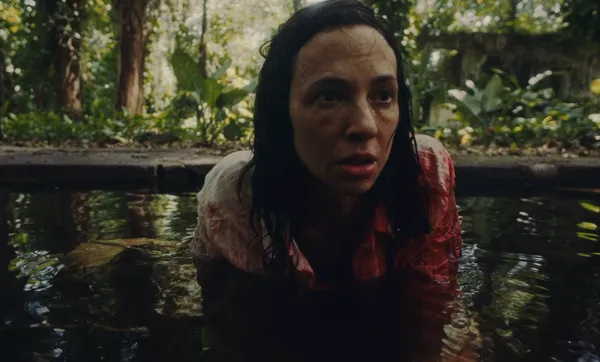
Asia Argento is Caro, an Italian woman who travels to Venezuela to lay claim to a house which belong to her deceased father; Dogreika Tovar is Sonia, the local woman who looks after the property and may have a claim on it too. This is the dynamic in Death Has No Master, a powerful drama by Jorge Thielen Armand. He and I met for a chat when it screened at Fantastic Fest, and I begin by congratulating him on an earlier screening – its première at Cannes.
“Thank you very much,” he says. “Yes, that was quite a milestone for us, a dream come true. Very fortunate.”
The film’s origin story is more vivid than most.
“If I could define the germ idea, it would be stemming from a nightmare. A recurring nightmare where I find myself in abandoned building. A factory comes to mind, some sort of big industrial building, and it's probably in Caracas, the city where I'm from. I'm roaming around the rooms. It's dark and it's moist, and sometimes there are people partying in certain rooms or, you know. I feel dirty, and I'm not exactly sure if I'm looking for. For the exit? Or I'm just part of this decadent party. But when I wake up, I think about what I left behind in my home country of Venezuela. In thinking about this dream, I wonder what will be there when I go back.
“I've been in exile for 22 years now, and I think this dream is about the nightmare of coming back and finding that everything you left behind, including the old version of yourself, is gone. I think that this is what the character of Caro is doing in my film. She's going back in a sort of confrontation of the past, and finding that the past has turned against her in a way.”
She was a child when she was there before, he explains, hence the intermittent flashbacks to her childhood experience of being kidnapped. I note that having a female protagonist in that position is rare, and that it gives viewers an opportunity to relate more to the idea of being vulnerable, despite the fact that she’s quite an aggressive character. Her weaponisation of her vulnerability points up some of the specific issues around white femininity in the context of colonialism.
“Yeah,” he says. “You know, I wanted to take the challenge of portraying a protagonist that was sort of antihero. I wanted to make a film where nobody - definitely not the protagonist, but nobody else – was a victim. Everybody in my film is a perpetrator at times and a victim at other times. I think that those perspectives are harder to engage with because they're less common in contemporary cinema. But, yeah, I wanted to see. I like flawed characters and I like these characters to be doing things that we are uncomfortable with.
“I was interested too, in working with Asia Argento in a role like this. We’re so used to seeing her in roles where she's sort of almost machined, you know, like, she's super tough. And this was a more fragile portrayal.”
We talk about a book she finds in the house, with an illustration of miserably people struggling in a pit whilst a man watches them from above.
“It's an early edition of the Divine Comedy,” he explains. “The illustrations that we see there are the ones by Gustav Dore. My cinematographer and I were working on the script in the pre-production and he mentioned these images, and when were looking through them, we realised that there was a real parallel between some of those images and the opening nightmare of the film. There is a sort of subterranean narrative in the film where there's elements of this initial nightmare that appear, such as these images from the book. Also some of the props that are around the house recall this dream, this sort of unravelling.
“This dream is dream that acts as a premonition, but also it infiltrates reality. You know, it goes with this proposal of not really knowing where reality is, where fantasy is, where the past is. It's all part of the same thing. As Faulkner said, the past isn't dead, it's not even past.”
To me, I say, that also seems to relate to the way that the forest is reclaiming the house, like Venezuela reclaiming its own territory and destroying colonial authority thing. It also gives us a bit of sympathy for Caro as the colonial figure who finds herself caught up in that and overwhelmed by it all. A lot of the film is focused on that location. How did he find it?
“I have an obsession with houses,” he admits, smiling. “That location in particular is a location that I saw in 2021 when I did the first location scout as part of my research for the writing. I discarded it initially because I had a different house in mind. But also, when I saw that house, it was completely painted in bright yellow with the white windows and the white staircase. And it was totally empty. You know, it was abandoned. The gates are open. Anybody can walk in there. But then in pre-production, we tried to make this movie in Colombia for financial reasons and for fear of the risk of shooting in Venezuela. But for one thing or another, the path led us back to Venezuela. The film wanted to be made there. And so we revisited this location, and now the staircase was gone.
“It was just so obvious that it needed to be that place. It was surrounded by this jungle, but it was a huge task because everything that you see in there is built: the doors, the windows, the furniture. We brought it in. The wallpapers. It was just the skeleton of a house. So it was a really big challenge to make those spaces look lived in. The house is located in front of a street, in fact, but you don't see that in the film so much. It's a historical house that was built by German immigrants near the port of Puerto Cabello. It used to be a very wealthy area, so there are several big houses like that in this one street. Some of them are completely in ruins. Others are still there.”
We've talked a little bit about Caro, so I ask about Sonia, as she's also a really complex character.
“Yeah. Sonia was a character that I always knew that I wanted somebody with a lot of presence for, somebody that could, in a way, be face to face with Asia Argento and be able to be like ‘Okay, I'm going to stand my ground here.’ But for me, you know, the script is the starting point when I find my characters, and I say ‘find’ because I usually work with non-professional actors, so I never know who I'm going to find until I meet them. I allow their qualities and their interests and their abilities to come in and rewrite the characters. So for example, this Sonia that we found, Dogreika Tovar, she knew how to play the drums. She was a very sort of loud and outspoken person, very energetic. So I gave some of those things to the character.
“Some other things, we changed with her. Like, for example, we dyed her hair and gave her this new haircut and decided to also go against the cliché of lower class characters in Latin America with the clothes. She would be wearing these different clothes and using these different things around the house that would elevate her and make her part of this house. In fact, she's the daughter of what would have been the servant, so it's like she grew up in the house not with but alongside Caro in a way.”
We discuss the challenges of shooting in Venezuela.
“The biggest challenge is the uncertainty, the climate of uncertainty that surrounds everything there,” he says. “It's a country where you feel like it's an open air explosive. Anything can change any moment, as we saw recently with the earthquakes, and politically too. This feeling, I think, really informs the film. The logic of a nightmare, you know, anything can come at you out of a corner. And this creates a climate of altered perception and eventually that fear can induce hallucinations. This is something that really informed the movie.
“On the practical side of things, Venezuela has had a history of cinema that is not very well known around the world. In the Seventies, Eighties, Nineties, there was a lot of European productions shooting there and even American films. A lot of people trained in this old school way of working, and that remains with the ones that have stayed there, so you find very talented and well trained people still working there. But there's a sense of urgency with every project that you make, because every project, if it's a miracle to make a film anywhere in the world, to make a film in Venezuela is a miracle on top of a miracle.
“There's a sense that every film is the last film, and so people shoot one or two feature films a year, and so people are willing to put their hands in the fire for you in a way that I don't find when I work in Canada or when I work in Colombia, let's say. It's such a rare thing to be making a movie. So, yes, that makes it very special.”
Before we run out of time, I ask about a particular scene that really stood out to me, about halfway through the film, when Caro visits a bar in the town and everything slows right down as we watch a singer. It gives us time to step back from the action and absorb the emotional weight of what we’ve seen.
His face brightens. “Yeah, that's one of my favourite scenes from the film. The concert, right, the bolero song. So how that came about is that I was looking for the location of the police station, and we were looking at this garage for it. Right across the street there was a little window with a sign that said ‘de la ciudad de Puerto Cabello’, meaning, ‘from the town Puerto Cabello’. And there was music inside. It was like a house. I saw through the window, and there was this man and his wife with a sound system, and he was wearing this red silk shirt, and they were singing there at 3pm or something. I was just like, ‘Whoa!’ And I started talking to them and I asked if they wanted to be in the movie.
“I didn't have a scene written for them, so then I had them in mind, thinking ‘Where can I put them in?’ And then Asia had made this massive playlist of Spanish songs that she used that she listened to, to practice her Spanish, and there was this one song from it, called Interrogacion. The lyrics were so on point with the film on a beautiful level, a sort of psychological level, that you could think that what is being said is what this character might be thinking sometimes, you know, and he's talking about love.
“I love that there's many ways to interpret that. You know, you can be thinking about Sonia, or what Caro's thinking about Sonia when she's listening to that song, or it's more of an internal monologue. But I come back to this way of making films, right? We come back to that casting question of Sonia. I let what I see in the world come in, and I let it come in at any time, whether that's in pre-production, during production, or in post production. I try to stay fluid, flexible and perceptive so that I can enrich the movie with the experience of making the movie. And that experience has to do so much with stuff that is outside of filmmaking. You know, it has to do with walking in the streets. I'm particularly happy about that.
“That scene was a series of chance encounters. You know, the chance song that I didn't find. The chance encounter with them. The chance encounter with this location. Because this location was actually this abandoned hotel that used to be right there next to this refinery in Venezuela. A lot of oil executives would stay there. But now the hotel is closed and it's up for sale, and the people that take care of it, they let us see the reception. I asked if there was a restaurant there, and they said not really. I said ‘Well, what's upstairs?’ ‘Well, the restaurant used to be there, but now there's nothing.’ And I insisted ‘No, let's go see it.’
“We go up and it was covered in pigeon droppings and the windows were blown out. And there was this mural there that I had written in the film that was in the script: this mural, so similar to this. And so it was just like whoa, you know, three chance things come together and make this amazing scene that I couldn't have written.”