 |
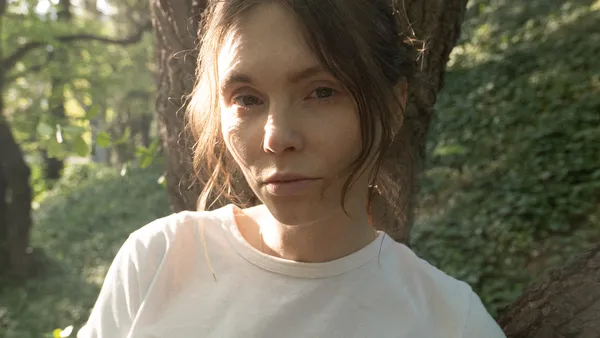
| Agata Trzebuchowska Photo: Maciej Edelman |
“It's my first feature,” says Agata Trzebuchowska proudly as we prepare to talk about Sick, which is streaming as part of Fantastic Fest 2026. It’s the story of two siblings who find their relationship taking a new direction when they are sent to a remote country house to care for their fragile, barely cognisant grandmother. Wonderfully fresh performances from Konrad Kakol and Katarzyna Lubik combine with immersive cinematography to create an engaging work that stands out in this year’s genre film landscape. It began, Agata tells me, almost by accident.
“Honestly, I got a bit frustrated when I was trying to make the other thing that was supposed to be my début,” she says. “I was struggling a bit to get the funds together, so I had this very great urge to do something now, to do something very quickly before the spark died. Because that's what happened to me with the other project. I wanted to make something with a small crew, very intimate, allowing myself to make mistakes – because that's what a début should be about. Testing yourself, testing the boundaries. That's how this film came about.”
It seems like a film that could be made on a fairly small budget. Did that mmake it possible to shoot over a longer period so there was more time for mistakes and for putting things together in different ways and trying things out?
“Yeah, exactly,” she says. “Because this was our priority, to have as many shooting days as possible. We had very limited crew of ten people, including actors, and one location, so I really wanted to have time and space to have rehearsals with actors and to find things on the spot. And we had 28 shooting days, so not bad.”
What really stands out is those performances and how fresh it all feels. Was that a product of having time to experiment, or of waiting until people were fully ready for particular scenes?
“I think it was both. I mean, the actors are very young, and it was their first performance on a big screen. We had those very extensive rehearsals and it was a combination of improvisations and trying things on the day, as well as very strict staging. Most of the scenes are shot in one single take, so it required a very specific kind of staging and rehearsal work with camera and actors. But I also shot many takes because I wanted to try things and go with actors to different emotional states and places, and they were very open and very ready to try new things and approaches. I'm very grateful for that.”
There are scenes in it that are quite intimate, very personal. How did she develop the necessary level of trust on set?
“Intimacy was the one thing that really worked with a very small amount of people. We gave ourselves time in pre production to talk things through and to rehearse certain stuff. And it's also, if you are referring in a way to the last scene, the intimacy I wanted to build into a more complex and bigger geography to some extent, to take some emotional weight off the actors. With other crew members, we know each other, and the cinematographer is my partner. He was the first collaborator, and the producer is also a friend of mine. So this core creative team, we have this trust and we know each other for a while, so it was definitely easier to bring people who we see eye to eye with.”
It's also a film where there's quite a lot of trust of the viewer, because a lot of things are hinted at and not stated too clearly in the film, and it's hard to get that balance right.
“I think it's always challenging,” she agrees. “I believe that there are a few stages when you create a story. First is the screenplay, obviously, then your work on set, and then you have the whole post-production process. So you can second guess yourself and ask yourself questions, if it's just the right amount of information that you're reading or if it's too little or too much. And that's what I was trying to do. To be aware, to listen to the story and the characters on every stage of the process and to find this right balance between information and leaving some space for the audience to bring something into the story: their own interest, intuition, their own interpretation.”
I tell her that I like the way that scenes of care for the grandmother are shown, realistic and not patronising. Agata is pleased that this came acoross, and says she thinks it must be down to her personal experience of being a carer. We talk about the way that the main characters’ behaviour feels, in a way, like a reaction to being so close to mortality.
“For me, it's like the change and the transformation of moving to a different state of life,” she says. “Whether we speak about growing up or aging, this is what lies in the core of the film. This dealing with mortality, dealing with change and doing that. We are becoming someone unrecognisable, even for ourselves.”
I observe that the aunt and uncle who live nearby and check in on the siblings from time to time are not going through that kind of change. They're static and people are changing around them.
“I've never thought about it in this way, but I think it totally makes sense that they're not really going through this specific phase of entering a different stage of life,” she responds.
There’s a particularly striking sequence when the protagonists have consumed drugs and alcohol, and both they and the viewer see their surroundings in a different way.
“This scene was very challenging,” she says. “It was supposed to be also made in one simple take, and that's how it was shot. It's also shot from a subjective point of view, and it was very demanding and challenging. From the very beginning, we wanted to find a way to make this experience feel very realistic, and also to somehow make this view a bit dirty, like you are sticking to some things. That was the idea of how there are glitches when you experience the world when you are in this particular state of mind. We were struggling a bit in editing with the scene and then in post production when creating this specific effect, but I'm happy with the outcome. It wasn't very easy to find the right balance.”
We discuss the location and I ask if we’re looking at the same place all the time or if she had to put different places together to create the house and its immediate surroundings.
“It's one place. And because we were a very small production and had limited resources, we were looking for a location that would be nearby our place where we were supposed to stay during the shoot. And we managed to find the right place. It’s a very beautiful old house – a bit run down, so we had to bring it back to life in a way. And me and the cinematographer, we prepared the whole location. We cleaned everything. We painted the walls to make them a bit dark, because the major idea for this location was it would create color contrast, this very sharp, strong contrast between interior and exterior.
“We wanted the house to feel dark and a bit run down and doomed in a way, and it would become another character. Also, the house had a very interesting layout itself because you were able to walk it around it in a loop, so it also created new possibilities for us in terms of staging.”
So how does she feel about Fantastic Fest?
“I'm very excited. I'm also, of course, nervous. I mean, it's my directorial debut, so of course I'm nervous. But I'm also aware that I'm touching on some sensitive subjects and I’m curious how people are going to react to it. So, yes, I'm nervous and excited.” She smiles.