





Eye For Film >> Movies >> Exhibition On Screen: James McNeill Whistler (2026) Film Review


The Exhibition on Screen team has delivered a variety of different art documentaries over the years, but where it has particularly excelled is in telling the stories of individual artists, looking at both their personal and their creative lives. James McNeil Whistler was a man who frequently told his own story, but was not always consistent about it, being very conscious of his public image and the need to build a brand – as well as, one suspects, having a sense of mischief. This has put the team’s research skills to the test. The result is something proper in academic circles but rare in cinema: a production which acknowledges uncertainty and explores the artist’s process of creating is story alongside the story itself.
It’s an interesting premise, and Whistler was an interesting man, with diverse interests across the field of creative endeavour: drawing, painting, etching, writing and interior design. He also took on the practicalities of printmaking, and pioneered the now common practice of releasing his own prints as signed limited editions. All of these things are considered here as we follow him from the disputed (but verifiable) circumstances of his birth through to the final years of his life, his marriage to Beatrice Godwin, and the lithographs he made of her as she lay dying.
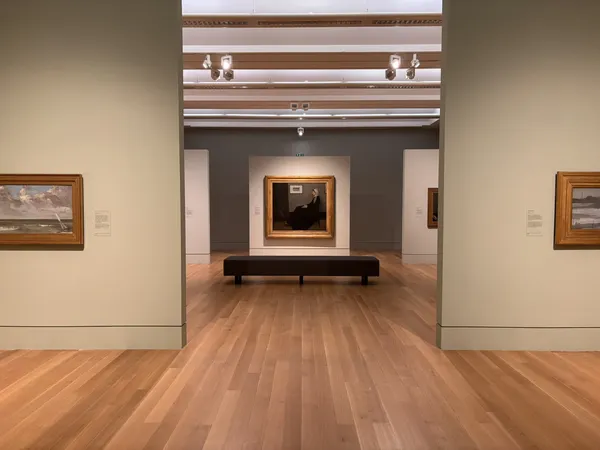
The Tate Britain gallery is currently home to the first major retrospective of Whistler’s work for over 30 years, and this is the inspiration for the film, which takes us on a tour of it as the story is told. Given Whistler’s interest in controlling the whole environment in which his pictures were seen, it’s interesting to observe the gallery’s choices, the pale greys and cooking apple greens – shades often found in the artist’s own works – used for the walls. Whistler’s Mother (Arrangement in Grey and Black) – probably his most famous work – holds pride of place, with her sons on either side of her. Elsewhere we find his romantic partners in various guises: Joanna Hiffernan (who was also his agent for a time) in his three Symphonies in White; Maud Franklin in her fur cape. There is also Frances Leyland, the wife of his sometimes patron Frederick, with whom it is speculated that he was in love, wearing soft peach (unthinkingly described as ‘skin colour’) and standing beside an almond tree in blossom, one of the first signs of Japanese influence beginning to creep into the work.
Open as he was to manifold artistic influences, Whistler makes a fine subject through whom to explore the late 1800s and the changing society of the US and Europe. We visit the peacock room which he designed for Frederick Leyland somewhat contrary to his wishes – it is gorgeous, but one can imagine it having been a little intimidating for dinner parties. Famous figures flit in an out of the story. We hear of his friendship with Degas, with Monet and later Manet. We hear also of the reputation he gained for torturing his subjects with long sittings. The teenage Cecily Alexander’s resentment is captured forever in oils, a much more noteworthy expression than any number of polite smiles; and then there is his immortal remark to the Comte de Montesquiou-Fézensac: “Look at me a moment longer and you will look forever.”
The film is full of intriguing little details. We see the working in the St Petersberg sketchbook where his ideas first took root during childhood, and even there one can discern his preference for capturing movement and vitality over precision of form. We hear how he learned more formal drawing, and then etching – a vital moneymaking skill during his early career – at West Point Military Academy, then go on to see some of the brilliant illustrations he created when serving on the US coastal survey team after being discharged. Attention is paid to the detail in the paintings themselves, particularly in his urban landscapes where labourers and others going about their daily business can be seen chatting to one another and undertaking tasks as if captured in candid photography, unaware of anyone looking, with no condescension to artistic tradition. Later there is, of course, the tale on his efforts to sue a critic, which is dealt with sympathetically; and after it produced an unlikely yet, perhaps, predictable result, his immediate resolve to move on, travelling to Venice to pioneer new techniques in etching.
Everywhere in this narrative is that sense of movement that was vital to him. There are the self portraits, revealing at every stage the care that he took with his own appearance. His books and his many letters to newspapers allow us to hear a good deal in his own words – where they can be trusted – and this contributes to the fullness of the film, to the sense of his presence in every aspect. A man whom one can imagine being very comfortable in the modern age, he despaired of the struggle that his contemporaries had in seeing a painting as a things in itself, not its subject. Here you will see so many of his works, so eclectic and constantly inventive, that there is little time to take in the subject of some, yet the visual impression remains, and in it his voice in a different way.
Reviewed on: 14 Sep 2026