 |
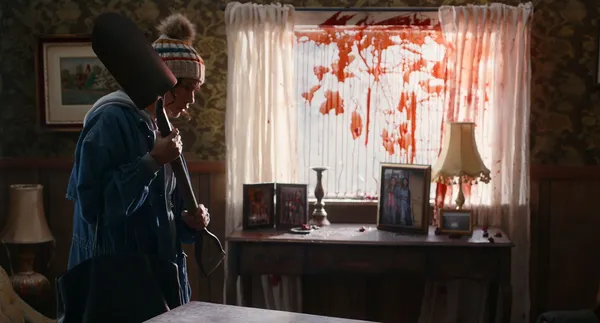
| Ancestral Beasts Photo: Fantasia International Film Festival |
When I meet up with Tim Riedel to discuss his film Ancestral Beasts, which is screening at the 2026 Fantasia International Film Festival, he’s very excited to discover that I’ve actually seen it. He’s just shown it to a group of elders from his indigenous community, and Sixties Scoop survivors. I’ve just been covering ImagineNative, where I was talking about the Sixties Scoop with Tasha Hubbard - the awful process whereby children from indigenous families were taken by the Canadian authorities on any number of flimsy pretexts and adopted out to white families or placed in residential schools, resulting in massive, intentional personal and cultural damage. Like Tasha’s film, Ancestral Beasts explores something of the legacy of this, but it uses a horror lens to do so.
“I didn't want to put too many labels on things like what mental health issues any of the characters were facing or what kind of systemic institutional violence was put onto their family,” Tim says, pointing out that he doesn’t actually name the Sixties scoop in the film. “It's important socially to have labels for those things, but relationally, I think it almost does a disservice. Relationally, it's more important that the audience just sees the humanity of the characters going through the situation rather than labelling them, just because the label makes an audience member think with the brain and then hopefully trickles down to their heart. When you’re sharing time with the person and going through their struggles, well, now you're just feeling with your heart first and hopefully after it hits your heart, it's easier to intellectualise afterward.”
That background awareness is important, I suggest, because it adds a further dimension to the idea of a monster appearing and taking someone.
“Exactly. The institutions that would take your children exactly are monsters to the child and to the families. So the monster could be anything, whether you're living in Siberia or Hawaii or Scotland.
“This is extremely autobiographical. It was supposed to be a very small film, like maybe made for $30,000. I've always been telling other people's stories. My background's in documentary, so I travel as far away from home as possible to share stories of other people being marginalised in their world, and help create more awareness for what they're dealing with. And then I was challenged by one of the elders in my community – for those who don't know, an elder is a longstanding citizen of a community who is very influential, very knowledgeable, but also very respectful. It's not just about opinions, it's about sharing perspectives and ways of thinking about things and also giving comfort. So I was challenged by an elder who said ‘You're always going across the world telling all these other people's stories. Why don't you ever your own story of your people?’
“Truth is, I never thought my stories matter. Life had taught me that my stories didn't matter. Nobody cared what I thought. And so the truth is, as much as I have a heart for helping other people and travelling did that, even though I don't like travelling – I don't like flying, so you know, I could think of nothing to help me get over my paralysing fear of flying better than being a travelling documentarian. But anyway, I digress. I decided to just listen to my elder, because that's what you supposed to do, and tell my own story.
“I had zero expectations other than at the end of the day, I'd have a script that was very cathartic to write. It's like journaling about my past and my relationship with my mother and relationship with my family, and understanding that a lot of the chaos and instability that was happening in our home and in my mother's life before I came around was due to this force from the outside that she didn't deserve but maybe didn't manage as well. I had this idea that, the curses we inherit are not our fault, but what we let them become is our responsibility.
“We shouldn’t be ashamed for these things that have happened to us, like anybody in life, whether you're indigenous or not, but we have to be accountable for what we do with those things, how we let our lives go forward from that. If I tried to put that in a documentary, it just wouldn't work. The only thing that it could be was a genre film, and I hadn't made a genre film since I was like a kid running around with the camera in the forest with my friends, which was what we’d do instead of being on the streets getting in trouble with drugs and crime and stuff like that. We'd make movies. And so I thought, maybe I can do this. I can just write it as a genre film. Because I know the format well from my youth, and it really feels right.
“So I just wrote it just for me and my friends, and we were going to make it for $30,000, but I ended up sending the script around once it was done. Because I don't own the exclusive rights to trauma, you know, and I'm not the only human being who has troubled relationships with their family. So I sent it to a couple artists that I really admire and respect, and asked them about it.
“There were parts I wasn't sure about and stuff. When I started sending the script out, I started getting incredible feedback, and the script started to get sent around, and people came back to me saying ‘We'd be interested in doing this film, but there's no way we're going to let you do this for $30,000. You’ve got to have a much bigger budget than that.’ So I'm like ‘Okay, $499,000,’ because that was the maximum you could do before you get audited by the government.
“To get $499,000, you’ve got to send the script out to all these fancy people who are like big professionals and stuff. And they said ‘Oh, I love the script, I love the story and your background, but there's no way we're going to be able to do this for $499K. You’ve got to do it for more.’ So now the budget eventually went up to $1.7 million. The final budget was something like $2.2 million. And I raised every penny of that myself.”
“I am relentless. It was like a snowball rolling down the hill. But, like, I was doing my best to keep chasing it, making sure it was following a good path. The thing that I think sets me apart from others is I sit so strongly in my values. I'm so firm about them, that I would be willing to never have this movie go out into the world, no matter what, at whatever budget, if it meant compromising the integrity of the storytelling and integrity of filmmaking. And somehow that was a great filter of who not to work with, who might have had ulterior motives and who to work with, who wanted to just support it and elevate it to where it needed to be.
"I still have to do all the work, though. It was like a snowball rolling down a hill. Many times it was like me rolling a boulder up a mountain. But we have great support in Canada through like the Indigenous Screen Office. There’s a government body called Telefilm that was really supportive too. I never really worked with either of them before, but once I got working with them, they really helped show me the way. And a bunch of other groups like that were very supportive. I think that because of my values, I found these great supportive people who saw that I was willing to push the boulder up the mountain myself, and they thought ‘Well, we better come alongside this person so they don't crush themselves.’
“There's a university out in Western Canada called Capilano University and they have a specific indigenous accelerator program called Filmmakers and Indigenous Leadership Management and Business Affairs. In 2024, they were teaching me the business side of filmmaking with the intention that eventually their class would be able to manage multi-million dollar projects. They put me in touch with great mentors, and I made the most of that. I would reach out as much as possible to these great mentors and use the materials. I learned like crazy.”
All of this support helped with practical things like casting too, he says.
“The casting came together very easily. Morgan [Holmstrom], the star who basically carries the whole film and does such a good job, she's from my community. She's Red River Métis, like myself, and I knew I wanted to work with her. She was number one on the people that I wanted to work with. I reached out to my community to be like, ‘Hey, does anybody know Morgan?’ Somebody did. But at the time, she was a big star. She's on this big show, SkyMed, that's on the fifth season. She's on three seasons of that show Outlander, you know, but yeah, I got put into touch with her. Again, I was willing to walk away from working with her if our values didn't align. But our values completely did align.
“In fact, it turns out she's my cousin. She's a not too distant cousin, but a lot of our families are separated and displaced because of things that happened over the years. But through our genealogy, we see how closely we're connected. So, yeah, that's how I got Morgan. A lot of the other cast was the same way, just working through community, like Darla Contois, who plays her sister. Darla was a big star. She won the Canadian Screen Award, which is like the Canadian version of the BAFTAs or the Oscars, you know, for Best Actress for a project she did called Little Bird that was really big.
“I would have never thought Darla would want to do a small horror film like this, but she immediately was on board. I just cold emailed her. I didn't really do auditions or anything like that. It was all through people within the community whose work I really admired, but also meeting them as people, they were very good people. There's nobody that I hired personally, whether it was cast or crew, that I didn't meet with first and find out about their values and their intentions for working and where their heart was about things.”
It’s interesting, I say, because there’s that sense of community and support in the film too – and of the heroine, Elise, coming into contact with it as something of an outsider.
“Oh, I love that you've seen it and you understand,” he says, smiling happily. “Yeah. The first half of the movie is a lot about tangible horror in our lives right now. It could be a documentary, you could be following this person with these issues and you see how much institutions and systems work against them and actually don't provide the support that they need, and the risks of that. Because when you do get into a community that is super supportive, you see the potential and the hope, you know? And then the second half of the film is, how do you internally manage that? Not only the effects that those negative institutions have on you, but even when good things start to happen in your life, how if you're not mentally prepared, you can just fuck things up for yourself. So that's the big risk of film. I'm so glad that you saw that. I wasn't sure how it was going to resonate with people.”
It's quite rare that I do an interview without having seen the film, I explain. There's one shot in the middle of this one that I loved, where we're looking at Elise through a raccoon cage while she's on the phone. It seemed to sum up the film by inviting us to wonder if she’s in the cage because she's become trapped in this place that she's gone back to and she's in danger, or if she’s in the cage because she's dangerous and everybody else needs to stay out of her way.
“In any story, I do. I try to give about 70% of the answers, but make it seem as though there's enough information to get 100% of the story,” he responds. “Really, I want the audience to author the last 30%, so it's very personal to them. That shot was designed with great intention for that exact specific moment where she was in the film and the decisions and the implications and consequences of the decisions she was going to make in that moment.”
We talk about Elise’s interactions with Cody, a young man local to the town who takes a sine to her. Their relationship doesn’t develop in the way that viewers might expect.
“It's so that you can understand her a bit more of a person, but also him as a person, his effect on her,” Tim says. “It's also very autobiographical to me. There's a lot of me in that Cody character, believe it or not. Something else about that Cody character which you may not have noticed: the Cody character and the Max character – the creepy neighbour – they're parallel characters in many, many ways. They both have their own version of misplaced altruism. And Elise is learning how to set boundaries. With Max, she doesn't set her boundaries as well, but she's learning.
“By the time she gets to Cody, she's getting better at communicating her boundaries. But with both characters, she keeps communicating what she wants. And the characters, both Max and Cody, dictate. They think they know better than her.”
Then there’s the relationship between the sisters. Each of them feels very strongly that she's right in how she handles the other one. It was important to keep that in balance, Tim says.
“The protagonists are very complex, but on the surface being relatable. And that there's not really an antagonist in the film in your traditional sense. A person might think something is an antagonist in the film, but they could get into very good debates walking out of the theatre with their friends about the intentions of the perceived antagonist. That was very important to me. I don't know any person in my life that thinks that they're the villain in somebody else's life. Everybody feels justified in what they do, and everybody has reasons for the decisions that they make, so I wanted to plead a case for every single character in the film for the decisions that they were making, which was an interesting exercise for a horror film.”
As noted earlier, there is what seems to be a malicious presence in the film. I tell Tim that I was reminded of the work of André Øvredal by the way that he worked with classic horror tropes and made them scary again.
“Yeah, for sure,” he says. “Many horror fans will say that they're burned out by the trope of an allegory for mental health and trauma in horror films. I would contest that. Name any horror film. Name the majority of horror films that have ever existed. What's happening is traumatising. This is what the horror is. Horror. It's understandable that there's a relationship between trauma and horror in any story. However, I do see that there are films out there and audiences are getting burned out by it because it's being done in a way to just sensationalise the horror.
“I was very much looking forward to the challenge of making an autobiographical story that communicated the horror of trauma, not using trauma to justify the horror. So that's the first part of it. And finding a very unique way to do that. In that sense, I believe it was successful. I'm very satisfied with that. We'll see what audiences think. As for using the horror tropes, that was very intentional because my approach into the story, my way into the story and the way the story flows is so unique.
“I wanted to bring some recognisable horror tropes so the audience would always feel oriented in the horror film, but then pull the box and give them a whole other experience they didn't know of, Trojan horsing it in to make those horror tropes fresh and, like you said, intense in a different way. Because it's not coming from their brain, like, ‘Oh, I've seen this a million times.’ It's coming at them from their heart. Their heart was on already invested in this character, in this moment. And now this one comes and their brain is saying, ‘No, this is something that normally in horror films is really bad. But how is this going to intersect?’ And then we bring something completely new and different to those tropes.
“I'd say that car scene is a perfect example of that. Or even the first encounter with the entity: that isn't just a scary moment. That has such deep plot implications going forward. I like all my stories to work like a Swiss watch, where in every single frame, there's something in there that's setting chess pieces for the rest of the film. Everything's done with intention. So that moment wasn't just for the shock of that moment and to give people the chills. It puts pieces in place that have ramifications throughout the rest of the story.”
That part of the film is perhaps scarier because Elise has been expecting other people to support her, but they’re not reliable. Is that then taking us back to the start and the Idea of a fractured family and things going wrong at that level?
“Yeah, yeah, that's right. That's exactly a reflection of when you are trying to make things better and when you're suffering from a mental illness, there's an aspect of you that's waiting for the other shoe to drop – that all people are going to let you down, and you project your own anxieties and depressions on that. Like, life happens, you know, but to the individual that this is happening to, it becomes so much more, unintentionally. And then if they're not managing that within themselves, that disappointment, it can fester and resentment can build. And as you can see in the film, there are big consequences to that.”
So how does it feel to have got to Fantasia? Did he expect that to happen?
“I did not expect it at all. I didn't expect any of this. This was supposed to be a very small film that was just for my own healing. This story was medicine for myself and it's been very good for that. I had no expectations that it was going to go to Fantasia and have its world première there. This is all just so lucky. But there is also a sense of dread because this story is so personal to me that I can't imagine that other people could relate to it. I hope Fantasia horror audiences will find comfort and entertainment from the film, too.
“I really feel like we're the underdog for this film festival. I'm so grateful to Fantasia for programming this film. The other films there are so incredible. I hope they give us a chance there.”