 |
| Synthetic Sincerity |
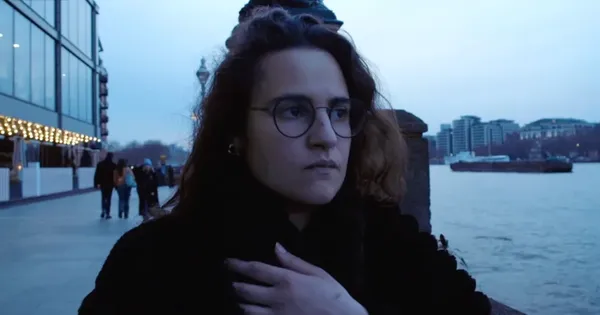
Director Marc Isaacs and writer Adam Ganz's Synthetic Sincerity revolves around The Synthetic Sincerity lab based at the University of Southern England, which licenses the films of Isaacs to understand those authentic human traits their AI characters are lacking. Blending documentary with fiction, the filmmakers ask timely questions about how AI will shape our future and its impact on cinema. Meanwhile, the film features an AI assistant, developed with Romanian actress Illinca Manolache, that shares a dramatically amusing arc with Isaacs.
Synthetic Sincerity is the third collaboration between director and writer. Beginning with The Filmmaker's House, which was also a blend of documentary and fiction, Isaacs responds to calls for his next film to be more sensationalist by shooting it in his own home. His cast are those people who come in and out of his life: builders replacing his garden fence, Zara, his Pakistani neighbour, a homeless man and Nery, his Colombian cleaner. Their second film, This Blessed Plot, is set in the small English village of Thaxted, which Lori, a young Chinese filmmaker, is visiting. She meets builder Keith (from The Filmmaker's House), who, after the death of his wife, swapped the hustle and bustle of London for village life. As Lori experiences life in the quaint village, she comes across the story of a former vicar who preached Christian socialism and learns that in Thaxted the dead continue to live alongside the living.
An Associate Professor of Ethnographic and Documentary Film at University College London, Isaacs’ previous works include Lift, Phillip And His Seven Wives, All White In Barking, Men Of The City, and Outside The Court.
In conversation with Eye For Film, Isaacs discussed human-inspired emotion, tech's takeover, and divisive politics. He also reflected on a mercenary-led future, Chinese soft power, freedom of expression, and more.
The following has been edited for clarity.
Paul Risker: How does Synthetic Sincerity align with your previous two collaborations with Adam Ganz?
Marc Isaacs: When we did The Filmmaker's House, we were looking at questions of documentary truth and performance and also the language of documentaries and what we the audience give ourselves over to. We were interested in pushing the idea of people self-performing much further in This Blessed Plot, and we called it a documentary fiction film pageant. We were looking at myth and the history of the town and how people identify with or use that at a time when we are scrambling around to belong to or to feel connected to something.
So, when we were thinking about what to do next, we had various ideas and at some point, in our discussions, we realised AI was becoming much more prevalent. And of course, it took those questions that we were already interested in about documentary, truth, and performance to an extreme level.
I remember watching a little clip that one of the AI companies posted as an example of how much progress they were making in their generative AI videos. It was of a guy sat in a café wearing a cap. He looked like a poet or something and was just staring into the middle distance. It was so convincing that I immediately started giving him an interior monologue or voiceover about what he was going through at that moment, or rather, what was going on in his head. It was interesting to think about what that means when we might get together and be in a room to watch images that aren't generated by a camera at all. And especially for documentaries where there's no interaction with a human on the other side of the camera. What would that mean? Both Adam and I felt compelled to explore that in a way that wasn't so doom and gloom and apocalyptic.
Adam had been working in the area of new technologies a little in his position as a screenwriter at Royal Holloway University. So, he'd had much more exposure to the world of AI and what was going on, and he knew the professor in the film from the University of Surrey. At some point, we had the idea that it could be interesting if people like that were given my documentary films to analyse. This would offer an opportunity to think about the differences between the human face and the AI face and what that all means.
Once we had that premise, it was a solid foundation to start thinking about where we could go from there without knowing exactly where we would go. So, we started the process of filming that first scene to see what would come of it.
PR: It's interesting how you begin by acknowledging the presence of the human face, because it compels us to think about the implications of AI, and why we love films. Is it the story and emotions it elicits or is it another human being or a collection of people sharing their creative expression?
The choices an actor makes, or the positioning of the camera are things that cannot and should not be casually overlooked. Some might argue that the end goal of telling a story is achievable with AI, but if we remove the human element, are we undermining the reason why we fell in love with cinema?
MI: That hits the nail on the head, because AI will be really good at making what is just a story, in which all those other things don't matter. So, all those action films and absurd stories that the industry thrives off will be fine and will be made by AI, because they probably can be. For example, The Lord Of The Rings and those battle scenes.
But when we think about some of those older films that have these epic scenes using thousands of extras, that's fascinating in itself. You're thinking about how the hell they have pulled that off and all the human work that has gone into it while you're watching the film. And extras died making those films because there was no safety on set. Knowing that and maybe even feeling that danger of epic human endeavour gives these films life.
I went to the cinema to see Werner Herzog's Aguirre, The Wrath Of God, which is shot like a documentary. It was probably shot by a very small crew with a bunch of actors on a raft in the jungle, whose relationship creates a certain feeling.
When we're making these films, Adam and I talk a lot about how working with real people that are performing versions of themselves is fascinating. You're in that space where you're feeling the weight of that real person, and you're enjoying the gap between them and the performance of the character. So, yes, the key question is what does that mean when it's just AI?
In some ways, it's absurd because it can never fill that hole, and it's always going to be a machine. But we're obsessed with it at the moment because it's still early days, and it's intriguing.
PR: When you ask the professor whether he's worried about AI, he makes an interesting observation about the need to democratise it. If history has taught us anything, it's that we lose control of technology. You only need to look at governments enforcing these social media bans for under-16s. And one only needs to think about what Oppenheimer created, that the government then used against the advice of the scientific community. History suggests AI will be monetised and exploited.
MI: It feels so ungovernable at the moment and that's also fascinating because, like you say with Oppenheimer, the way government took hold of it. Now the money is so big, and the temptations are so strong that it feels like the Wild West where it's not the government leading this. Instead, it's these tech guys that are pushing it, and where are they taking us?
This is where the film's so fascinating, because it starts off with a simple premise, but it really sinks into the nuance. Are we looking at a future where we think of AI taking over? Or is it not so much AI? Instead, are we looking at a future where democracy is under threat? Are we going to see a collapse of a certain order we know? And are we going to see a future governed/controlled by tech and non-tech companies that are almost like these mercenaries? Are we looking at a mercenary-based future? Is that the real threat and is AI the distraction, the master red herring or magic trick?
AI is such a great tool for those kinds of people. I don't know how much you use your phone, or you pick it up when you don't want to. We all know we're addicted to it and it feels uncomfortable. Sometimes you even want to throw it away, but you can't because you can't function without it.
PR: There's the temptation to draw moral lines and judge characters, and it's easy to see the professor and Lynn, who is his right hand at the lab, as gambling on our future. Lynn can be blunt and is driven by process. Meanwhile, the work of her colleagues to define different emotions feels like it's stripping emotion of its humanity. Then there's the chef who you go out and find to be part of the AI experiments who feels like he's objectified and treated like a lab rat at times. Is the challenge of the film to not get drawn into that judgement mode of us versus them; the good guys versus the bad guys?
MI: For them, it's a science, and it was interesting for us to think about who they are outside their work. I guess that's also fascinating because those people who work in the AI industry are a metaphor for all of us. In many areas, we're forced to put to one side moral and ethical questions. I teach at a university, and that's the reason why a particular question is in the documentary — China and its soft power within universities is fascinating. In this place where we're supposed to be able to talk and to have debates about anything, we've all accepted that there are some things you just won't bring up because of the power relationship and its consequences.
I wanted to include that question of complicity, which here is on a smaller scale, because it's such a fascinating subject in a film like The Zone Of Interest. That sense of knowing what's going on and choosing, or not even choosing, but just how complicit one is becomes really dangerous. That's the first time in my life I had to think twice about what one says. And even what films you show in university is a nightmare these days.
I remember doing a guest lecture at a film school and I wanted to show a sequence from a film that I love by David Perlov. He made a series of films in Israel between 1973-1983 called Diary (Yoman). This sequence I wanted to show is a good way to talk about filmmaker narration, editing, music, and documentary and diary filming. And at the end of showing that a student was really pissed off because Perlov is an Israeli filmmaker. This student didn't know anything about him. He was a guy on the left, and a good guy, but he didn't know anything about the films. The shutting down of those kinds of conversations is really dangerous and perhaps next time you wouldn't show that. And there was a discussion among other tutors about what can and can't be shown.
I met a Russian filmmaker who made a wonderful documentary film called Shards, about her and her friends filmed over a couple of years during the war. So many festivals will not show it just because she's Russian. The film's anti-Putin, and it's made from the inside and is able to show us something.
So, all of those questions of complicity and what we accept and what we don't accept, it's probably the same for those AI guys or people working in banks, who, when they leave the office at the end of the day, what's going on in their lives?
I'm in contact with a lot of young people who are out of university looking for work in the film world, and they end up having to make branded content for companies because that's where the money is. You can feel them trying to find meaning in it where there isn't really much meaning because the end goal is just to sell a product. The process of putting something together might be creative, but the end goal is meaningless. But that's all there is for them in some ways, and in your mind, you then start to justify to yourself that it's meaningful, which is quite disturbing and disappointing. Not that I mean I'm disappointed in them, but in the way that the space has shrunk so much.
PR: Is a part of AI driven by humanity's obsessive need to understand and articulate everything? Are we trying to fill in what we perceive as holes in our human limitations?
MI: It's the poetic and the imagination of who's Paul beyond the frame that I can see, which is something AI can never replicate. It doesn't have a subconscious or an imagination. It can't imagine in that way, but it can hallucinate, as people say.
And that need to rationalise everything is quite disturbing because it's absurd trying to measure the unmeasurable. It's almost like, for some people, being human is unsatisfying unless it can be perfected, which is absurd. I'm only interested in characters that are flawed, because that's what we are. Those people that hide that and present perfection, is really scary and worrying. And that's why AI will be so useful for institutions. When they want an HR person to fire somebody, they just present this thing on the screen that will only want to get to an end result that has already been decided.
Synthetic Sincerity is in UK cinemas from Friday 17, July.