 |
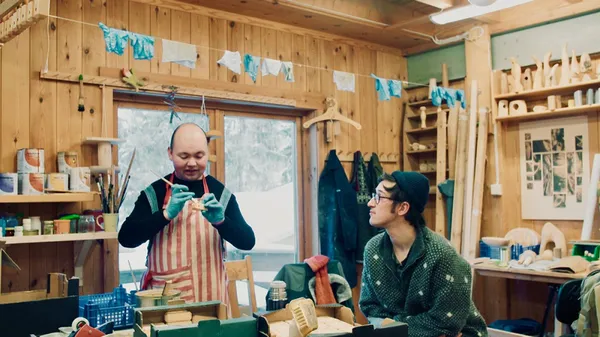
| Ola Henningsen and Lasse Kortegaard Kristensen in Being Ola |
Ola Henningsen is used to being underestimated. When, in childhood, he realised that his brain worked more slowly than other people’s, he began to understand that his life might take a different course. As an adult, he lives in the village of VidarÅsen, a supported community where people with intellectual disabilities can live productive lives, engaging in a range of different types of work, growing their own food, socialising and learning together but having their own rooms and doing lots of things independently. It’s there that he met filmmaker Ragnhild Nøst Bergem, which led to a collaboration and the production of a documentary about his life, Being Ola.
“It started 10 years ago,” Ragnhild explains. “I was a film student at that time, and I went to VidarÅsen, the village where Ola lives, and I made a short documentary from the village. I was really fascinated about the place because I didn't know that we had this type of village in Norway. Now I know they are around the world, a different type of lifestyle village, close to nature, together, using your hands. I fell in love with the place and also with the people. So two years later, when I was finished at school, I went back to the village and I wanted to film more.
“I didn't know if it would end up being a short film, a TV series, a long film. I didn't know anything. I just wanted to film more. Ola was one of the ones from the first documentary short film, so when I went back, I started filming with him again, and eight years later, it ended up being a documentary about Ola. I didn't know that when I started. That's sometimes the way with documentaries. You just start, and then you don't know where you’ll end up. But I'm really happy where I ended up.”
Ola has joined us for the interview, speaking confidently in English that is close to fluent. in the film we hear him say (in his native Norwegian) that he wants to find a means of expressing himself. I ask him if this film helped him to explain who he is to the world.
“I think it helped me open up to new people,” he says. “To become not so afraid of what people are going to think, maybe because of the reaction we have already got from people who have seen the movie, which is huge. It. It helped me keep myself up and keep myself going, I would say. So it's interesting.”
It seemed from the film that he can really do most things anyone else can do if he just does them a bit more slowly and takes his time.
“That's right. And if I have the support I need, I could do anything,” he asserts.
“We all need support in different things,” Ragnhild points out.
How did they work together and work out who was in control of different aspects of the film?
“I'm also the cinematographer,” she explains. “So when filming, it's only me being present over eight years. A lot of filming, a lot of hours together. We got to know each other really well and we are good friends still.” She looks at Ola. “I think we found a way when filming that I could ask you the questions I had and then you would answer – and just honest answers. And honest questions from me as well. But it was important that I didn't start with that the first day.”
“Also Ragnhild had become very understanding,” Ola says. “If it was like something that she wanted to have, but I didn't feel like I could talk about it then, she picked it up later on when she found it the right time to ask it. That's very nice.”
It's also obviously a picture of the community. Were both of them involved in deciding what to show? How did they decide what was important in exploring the community?
“I think I was most in control of that, with the editing process and so on,” says Ragnhild. “It was important for me to show the way that the village is like, and so I actually think that the village was like a character in the film when I edited. You have the main character and you have me as a character and you have the village and also you have Lasse, Ola's friend. So balancing those four characters was a thing that we had in mind when editing. And to show that this is also [a way] that you can live. I think that's really important to show. This is not for everyone because it's an alternative lifestyle, but I think you can have a really good life there. Don't you agree?”
“I really agree.” says Ola. “If you are the right person, you can have a great life there, but it's not for everyone. You need to be like social if you want to live there. There's no other way. You cannot just be on your own.” So when the film began, did either of you imagine that Ola would go on that adventure to visit Lasse?
“Never,” says Ola.
“No. Who would have known?” asks Ragnhild, smiling at him. “When I started filming again, I met Lasse. And actually one of the scenes in the film – the first scene in the film with you and Lasse – it's the first time I met Lasse. I really liked observing you two for almost two years, because your friendship was so nice. And then suddenly Lasse told me he was leaving. I was a bit sad concerning my film because I wanted to film more with Lasse and Ola, but I thought ‘Okay, that's the way.’ That's how they do it in VidarÅsen. People come, people go. And then one year later you told me ‘Oh, it would be really fun to visit.’
“When you told me that, I was like, ‘Okay, we have to do this. Maybe I can help this happen a bit sooner.’”
“I think that it was a great idea,” says Ola. “It was like such great relief because I knew that was the biggest problem for my mum, that I didn't have anyone to travel with. So when Ragnhild was asking my mum if she could join, then every problem was solved and everything was clear. I could go.”
“Yeah, and it was such a nice trip also,” says Ragnhild. “It ended up being an important part of the film. And actually we went back to Copenhagen, I think it was two years ago, because the film was in a festival. We had like a reunion there together with Lasse, watching the movie in a cinema with a lot of people, so that was a nice experience as well.”
I ask Ola if he still felt that he was making the trip on his own. Was he confident that he could handle all the things on the trip by himself?
“I believe so,” he says. “And now [there are] workshop leaders in VidarÅsen who believe that I could like do things that I was pretty sure I was not capable to do. Like a few years ago I was pretty sure I was not capable to do this kind of thing that I'm now doing, like teaching other people. Teaching people that maybe society thinks that are there to teach me, but I'm really like their teacher. For me it was difficult to learn at the beginning and now I'm teaching. It's crazy. It's like such a great feeling. But I'm not so self-confident. I still I think I’ll do something wrong, and still I need to ask my workshop leader if I do it that way he thinks I need to do.”
I assure him that everyone feels like that sometimes, and go on to ask how he felt as the project developed and became bigger.
“It's interesting,” he says. “I didn't think it would become so big, not at all. Young people’s comments on the movie helped. The first time I saw the movie I maybe thought this was a movie for people who are a bit older, because it was so so deep focus and the young people [would] think it was boring – there was stuff in my head like that. And then it was the morning after the première, a review on the like radio show where the radio host was speaking so, so warmly about the film. It's maybe not the main reason, but I think it had something to do with many school students coming now and thanking me for sharing my story. Those two things were totally connected.”
Does he think that the film will help other people in his situation, if it leads to people understanding them better?
“I hope, I hope. It would warm my heart if it does. It was one of the main reasons why I decided to join the movie. For other people also to share their story. For those who don't have words.”
His parents have now seen the film, he says.
“Lots of times,” he says.
“I think maybe 15 or 20 times,” adds Ragnhild. “That would be a lot around travelling with the film in Norway, and also at festivals outside of Norway.”
How do they feel about it getting released in the UK now? We're really looking forward to that journey,” she says. “We will be travelling over to England, to start at the Oscar Bright Festival. That will be huge for us, so we really look forward to travelling with the film.”
Being Ola opens in UK cinemas on Friday 3 April.