 |
| A Safe Distance |
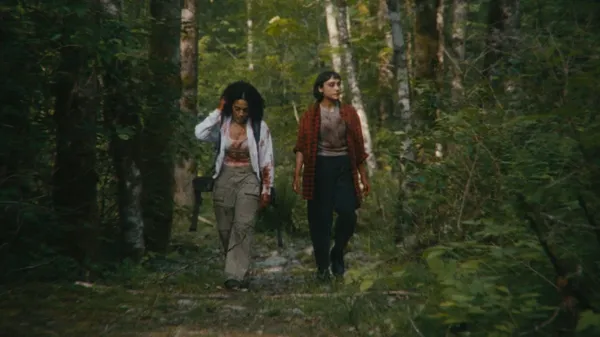
Canadian director Gloria Mercer’s feature debut, A Safe Distance, written by Aidan West, follows Alex (Bethany Brown), who finds her life taking an unexpected twist after turning down her boyfriend Joey’s (Chris McNally) romantic wilderness set proposal. Abandoned, she crosses paths with the mysterious Kianna (Tandia Mercedes) and Matt (Cody Kearsley), who live off the grid. When Alex accepts their offer of shelter at their remote campsite, she begins to explore an unexpected connection with the couple, which is complicated after learning they are fugitives.
Mercer’s short films include 2018’s All Happened Before, about a little girl and her babysitter’s day-long goodbye, 2021’s A Safe Distance, which follows two women trekking through the wilderness, trying to find their way home after a violent incident, and 2022’s Smoke Eater, in which a young girl watches a workday in the life of her firefighter mother.
Brown has appeared in episodes of V, Hellcats, Supernatural, Rogue, The Flash and The Good Doctor. She has also directed the music video for Marshall Williams’ I Ain’t Going Back, who collaborated as a co-writer on her short film French Girls. A Safe Distance is Mercedes’ feature début.
In conversation with Eye For Film, Mercer, Brown and Mercedes discussed the film’s personal roots, telling a story with a nuanced view about the pain and joy of life, and rediscovering oneself.
The following has been edited for clarity.
PR: Off the back of the film’s world première, how much stock do you put in the idea that the audience are the ones that complete a film?
Bethany Brown: As an actor, I don't have any control over the audience — how big the audience is or how they're going to take the information in. I only have control over the process of learning my lines, showing up, finding some emotional truth, and then really fighting for my objective as a character. So, I get very in the weeds with my approach and try not to get too, "Oh, I hope the audience likes this,” or “Oh, no, what if my character isn't likeable?” I think that hampers my willingness to tell the truth because there are moments where as humans, we're not likeable, it's not pretty, it's not fun to watch. And I don't want to stop myself from going there because I'm worried about who's going to be looking at me.
Tandia Mercedes: As Bethany said, as actors, we have no control over the audience. We only hope that the audience enjoys what we've made, but you don't really think about that as an actor. On set, you wanna be truthful, and the truth can be ugly. So, you wanna be grounded and let the ugly show itself when it needs to be shown. If you're just trying to be pretty the whole time, then it's not truthful, and the emotions will not come off as real as they should, because reality is ugly.
Gloria Mercer: It’s weird because I directed the film, but I also produced it along with the wonderful Nic Altobelli and Aidan West, and it's hard to take your producer’s hat off when you're directing. I was lucky because we had such a small cast and crew, and it was a friendly, intimate set. Even though we were stressed, and it’s hard making a movie, we were able to show up every day and just try to be there in the moment. Bethany and Tandia had these wonderful scenes, and I was able to just be there with them and not think too much about what was down the line. But then you finish shooting, and it does become nerve-wracking waiting for the audience to see it.
Having people watch the film, as I have been doing recently, after a long-time waiting, has been so crazy because a lot of people don't understand how much time passes in the making of a film. It goes through all these lives, and so, we're just starting this new life right now where people are reacting to it, for whom, it is really fresh.
The idea and the film have lived with us for a long time, and that we were able to have this intimate experience on set without a lot of oversight from others, which can be good or bad, was really good for us. And now, we're bringing other people in. Luckily, it is resonating with people in ways that are surprising and interesting and really gratifying.
PR: The film has its roots in the personal, but I’m always reticent about calling anything autobiographical, because throughout my conversations with creatives, even stories that don’t fall under this heading will have personal traces of the filmmaker. To what extent did the personal shape A Safe Distance?
GM: It definitely came from a personal place. When I was developing the idea with Aidan, I was saying that I wanted to make a movie about relationships. I had some shitty experiences that are really echoed in the character of Alex — a certain feeling that I had put all this time into something and then come out the other end feeling like I was just not happy with who I had made myself into during the process, and feeling like I’d stuck myself in a box. The way Aidan wrote the script and brought me into that, made him an amazing collaborator.
The first iterations of the script were a little bit mopey and a little angrier. Then, it clicked when he pitched moving it into the genre space and the lovers on the run story. But the movie also evolved into being more about, as Bethany has touched on before, women's joy, as well as those not so happy things. So, the film went from being a little bumpy or whatever you want to call it, to showcasing what that joy can look like, too.
BB: I always move from a personal place because I'm trying to move from truth and lived experience. It doesn't mean that I've had every single lived experience that the characters are going through, but, of course, I can go to the base emotions of fear, sadness, and joy, and what those things brought to me.
As women, we've been socialised to meet other people's needs before our own. And as we get older, it's this challenge of how do I meet my own needs, or what are my needs? How do I even become aware of them? Stepping into my power, what does power look and feel like? And how do I do that in a safe way, while making mistakes along the way? Then also exploring desire, because it wasn't something that was well taught to me in my youth or into my teen years. So, I had to figure out what desire looks, feels, and tastes like for me. And this film does a really beautiful job of doing the slow burn of female desire.
TM: Many of us can relate to the idea of being an afterthought in a relationship. The film beautifully shows Alex, the main character, grow from that and find new desires and new joy and essentially rediscover herself. When we're in long-term relationships, many of us can lose ourselves in them. We can lose our desires and our passions. So, it’s about finding a way to rediscover those things, whether it means ending that relationship or refining it within that relationship. The movie is an interesting way of showing a woman rediscovering herself.
PR: While A Safe Distance speaks to women and about the female experience, it's as much about the human experience. In a time when we’re losing our grip on nuance, your film honours the feminist perspective while not losing the broader human one.
BB: It's so nice to hear the male perspective and that you go, “No, no, no, this is just a human experience”, because so much of my life feels far more human than how it is pitched as feminine or female. I have so many amazing male friends, and we talk about all of this stuff: the nuance of expectations in relationships, of roles that are really outdated and archaic and wanting to get into a relationship where we can just play to our strengths, and also learn about ourselves along the way, where there's room to make a mistake. And if I make a mistake, it doesn't mean I'm 100% bad for the rest of my life.
I love that you're taking that away from the film because, for myself and in the character of Alex, I really wanted to explore that as well as the making of pretty big mistakes, and what that means. Or when will I be excluded from the group, when really, I want to be included, but I want to be authentic. I want to belong, and I want people to actually know me and for that to be okay. So, I'm really thankful that you shared that.
GM: I want to shout out Cody Kearsley and Chris McNally, the other two actors in the film, for just being such amazing collaborators. I hope that the film, if it's successful, is like you said, showing a female experience but also a human one, and also showing the men as fully fleshed out people and not just antagonists or obstacles. And it was really great in prep talking to both of those gentlemen about their characters, because both of them are sympathetic, even though we may not always sympathise with them. They are both grappling with these things, just as we all are. I think our collective understanding of feminism, toxic masculinity, and all these big things are always changing and have changed so much in the last few years.
BB: To double down on Cody and Chris, Cody's been my male friend for a long time, and he's taught me some of the most about reimagining what relationships can look like and what they can be. He has literally challenged me as a woman to figure out my needs and my wants — my actual desires. And I went to acting school with Chris, so I've known him for a really long time, too.
Paul, you said it becomes very black and white. It’s like, oh, men, therefore, toxic masculinity, and I'm like, no, these are some of the least toxic masculine men, while being very beautifully masculine. And they hold that masculine space with grace and power, and they’re really clear about their goals and achieving them, while encouraging other people to do that too. And they also embrace their femininity, which isn't a bad thing.
TM: I love how in the movie, both of the male characters aren't inherently malicious or evil. It just shows how they react isn't necessarily the best way, but neither of those characters intend to be evil. It just happens and that shows the human connection too, in how different people react to things. And sometimes, how you react to something can be a big mistake. And then hopefully, both characters grow and learn from that. But the movie shows the subtleties that they aren't inherently bad people — it’s just they've both made mistakes and reacted poorly to things.
BB: And in that same breath, women aren't inherently good people.
PR: The spatial is an important consideration in the film, and as much as the characters are transforming, so is the space. An interesting line of enquiry is how the characters come to define the space, and whether the spatial has any autonomy.
BB: When you said that I just saw Alex living in this small house, with this mortgage that's crushing her. It's like carrying this heavy backpack through life filled with all these expectations of how it's meant to go. And then you put her out in this forest, which is this big, vast space where animals thrive, and humans are technically animals, but we just really suck at it. Bears are really good in that space. Squirrels are nailing it. But Alex is not great at all. So, it forces her to get primal. It forces her to figure it out and to find that, if it's rage, okay, its rage, because it's really necessary when you have that vastness of space. It’s like if you put a goldfish in a small bowl, it stays small. If you put it in a larger aquarium, it gets larger. And I think that's exactly what we're seeing from Alex.
GM: The character of Alex has built these walls in her life, but in this new place, there is an immediacy that she just has to react. And not just react, but act in ways that are so immediate. She can't buffer like she has in her life, and so, it was fun to play with that.
TM: The literal setting of being in a forest, essentially for the whole movie, can feel really welcoming and cosy, but it can also feel like this vast scary space that suits the film as well.
A Safe Distance premièred at the 2026 SXSW Film Festival.