 |
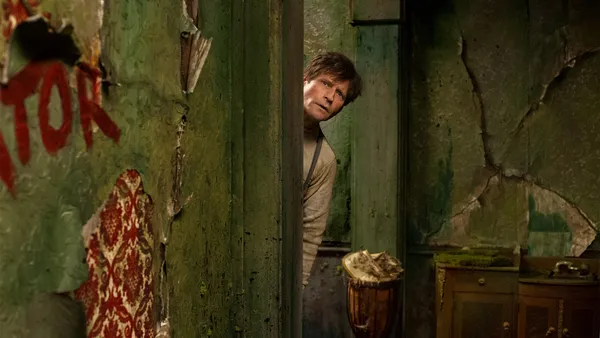
| Mr. K Photo: courtesy of Doppelgänger Releasing |
Director Tallulah H Schwab's Mr. K has an undeniable Kafkaesque vibe. It stars Crispin Glover as the down-on-his-luck travelling magician Mr. K. After stopping at a hotel overnight, he awakens to discover that he cannot find the exit. As he searches for a way out, he hears strange noises and encounters a strange collection of inhabitants. While his search appears to be hopeless, his perseverance leads to an unexpected discovery.
Glover is known to audiences for his diverse onscreen roles, especially George McFly in Back To The Future. He has worked with David Lynch on Wild At Heart, Jim Jarmusch on Dead Man, and Oliver Stone on The Doors, in which he played iconic real life artist, Andy Warhol. He has starred in Lasse Hallström's coming of age drama What's Eating Gilbert Grape, Goen Morgan's psychological horror Willard, and Miloš Forman's The People vs Larry Flynt.
In conversation with Eye For Film, Glover discussed his storytelling journey, the similarities between Kafka and Chekov, and the intensive collaboration he shared with Schwab.
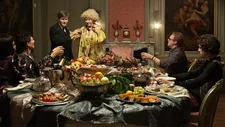 |
| Crispin Glover, Sunnyi Melles and Fabian Jensen in Mr. K Photo: courtesy of Doppelgänger Releasing |
Casper Borges: In researching for the interview, it struck me that storytelling is such an important part of your life.
Crispin Glover: Well, the books that I tour with, that are profusely illustrated, are all stories. I started creating them in 1983 when I was 19. I had taken old bindings from the 1800s and reworked. Sometimes I would utilise words from the books, but I often was using illustrations or drawings from books from the 1800s and turning them into different books from what they originally were. There was a surreal game playing that I realised later on that I had coincidentally done on my own. That was something that the Surrealists imposed upon themselves. And I've always had an affinity toward the Surrealists anyhow. But I didn't know that I was actually doing something that was prescribed by them at the time. I just did it more instinctually.
So, I originally just made the books for my own pleasure. Then I showed them to people and I finally ended up publishing. The first book I published was a book called Rat Catching, and I published that in 1988. It wasn't the first book I made. I was 24, and I did it in the correct fashion because to become a publisher in the United States, you have to have an RR Bowker identification number. RR Bowker is a company that publishes a book called Books In Print, which before the internet was available, that was how people would get books. They would go into a bookstore and say, "Oh, I heard there was a book by Crispin Glover called Rat Catching." Then the person looks up the author's name and title, and then they find the ISBN number. They then contact RR Bowker who gives them the publisher's information and how they can get a hold of the book.
CB: So, walking the path of a professional author, have you found ways to make it your own unique journey?
CG: People said to me that a published author usually does an appearance in a bookstore with book readings. But because the books are so profusely illustrated, and the stories move along with the images, it would not make much sense if I just read from the text. So, I knew if I was going to do this, I'd have to have slides of the book. And it wasn't until 1993 that I was invited up to a film festival in Olympia, Washington. They were having a retrospective of some of the films I'd been in up until that point, and I realised this was a good time to perform the slideshow.
I picked eight of the 23 books I'd made altogether in that time period, that I felt would well represent. And at that time, it was 35 millimeter slides with the two carousels and I held corded remotes to change the slides. Somebody had to change the carousels in the midst of the show, but now it's much easier because it's done from the computer. From that first slideshow, people really liked it, and I was invited to perform elsewhere. I realised this would be something I could use to distribute my own filmmaking, because I was already interested in making my own films. I started shooting a couple of years later in '95.
I recognised that I was dealing with taboo subjects that were not corporately friendly, and this would be the proper way to have a direct reach to the audience. And happily, it has been more than 30 years with the slideshow. So, it has worked out well. I would never have anticipated that. The books were not originally going to be books I published; they were not going to be books that I performed in front of people. But it has all ended up making sense, and I've published five of the books altogether. Four of them are in print right now and I'll keep publishing more of them. They end up being a big part of how I recoup on the films.
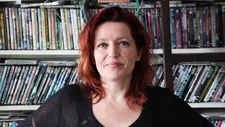 |
| Tallulah H Schwab Photo: courtesy of Doppelgänger Releasing |
The last book I made was in '92, although I've done things specifically for newer slideshows. I make each slideshow presentation different for each film. In the second film I have a book in it that I had gathered images for in the Nineties that I had not physically placed in a book. Most of the books were physically made, but this one, I never physically turned it into a book, but I knew it would work very well as a performance and it helped make that second slideshow. And something similar has happened with the new slideshow. There's a book that I had made that I've changed a little bit to make it work for the slideshow — not the visual images, but the story and the way I tell it.
And that energy I originally had that went into making the books has gone into the filmmaking, which has been very energy intensive and time consuming. I'm proud of the books and I'm proud of the films. So, they're different but they correlate to each other. And it does have to do with the storytelling and specifically the surreal aspects of the storytelling that I personally value as an audience when I'm looking for movies to watch. I rebel against being dictated to how I'm supposed to think and feel about something. Whereas, if a filmmaker lets the audience put things together in their own way, I can enjoy that type of filmmaking.
CB: Does Mr. K do that in the film form?
CG: Yeah, it does. And that was part of what I liked about it. I could tell when I read the script that there were elements that were open for interpretation and that is valuable for sure.
CB: How did you go about breaking down the central character of the film?
CG: This particular character was written in such a way that it was interpretable and it was stated that it was influenced by Franz Kafka, who I read a lot of when I was 15-years-old. He was my favorite author until I read Dostoevsky in my mid-20s, who became my favourite author. I still love Kafka and I had a very specific voice in my head when reading Kafka. So, even in the visual images that have been sent to me, there was a lot to indicate that it was influenced by Kafka.
So, I have had a specific literary idea in my head, which I realised about midway through shooting, that Tallulah had in her head. She had been highly influenced by Orson Welles' film The Trial, which was an adaptation of Kafka that I had seen many years previous. And then I went back and looked at it because there was a discussion about tonality where Tallulah was saying something to the effect of "You're playing this like Chekhov." And I said, "Well, what literary element do you think it should be played like?" She said, Kafka, but to me, I would play Kafka the same way I would play Chekhov. And, so then I started to realise that she was thinking about the way that Anthony Perkins was instructed by Orson Welles to play Mr. K in The Trial. And so, I went back and looked at it.
I love Orson Welles' filmmaking, and even his movies that I don't find to be among his best, he's still interesting to me. When I saw the Trial, there were aspects that I liked, but then there were things that I did not agree with.
There is a humour in the literary Kafka, but it is of darkest kind because the overall writing theme of Franz Kafka's literary works has to do with a disregard of human elements, psychologically, physically, or whatever it is. And then there's a protagonist that as the reader you become attuned with. And the world is terrible. There's a misunderstanding at all times that you can never figure out, even when you have finished reading the story. But there is a humour in how horrible it is, that's not played up.
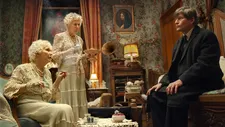 |
| Mr. K Photo: courtesy of Doppelgänger Releasing |
That's why I would say Chekhov and Kafka would be played the same way, essentially. But what Orson Welles had instructed Anthony Perkins to do, and you can see it in the nervous performance, was to play it in a comedic way where everybody's suspicious. The idea was that he was guilty of all things, is apparently what the direction given according to Tallulah. But that to me was not Kafka. It was not the voice I had in my head, because the characters are not nervous. They're confused but they're not showing the confusion. Instead they're just dealing with it, and part of the tension of Kafka is trying to figure out what's going on. You get pieces of information and clues so you can try to figure it out, but whatever it is, it's not good. The information you're getting doesn't lead to a happy outcome.
If somebody's showing nervousness, they're revealing something that's open, and then the characters or the situations would infiltrate and tear it apart. So the characters in Kafka are often masking the terror that's going on. So, the voice of Orson Welles directing Anthony Perkins didn't resonate with me and what I had understood Kafka to be. So I didn't think about that when we were starting the film. But for whatever reason, it did resonate with Tallulah and she was thinking that I should be playing it that way. But I'd already set down two weeks of work, so I couldn't shift with that. These were the long and intensive discussions to try to make it work. But it seems to have ended up working out okay.
CB: Is the filmmaking process about giving up control or is it about finding a way to get on the same page whereby you are in synch with one another?
CG: Tallulah and I definitely had a lot of discussion throughout about the tonality, but I would say 98% of the time we were aligned. There were occasional differentiations, like at the end where there was something I had an interpretation for. It was important for me to get it because there was an emotional aspect that I wanted to have at the very end, which is in the actual film. But in order to get to that point, you sometimes have to trick yourself as an actor into having a thought process that has a truth to it. And there was a thought process I had that Tallulah liked the outcome of, but she didn't like the intermediary part. But if I didn't do the intermediary part, I couldn't get to the final part, and I don't think she really understood that. And I couldn't really express it because there are certain things you have to have in your head, and if you express them too much, then it starts to become performative in a way.
If you don't have this kind of true secret, then there becomes an expectation of what you're going to do and you have to be able to be free to not necessarily know what the outcome is going to be. So, that was a very particular thing. And the median part that I'd gotten to, the part that she liked at the end is not in the film. And I still think it would have been helpful to the film, but it doesn't negate any of the elements of what I like about the film, being that it's open for interpretation. I'm glad that it got to the point that it did get to and that end part is in the film. I think the median part would have also been helpful. But it's okay. The most important thing that I always liked about the screenplay was the interpretable aspect and the fact that remained, that is good.
Mr. K is playing In US cinemas now. For more information on Crispin Glover's projects and his upcoming UK tour, visit www.crispinglover.com