 |
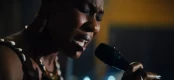
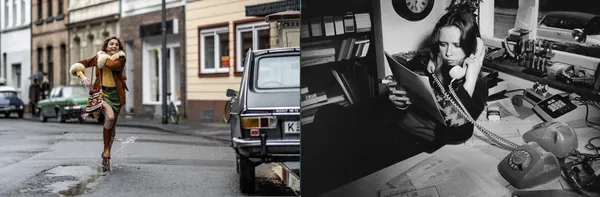
| Mala Emde as the energetic and determined Vera Brandes in Ido Fluk’s fast-paced and suspenseful Köln 75 and Vera Brandes herself, the fearless teenage booking agent at work (at her first office Kölner Weg) in the Seventies. Photo: Zeitgeist Films / courtesy of Vera Brandes |
In the first section of my conversation with Vera Brandes we discuss how she felt about Ulrich Tukur playing her father, Jördis Triebel (Christian Schwochow’s West) as her mother, and the immediate bond she felt with Mala Emde portraying her younger self. Susanne Wolff (straight from playing Empress Sisi of Austria in Frauke Finsterwalder’s delectable Sisi & I) is Vera at age 50. Whereas the last-minute piano debacle comes close to real-life events, Vera explains how the convincing of Keith Jarrett (John Magaro of Kelly Reichardt’s The Mastermind) went a different route and included some inadvertent swearing she had picked up from Miles Davis.
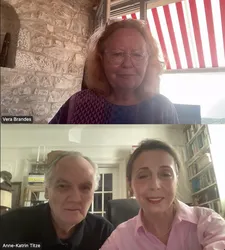 |
| Vera Brandes with music producer and 99 Records founder Ed Bahlman and Anne-Katrin Titze on watching Mala Emde play her: “I said, Mala, you're doing a great job. It's all yours now.” |
From there we are joined by the incomparable Ed Bahlman (ESG - Bush Tetras - Liquid Liquid - Glenn Branca - Stephan Eicher - music producer and founder of 99 Records) as we discuss Michael Chernus’s impish performance (as Jazzworld critic-at-large Michael Watts) and the false start by The Cramps. The John Lurie Lounge Lizards connection to Vera’s label VeraBra Records and Garret Linn's documentary, John Lurie and the Lounge Lizards Live in Berlin 1991, recorded at the Quartier Latin Club, and so much more also came up.
Ido Fluk’s Köln 75 tells the story of the fierce journey by teenager Vera Brandes, self-made concert promoter, who clandestinely at first out of her father’s dentist practice, arranged an improvised concert by Keith Jarrett at the Cologne Opera House (following a performance of Lulu), that was to became the best-selling Jazz solo album ever recorded.
From Greece, Vera Brandes joined us on Zoom for an in-depth conversation on Köln 75.
Vera Brandes: Hello!
Anne-Katrin Titze: Hello! Hi! Good to meet you! Where are you right now?
VB: I'm in Greece.
AKT: I see the wall behind you, which looks fantastic.
VB: Well… Let me show you… It's still summer here [on September 19].
AKT: Oh, wow! Oh, my, what a view!
VB: Pretty fantastic, yeah. I would say it doesn't get much better. I'm in the very south of the Peloponnese, with a car, like, two and a half hours to Kalamata, and one hour to our valley. It's a famous valley in Greece. Because it was the place from which the liberation from the Turkish occupation happened. And so it has the reputation of being the village of the unbreakable people.
AKT: That's a good reputation to have. Apropos unbreakable, let’s start with the portrayal of your father. In the film he is played by Ulrich Tukur.
VB: Yes.
AKT: Such a fantastic actor. I was blown away by his performance. I was wondering how you felt about this performance, and if it matched somewhat your own issues.
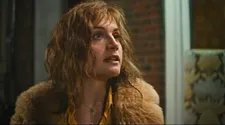 |
| Vera Brandes on Mala Emde: “Mala and I have such a special relationship.” Photo: Zeitgeist Films |
VB: Well, I tell you, I came to Cologne, to the set, to the big film production company. If you would sit on the roof of that new building, you could see my parents' house. I mean, it was that close. And so this was the night before the shooting started, and the whole crew was there. He [Tukur] had not arrived, but Mala [Emde] was there, and lots of the other actors. Anyway, big party, great evening. Then the next day, they started shooting in that villa that they rented, which was my parents' home, not the real one, but the shooting place.
And I was sitting in the kitchen on a monitor, watching them do the scene where Vera comes up late at night, takes off her shoes, goes silently to the first floor, hoping nobody would hear her, and then the light goes on, and here he is, screaming, yelling. And it really crawled up through my feet into my bones, you know, every repetition of the scene, it got worse. I think after the third or the fourth I dropped down my headset and sneaked out and just said to Sol [Bondy, Köln 75 producer], sorry, guys, I gotta leave. This is so well done. It's like my mirror neurons are dancing polka! Thank you! I can't take this! It was like in a break between two takes, and I just briefly looked at Mala, and I said, Mala, you're doing a great job. It's all yours now. Bye!
AKT: The scenes with the father also form the frame narrative of the movie with Susanne Wolff playing you. I don't know if you've seen Frauke Finsterwalder’s fantastic Sisi & I. She went from playing Empress Sisi of Austria to playing you!
VB: Whoa. Wow, wow, wow. Well, I can only tell you that I was not able to speak to Ulrich Tukur on the set ever after I saw him play that. I just said, don't even come close to him, because what the amazing thing is, he looks like the twin brother of my living brother. They are the same age, they have the same kind of body language. Really, if you would see two photos of them next to each other, it's like twins. And my brother kind of took the role of my father of doing everything they possibly could to make me change into what they think I should be, and … brutally so. I mean, with all measures you can possibly imagine, psychologically, economically, politically… Even physically, like, oh my gosh! I mean, this is so real.
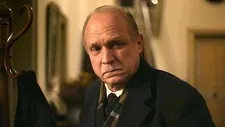 |
| Vera’s father (Ulrich Tukur) |
I met Uli Tukur, of course, at the première in Berlin, at the Berlinale. I'm so on my knees, for his performance, and I think all of the actors did such an amazingly great job, and particularly Mala. And Mala and I have such a special relationship. She sent me a WhatsApp message a few months ago, when she embarked on her next project, and she said, you know what, Vera? It's the strangest thing on earth to play somebody else but you!
AKT: That sounds like a very special connection. What about Jördis Triebel, who plays your mother?
VB: Oh, she was really, really so close to what my mother was like. It's like all of them, as if they were magically guided by some force that I have no clue what it is and where it comes from, but it's so amazing. Just the guy, Alexander Scheer, who plays Manfred Eicher, I told Alexander, you gave that role in the movie, that personality, that persona a shine that the original never had. In real life, Manfred is and was something that we in Germany would call “sperrig” [unwieldy]. Rusty, you know, like edgy, and raw on the surface, and definitely raw on the inside. The guy's got great ears, apparently, but, Jesus, I mean, social skills? None. Close to none.
AKT: The first time I heard about the film was actually from my stepsister, Veronika, and my brother-in-law, Johannes, who went to an outdoor screening inside a monastery court yard in the summer. They saw it, and they loved it, and were especially impressed by the piano tuning scene, and the organizing of the concert piano. They adored that. Did the film capture how it felt to you?
VB: I mean, that's the core part of the story, the piano. It was exactly as dramatic, and the only scene in the movie that is a different scene than the one that really happened in real life was how I convinced Keith [Jarrett] to play. In the movie, it's inside of the hotel, with Mala knocking on his door until he finally lets her in, and she has this conversation, which I think was necessary for the film to make things clear, and what this was about. In reality, that scene was happening in a car.
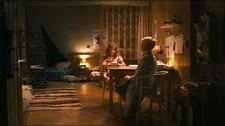 |
| Vera Brandes (Mala Emde) with her mother (Jördis Triebel) Photo: Zeitgeist Films |
Actually, half in and half out of a car with an open door, me sitting on the edge of the door, trying to be on the same height with my eyes as Jarrett was, and my English was not very good at that time. I was probably much better than an average pupil would speak English after having learned English for years in school because I had already a lot of contact, and Ronnie Scott corrected every mistake I made, because he had that ambition, and he wanted me to speak perfect English. And I had overheard a conversation backstage, Miles Davis talking to his musicians. And there was a word that appeared in that conversation, in every sentence.
I had no clue what it meant, but it impressed everybody, and so that’s what I said to Keith in that car when my brother was actually driving him back to the hotel. I knew if the guy is leaving now, he's leaving, it's over, so I saw that my brother was opening the gate to the parking lot, and I flew down the stairs, and I opened the door, and I put myself next to Jarrett, and I looked into his eyes, and I said, Keith, if you don't play tonight, I'm gonna be truly f***ed. And then, like, I paused for a second and I said, and I know you gotta be truly f***ed, too.
He stared at me like, I don't know what he thought I was at that point. I mean, certainly not this 18-year-old blonde, blue-eyed girl that looked like Brigitte Bardot's little sister talking to him like Miles Davis. After a stretch of three minutes with none of us blinking, he said, okay, in this Miles Davis voice, I'll play, but never forget, just for you. So that was it, he played, but yeah, that was definitely the shortest conversation I ever had with a musician, and the most effective one, too.
AKT: Without knowing exactly what you were saying!
VB: Without having a clue what I was saying!
AKT: I have someone here who would like to say hello, who knew John Lurie. Ed Bahlman, music producer and founder of 99 Records.
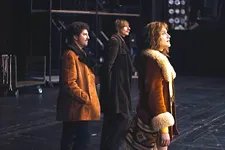 |
| Vera Brandes (Mala Emde) with Keith Jarrett (John Magaro) and Manfred Eicher (Alexander Scheer) Photo: Zeitgeist Films |
Ed Bahlman: Hello, Vera!
VB: How are you doing?
EB: I'm great. And you?
VB: Well, I couldn't be better, thank you for asking!
EB: Okay, yes, regarding John, I watched Garret Linn's documentary on the concert [John Lurie and the Lounge Lizards Live in Berlin 1991] that you put out on your label VeraBra Records, the 1991 live.
VB: Yeah! We did a double album [Lounge Lizards - Berlin 1991 Part I & Part II]. It was recorded in Berlin at the Quartier Latin Club.
EB: Yes, perfect, very nice, very good, yeah. I knew the original Lounge Lizards lineup from the Seventies. I'm here to bring in the Michael Watts character, played by Michael Chernus, who's a doll.
VB: Okay!
EB: Every role he plays, he just gives something extra to it.
VB: Fantastic, isn't it?
EB: Hilarious, hilarious to hear the first music after the Ronnie Scott Trio scene. The Cramps [recording I Was A Teenage Werewolf] when Michael Watts explains to the viewer what a false start in the recording studio is. I knew them very well, too, from the Seventies and early Eighties and carried their records in my shop, 99 at 99 MacDougal Street.
VB: Whoa.
EB: What a quick setup in the film, hearing Lux [Interior, the vocalist] screaming at the control room when they stopped the tape and everything like that. Does the whistle have anything to do with what Michael Watts says about Bird [Charlie Parker] and Miles [Davis]?
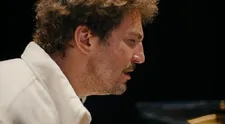 |
| Keith Jarrett (John Magaro) performing at the Cologne Opera House Photo: Zeitgeist Films |
VB: Yeah.
EB: Is that part of it?
VB: We have to ask. I can't answer this question, unfortunately.
EB: But the whistle is yours, though, at the very end of Köln 75?
VB: That whistle! Yeah. Okay, at the very end … well, we [Vera, Susanne Wolff, and Mala Emde] were asked to be whistling, and I couldn't do it, and this is why I said, this is a complete disaster.
EB: You sent a photo of yourself with Andreas Vollenweider. I met him in the early Eighties in Zurich.
VB: Fantastic! That's when I started to work with him, yeah.
EB: I started my record label in 1980 out of the shop. We sold only independent music, reggae, and African, and imports from Europe.
VB: Wow, fantastic.
EB: I started with just the first new releases from the UK in June 1978. I air freighted them over through Rough Trade. So, if a record came out Friday in the UK, I had it in the shop on Saturday. At that time there were a number of musicians and bands in New York who could not get a recording deal. I had no intention of starting a label until I heard that they were told to make demo tapes on their own to be considered for a release by those small labels in the UK. I knew the musicians on the scene. I had seen them perform and they were customers of mine. So I thought, this is ridiculous, I'll start a label.
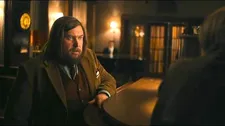 |
| Jazzworld critic-at-large Michael Watts (Michael Chernus) Photo: Zeitgeist Films |
VB: Whoa! Amazing! This is how I started my first record label. It was with Ian Carr's Nucleus. They were assigned to a British record company, and they wanted them to play things they didn't want to play. And I said, you know, nobody should be asking you to play something you do not want to play.
EB: We did a couple of features with June Millington, who co-founded [with Ann Hackler] The Institute for Musical Arts in Massachusetts for young children to learn.
VB: Oh, how great.
EB: She co-founded the band Fanny in the late Sixties, got signed to Warner’s Reprise Records, and they were telling them how to record their songs and dress. Totally destroyed their career. At Lincoln Center, there was an American Songbook: Singer Outsiders Tribute to Fanny, they were honored. And the band I produced and discovered, ESG, performed at Lincoln Center in David Geffen Hall for that occasion. They were four Black sisters from the South Bronx who never had access to the club scene in New York City. They were on my label 99 Records. I could book them. I also booked the bands I worked with, and did their live sound.
VB: Great, amazing! Amazing, amazing, amazing!
EB: I understand what you had just said, because the A&R companies, Warner Bros., Columbia Records, were coming in my shop before I had a label, and asking, what do you have new from the UK that's unsigned in the US? I had two turntables with a mixing board, so any customer could hear the latest releases. The music wasn’t as yet heard on the radio or anywhere else in the US until the club DJs purchased the records from 99. There was no other way they could hear it.
 |
| Vera Brandes on getting Keith Jarrett to perform: “That was definitely the shortest conversation I ever had with a musician, and the most effective one, too.” Photo: Vera Brandes |
VB: Yeah, this is how records were sold those days.
EB: Yeah, exactly. We were customer friendly.
VB: Wow. Well, I'm really happy you're still around. It's great to talk to you.
EB: Do you know the documentarian Oliver Murray? Do you know his work?
VB: Nope, I do not.
EB: He did a film on Ronnie Scott, called Ronnie’s.
VB: Oh! Oh, fantastic!
EB: Yeah, and also, They All Came Out To Montreux. About Claude Nobs, the founder of the music festival.
VB: Yes, my favorite place on earth, I mean, in terms of jazz festivals, yeah.
EB: He's a really good director, we also did a conversation with him. You have a terrific spirit!
VB: Thank you! You two, too!
AKT: Thank you!
EB: And maybe see you in New York!
VB: Yes! Have a great one! Bye-bye!
Köln 75 opens in New York on Friday, October 17 at the IFC Center. There will be a post-screening Q&A with Vera Brandes, Mala Emde, Michael Chernus and Ido Fluk following the 6:45 show. And on Saturday with Vera Brandes, Mala Emde, and Ido Fluk following the 6:45pm show.