





 |
| The Boy With White Skin |
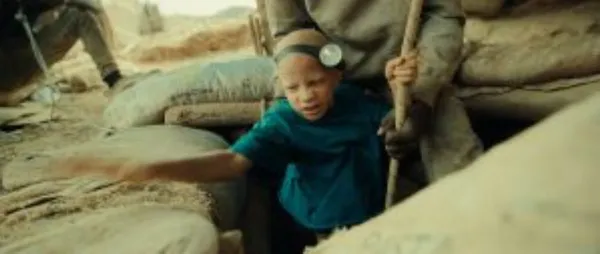
An immersive short film capturing a transformative episode in the life of a Senegalese albino child, Simon Panay’s The Boy With White Skin has qualified for Oscar consideration, and it’s easy to see why. It’s a powerful, emotive piece of work, cleverly made, and it also provides an intriguing insight into a centuries old ritual. When I met up with the director he began that story by telling me something of his own.
“I basically made films in West Africa since I was 18 years old. I didn't make film school and started right away after high school to make films which were independent documentaries, in Burkina Faso mostly. I really enjoyed it. I discovered the world of artisanal gold mines in 2015 for my documentary short film Nobody Dies Here, which was shot in a clandestine gold mine in Benin, and it was really a fascinating experience, for many reasons. It's a very special world with its own rules, its own beliefs.
“I really wanted to understand this world, like why people come there and why people stay even if after 10 years they don't find anything. And the trap that catches them for years and years and the addictions that comes with it, with the adrenaline. The addiction to adrenaline, to find gold and hopefully change your life if you find the nugget – which never happens. It really fascinated me to understand the human aspect behind that, to understand why people can't leave.
“During that project we got arrested after only eight days because it was a very corrupted place and we got unlucky enough. We witnessed, by extreme unluck, the right hand of the Ministry of Gold of Benin coming to get his bag of money from the boss of the gold mine. We were there with cameras at the exact moment he came for money, and the mine was supposed to not exist because it was clandestine, but yet corruption is corruption. So we got arrested the next morning at 5am and they destroyed material and an SD card, but we still managed to do the film.
“I was pretty frustrated to film only eight days and to only start scratching the surface. And I felt it was still very artificial. So that's why I did a long term film documentary afterwards. That took me five years, and two years filming in the gold mine in Burkina Faso. It was really fascinating and it was a real dive into this world, staying every day for two years at the mine and really being there with the people to really understand, almost anthropologically.
“The belief behind this world is fascinating. They consider gold as a beast. A living creature that you need to hunt, and they picture themselves as soldiers or hunters rather than gold diggers. It takes a lot of time to really understand how it works, and the more I dive into this world, the more fascinating it seems to me. I witnessed during this feature documentary what would then begin the adventure of The Boy With White Skin. I witnessed the fact that they bring down albino children in the underground galleries and asked them to sing.
“I was not allowed to film it in documentary because since it's a magical ritual, they were afraid that the presence of the camera would somehow break the magic. But still, I found it quite fascinating just to witness with my own eyes, and I wanted to yet relate that. So I made it as a fiction short film, live action.”
I ask if it’s one of those things where people think that if they've put a certain amount of years into it already, then they're wasting those if they don't keep going and find some gold, so they feel trapped. He says that is the case, but there’s more.
“The trap with artisan gold mining is, I mean, you will always pretty much find a little bit of gold, but never enough. It will never change your life. In every bag of rock, you will earn, let's say, between three and seven euros, something like that. There is no nugget. Geologically speaking, it doesn't exist there. You have nuggets in North America in some areas, but not there. So the trap is basically the more you stay and the more you sacrifice – because you lose people, you lose friends in accidents. It unfortunately happens all the time. And you also lose money, because on the gold mine, everything is expensive because it's far away.
“The bosses don't pay you to work for them, but they will give you bags of rocks at the end of the month. They will take the majority and the rest will be shared between gold miners. But anyway, it costs more on the gold mine to eat than what you earn from your bag of rocks. So after, let's say, six months, you owe your boss a lot of money because he lends you money to buy food from him. It's a mafia and it's very dangerous if you want to walk away with a debt to those people, so you are basically trapped without realising it until it's too late.
“Also, they believe that maybe their lucky day is tomorrow or next week or next month. So like every addiction – it's the same with gambling, exactly the same – you have the addiction to adrenaline, and the sad part of it is that most of the time for gold miners, the fate is death, for many reasons. Most of it is dust and exposure to mercury. We think about collapsing, we think about stuff like this. Of course, it happens, of course, a lot. But dust, basically, they work in dust all the time, and at 30-years-old they have lungs like a 60-year-old. They cannot treat that, so they die for that reason, very, very young.
“When they find gold, they break the rocks, so they get dust with it and then, I mean, gold is heavier than rocks, so it catches some gold, but then you need to separate dust from other stuff to sell it, because you need to sell pure gold, of course. And so you use mercury. You burn it. It's crazy to look at it when you know how dangerous mercury is. When you set it on fire, even briefly, you can lose months in seconds, just breathing it. It's very volatile.
“So you are on a gold mine, there are lots of pits, and the wind can take the mercury anywhere. It doesn't smell of anything, but if the mercury gets in a tent and someone is sleeping on the floor, he will breathe mercury and can lose years just sleeping, far away from the people burning the mercury. It's extremely dangerous. But they have no other choice to separate gold from the rest.”
We discuss the ways that albino peple are treated in different parts of Africa.
“You have in all the African continent. In a lot of countries there are very different beliefs and most of those beliefs are negative. They believe that the albino will bring bad luck to the community or the village or family, so sadly, most of them are killed the day they are born. The family never talk again about it, and it's just a plus one in the data of kids born [dead] after labor, so police don't do any investigation. The big majority of them are killed the day they are born. But for those who live, life can be complicated. Of course, in some countries you have kidnapping and some albinos are murdered. You hear very terrible stories. And they cut them in pieces and sell bones.
“They used to say, in countries like Tanzania, an albino is worth $80,000 US dollars. So in a country that when you look at the medium salary...” He shrugs. “People, desperate people can have that in mind. So albinos know that they are always in danger and they have to think about that.”
He recalls a story that he thinks comes from Mali, about a god who created albino people, thus infusing them with magical power.
“The interesting thing is that in general they are seen as bad luck or something negative,” he says, “but in the gold mining community, it's really the opposite. They are seen as half gods somehow, because they believe that the song of an albino will attract the gold. So they are willing to pay a lot of money to the people that bring those kids from gold mine to gold mine. And in some gold mines like the one we shot, you have thousands of pits. So a lot of bosses and gold miners are willing and ready to pay for that.”
I note that the logistics of making a film like this would terrify most people, and he laughs as if he now knows that he should have felt a little of that terror from the start himself.
“Generally when you write a story, you try not to think too much about ‘Is it possible?’” he says. “We used to say ‘Okay, we will see later. First let's write the story we want.’ But then of course, when were in preparation, the financing was here and we said ‘Okay, let's move on with production,’ we sat down with all the team and the crew and the producers in Senegal too, and we asked ourselves, ‘How are we going to do this film? Basically, half the film is set underground. How are we going to make it?’ Because I did go down, for my documentaries, to film in underground galleries, but here you have actors and you have a crew, and you cannot risk their lives and bring them in dangerous places.
“We do fiction, we do cinema. We have to make a trick, but the trick is expensive when you have a short film budget. The idea to recreate it from scratch in a studio was impossible and way too expensive for us. So we looked for a very long time for options. And the production team in Senegal found a cave on Gorée island in front of Dakar. it was wonderful because we had the set, and we had a set crew that rebuilt inside the existing cave to make it look like how it really looks underground. I have a lot of footage, of course, from my documentary, so they knew exactly how it must look. You don't realise it when you watch the film, but it's ten meters away from the ocean and not underground at all.”
How did he find the right boy for the central role?
“We worked with an association of albinos in Senegal. They were really helpful because they are in touch with families, and they helped us. And we had a few kids in the casting, including Boubacar Dembélé. We were extremely lucky because he really was incredible and willing to learn and to practice, and he wanted to do it right. And he was really involved. But he was basically a very joyful kid – I think the most joyful kid I ever seen in my life. And were asking him for fear and those kind of feelings that, to him, felt unnatural. But, yeah, he was incredible.”
The film ends very abruptly, without a conventional conclusion. I tell him that personally I felt that made it more powerful.
“This story we could have continued, of course, and we could have answered more about where the father went, what's going to happen to him. You feel in the end of the film that he now belong to the gold miners, but you don't know exactly what it means. You can only feel it – is he in danger or not? But it's really a film that is made to be felt in your bones instead of in your brain. It can be frustrating, I guess, to not have all the keys, but I feel my cinema language is more about how you feel things.
“To me, it was really important to have an idea and to stick to that firmly. The kid doesn't know anything. He doesn't know why his father brings him there. He doesn't even really know where he is. The first time he puts a foot in a gold mine, he doesn't understand why he has to go down, and he doesn't understand why people ask him to sing or when he goes up, why his father is not here anymore. So does the viewer. And you don't know more or less than the character. To me, it's very important to feel, as much as possible, how the character feels.
“Also, with the proximity I have with the camera that is very much in the same area, very close to the character, with a wide lens, and with scenes that have very little cast, to really have the feeling, to share a moment. Sometimes you have to cut and to not be trapped in a directing idea. But I try to cut as little as possible.”
What are his plans for the film now?
“There are many things,” he says. “We try to show the film as much as possible, of course, for our work and the work of the team. But there is also raising awareness. Since we are in the middle of an Oscar campaign, we know that we have now a small window that you usually don't have to say the truth. So we are setting things in place, hoping we will pass some levels and have more exposure.
“Diandra Forrest is coming up as executive producer on the film. She's the first albino model signing up in major model agencies, and she's an activist and a very strong voice for albinos around the world and she's helping us. She will help us to raise awareness wider than what we can and we have few personalities like that. And she helps us also to reach more people, to make a network of people that can actually raise awareness. Because alone, it's not our work and we don't know how to do it. We can talk on our social media, but it will not reach the people that need to be reached for creating awareness and stopping those beliefs that make the albino life, especially on the African continent, complicated so they cannot have normal life. So yeah, we are talking with a varied range of association and NGOs, and working together.”
How does he feel about the Oscar possibility?
“It's fantastic. Of course, when you do films, you don't think about that. I'm happy when the film is shown basically to say the truth and be seen, and it's just a bonus. And of course more visibility and more press, and it's great. So I enjoy the moment. It's exciting. Stressing. Busy too. And I would lie if I would say that an Oscar is not a dream. I think it is for most filmmakers around the world, and I wanted to do film since perhaps I'm 10 years old.”
I guess part of the dream has already come true, as he gets to spend his life making films, I say.
“Yeah, absolutely,” he replies.