




 |
| Little Trouble Girls |
“The first inspiration for the title came from the Sonic Youth song, the Little Trouble Girl,” says Urška Djukić. “When I heard this song the first time, I really loved it, and I had this feeling that it understands me. Especially because the lyrics, in a way, say that a girl needs to learn to pretend in order to be accepted in society, and all this wild, destructive nature that a woman and a girl have inside is not accepted, but it will still be there even if I pretend. So I really loved it and I thought it would be perfect to sum up the idea of the film.”
She’s talking about her film Little Trouble Girls, which wowed audiences at the Berlinale, Tribeca and other major film festivals this year. It has recently been named as Slovenia’s official Oscar submission – not bad for a first feature – and it will shortly be returning to US cinemas.
The Sonic Youth song was so pivotal for Urška tha she always thought of the film first by that title, she says, and it took her a while to come up with a Slovenian one. In the end, she found inspiration in a similar place.
“We chose this other song title, which is a very famous Slovenian folk song. The title of the song literally translates to ‘What's wrong with you, girl?’ So that's also a very meaningful sentence, because apparently there has to be something wrong with the girl.
“You know, the voices of women have been so repressed throughout history that a lot of women even today still have problems expressing with voice. Voice is a very important instrument that we own. Lucija, in the beginning, she sings very well, but when she get into this stressful moment, the voice breaks down. That was a very important metaphor of the connection with the body. When this conductor attacks her, he really enables her voice in a way, also metaphorically.”
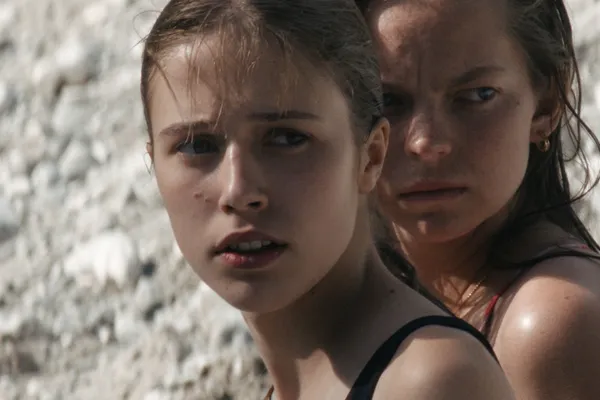
Lucija, played by Jara Sofija Ostan, is one of several teenage girls in a Catholic school choir. We follow what they get up to when on retreat in a convent.
“I really loved when I was observing one choir in this rehearsal process,” Urška recalls. “Not only the music, the piece in the end, when there is a concert and you can enjoy the music, but how the music is created through the rehearsal. It becomes at one point harmonious and then it falls apart and [does it] again. And at the same time, there's a relationship between these people happening when they are creating artwork. So that was, for me, very important and I really wanted to show this part of the creating of music.”
Silence also plays a powerful role, I observe, as when Lucija goes down to the river and meets a construction worker she’s attracted to. They're both completely silent for the whole scene. There’s a huge amount communicated between them, but without anybody saying anything. It felt to me like a very animal thing - sort of a pre-language thing.
She nods. “I believe it's all about the language of the body. Most communication between people happens in the vibration and in the body language. So we don't need to say anything. We can understand. I think this image is worth more than words Connected, of course, with the sound that helps this tension to grow. Yeah, it is maybe animalistic. That could be the word.”
There’s a complex web of communication throughout the film. It’s also there between Lucija and Ana-Marija (Mina Svajger) - it doesn't seem quite clear to either of them what the other is thinking, although they spend a lot of time using words and complex body language. Was that misunderstanding or uncertainty what Urška wanted to emphasise?
“Yes, yes, definitely,” she says. “This happens a lot of times between us when someone wants something and the other one is thinking about something else and we don't understand each other. With these two characters, I was exploring a lot, this concept of attraction and sexuality. That is not only in a box and in rules, that sexuality is about men and women, but the sexual energy is a broader life energy that leads somewhere. We have to discover something. This concept of attraction is so important. It doesn't mean that we want the sexual intercourse with someone, but there's something there that attracts us in order for our personal growth. So that was this kind of yin yang relationship with these two characters.”
I note that girls that age often have very intense, passionate friendships and there's uncertainty about whether it's something else or not. “Yes, also. Definitely, definitely. And this attraction, because, you know, sometimes you're attracted to something that the person has that you want to have or you don't yet have, but you don't understand it, that it's about. It's maybe not about the sexuality itself. And through sexual energy we explore it, especially when we grow up. And definitely the rules of the environment are a bit oppressive. And again, they say certain things. This is allowed, this is not allowed. Which makes tension and conflict inside the body of a young girl.”
There’s uncertainty about whether Lucija finds it an oppressive environment all the time or whether she's quite attracted to that idea and maybe thinking about becoming a nun herself.
“Yeah, yeah. Also because there's also an attraction towards this lady and their knowledge. So why not? When you feel someone who is very passionate about what he does, you can't not to be attracted to that moment. It doesn't mean that, yeah, you will go that way, but there is definitely something there that you need to discover.”
It’s a bold thing to have taken on with amateur actors. What was the reason for doing that and how did she make it work so well?
“I wanted to work with a 16 or 17 year old girl. For example, for Lucija, I wanted to find a girl who is on her transition from childhood into girlhood into womanhood. And of course she didn't have any experience before. So we did a lot: a lot of preparation, a lot of improvisational rehearsals to understand the characters, to explore them and then to learn. She really learned how to act and how to be in the body through this process.
“Mina Svajger, who was playing Ana-Marija, was still in academia, learning to be an actress, but she'd never had any experience on film yet. So for her it was also the first time, and the other two girls also. When you're working with such young cast, you have mostly people that have not done this before, so you go with that. But what was interesting that I felt was that these girls are much more free than the older actors who are already established and who have specific ideas about how they want to be presented. So working with them was amazing because they allowed themselves to make mistakes and to explore more. That was very nice process.”
The girls own knowledge of what it was like to be at that point in life also contributed to the development of their characters, she explains.
“I also used a little bit their characters because I realised when they are non-professionals, when you want to push them in a certain way, it doesn't really work if that is not something they have inside themselves. So we took their characters also and used them for the characteristics of the film characters. So they really helped shaping the story and the characters.”
A lot of other filmmakers with this kind of storyline would be tempted to cram in a lot more events and a lot more action. I explain that I like the stillness of it and the fact that there's not so much happening in terms of events, which makes more room for character development.
“That's the thing,” she says, after thinking for a bit. “Yeah, there's not so much action, because when you look at a certain moment in life and you go inside the body and see what all is happening inside the body at the time, there's actually a lot of action going on, but not outside action. So we should more focus also on the inner experience that we have, because for a young girl, one little moment is a whole roller coaster happening inside the body. So that's why I wanted to go inside the body, to have this bodily experience also for the viewer, this tactile experience, what a young girl is really experiencing.
“You don't need that much action, but it's so important what is happening inside you, and we have to more listen to it because there's a whole life going on there. So that was also the idea of this film, that the body has this intelligence of its own and it’s sometimes stronger than the mind. Especially for young girls, we need to listen to that, to understand our true potential and power.”
We talk about the experience of being a film festival favourite.
“Of course I didn't expect it, but we did work on this film for six years,” she says. “Of course, you wish that it would reach as many people as possible and that people would really be touched by. I knew there was something very good there and I was hoping it would go through to people. And it did. So it's amazing. It's very touching to hear people that really loved it and that really feel this magic of art and of filmmaking, and of course the importance of the story also. So that's very rewarding.”
She already has another project in development, she says.
“It's very early development. It will be set in a monastery again, but this time it will be set in a male monastery. And I'm tackling a very historical event that happened in Slovenia in the 14th century, which was one of the first witch trials in Europe.”
It’s a story that most Slovenians will be familiar with, she explains, but it has always been framed by men – “men who didn't understand women at the time and portrayed them very superficially and like passively awaiting their fate and not doing anything. So I feel I need to tell it through a woman’s perspective, but also I'm curious about the relationships between monks who are the guardians of knowledge, and one woman who enters this monastery.
“I'm very excited about doing it already. I can feel this drive that I had with my first picture. That's the most important thing.”