





Eye For Film >> Movies >> The Shepherd And The Bear (2025) Film Review


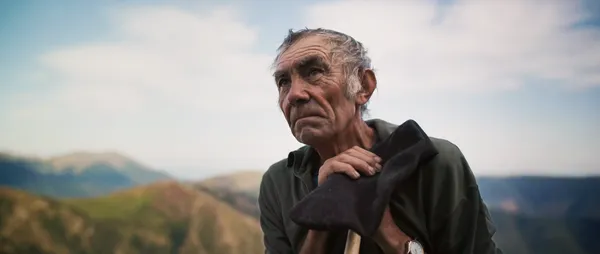

Though it twice found itself a the centre of the action in Europe, first during the Albigensian Crusade and later during the Huguenot rebellions, neither of which went well for it, Ariège is a region which has, for the most part, been overlooked by history. Its cities industrialised in the 19th Century, but in its rural areas, some things have remained unchanged since time immemorial. In the morning, the sheep wake up. It’s spring, and without their wool they look skinny, delicate. The shepherd comes with his dogs and escorts them through the morning mist, up the steep green foothills of the Pyrenees to pasture.
Abruptly, we cut away for this peaceful pastoral scene. Somewhere nearby, a helicopter is circling. It drops a blue crate onto a grassy hilltop. The crate bursts open and a brown bear comes charging out.
It’s argued here that bears were extinct in the region for a long time. The French government maintains that there were always a few, but that by the 1990s they had declined to the point where there was no longer a viable breeding population, so they decided to ship in bears from elsewhere to improve it. With the population now around 70, this experiment is officially considered to have been a success. The locals, however, see it rather differently.
85% of a brown bear’s diet is vegetarian, says a documentary playing in a village pub. Most of the rest is made up of insects and other small creatures – although it does happen, it’s exceptional for a bear to take a sheep or a calf. At this, the local people laugh. That’s not their experience. One morning, seven sheep are found dead. The shepherds talk about waking to find them half-eaten, sometimes still breathing; about the times when they have to kill them themselves, to end their suffering. We are also presented with some evocative footage of frightened sheep in fog, under a full moon, huddled together in tight groups, keenly aware that they face some kind of threat. After a close encounter with a bear, the elderly shepherd Yves tells visiting authorities that he expects a human will soon be killed too. These prove to be prophetic words.
There is discussion of the existential crisis facing ecosystems around the world. People with power think that more space needs to be given back to nature in order to restore balance, the farmers observe, but they are not the ones living in that space. Increasing the bear population may have seemed smart to begin with, but bears are intelligent animals, and their behaviour has changed over time. They are no longer intimidated by bright lights and shouting. The villagers lack the means to defend themselves. A group of them don balaclavas and make a video in which they wave placards and shout angrily for the benefit of others who are hard to impress. Ariège belongs to them, they say, and they have a right to their traditional way of life. What emerges is a picture of a territorial battle with ancient roots, obscurely manifested in the 21st Century.
The sheep, with red hearts sprayed onto their sides, spring up the slopes. Some of them have lambs, but after centuries of inbreeding, they don’t watch them as carefully as their ancestors might have done. Tendrils of mist are everywhere, so that one can never be quite sure what might be lurking nearby.
We get glimpses of traditional village life. A pig screams in distress as it’s lifted onto a platform to be slaughtered. Two men chase Maurizio the escaped rooster in a sequence which becomes increasingly absurd. There is a wedding with wild flowers and folk music. Yves’ young apprentice, who has dismissed the idea of going to shepherding school in favour of hands-on learning, becomes obsessed by the bears, tracking them, identifying their individual behaviours. Everybody says that they don’t mind the good bears, the calm individuals who don’t bother them. They go so far as to discuss giving food to them, as they have heard that people do elsewhere.
Yves and his trusted dog Djembe train younger dog Baga to steer the sheep more effectively. In the vivid magenta dusk, new fences are installed. Perhaps the only way to preserve the past is to draw on newer technologies. Yves is worried that fewer and fewer people are interested in learning how to be good shepherds, even as the bears make it more urgent. Max Keegan’s documentary sings a beguiling pastoral song, but has keen powers of observation. What may look to tourists like a bucolic paradise is as riven with distrust and trepidation as any modern city. Finding and maintaining peace requires paying close attention to its ursine and human inhabitants alike.
The film will be released in UK cinemas on February 6, 2026
Reviewed on: 22 Nov 2025


Streaming on: Criterion Channel
Search database: