





Eye For Film >> Movies >> The Good Daughter (2025) Film Review


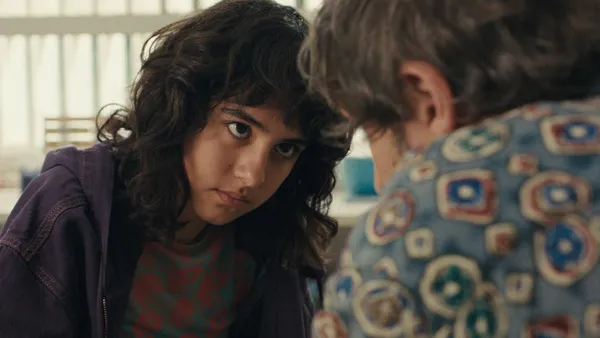

Marta (Janet Novás) scrubs food from a wall, left there by a plate now lying broken nearby. Although we didn’t see the act of violence that caused it, its impact is clear along with the lingering stain it has left, which is hard to erase. This small moment encapsulates the themes of The Good Daughter, which considers the imprint violence can leave on the wall of childhood through the experience of young teen Carmela (impressive newcomer Kiara Arancibia), whose point of view we observe throughout.
As Carmela adjusts to her new life with her mother under her grandma’s (Petra Martinez) roof in Catalonia, Arancibia’s performance, fuelled by the sort of nervous energy teenagers find hard to contain, will be our guide to her emotions. While the youngster waits at the visiting centre where she has mandated meetings with a social worker before and after seeing her artist father (Julián Villagrán), her excited anticipation is palpable. For all her joy at seeing him, however, and visiting his cool new house and pool, we can also see her immediate unspoken discomfort when certain topics arise – particularly her mum.

There have been other films about the shadow of domestic violence, including Xavier Legrand’s Custody, but unlike that film and many like it, director Júlia De Paz Solvas shows the effect a violent and manipulative father can have on others without giving him the centrestage attention he would crave – notably we never even hear his name. By degrees she also shows how the wells of self-pity men and narcissism men like him have will never run dry.
The whole approach of Solvas, writing with Núria Dunjó and expanded from their 2022 short Harta, is to keep us with Carmela as she navigates not just her relationship with her father but also the small acts of three generational healing she has with her mother and grandmother and the importance of her teen friendship group as an outlet. This means often being close enough to Carmela to study every twitch of her face but also far enough away to see how the stress at home sometimes leads her to isolate herself. This is also a film that never underestimates the importance of friends and family taking the time to ask how someone is feeling. Sandra Roca’s camera is attentive but also naturalistic and loose, while judicious scoring from Natasha Pirard helps swell the mood at key moments while avoiding melodrama.
Arancibia – whose Best Actress award at Tallinn Black Nights was one of a clutch of gongs taken home by the film, including the Grand Prix – uses body language with subtle effectiveness. From the stress signifier of a repeated leg tap of pent up emotion to the heavier than usual pressure she puts on pencils, we can tell all the things she is feeling but unable to voice.
We share in Carmela’s conspiratorial pleasure when she gets her father to buzz-cut her hair in an act of rebellion against her mother but we are also privy to the change of temperature from fun to fear as a game in a pool turns out to be much more than that so far as he is concerned. Carmela’s father is adept at turning his daughter’s innate desire for his approval and love into a weapon against her and her mother, while The Good Daughter also makes a more general point about how any children of divorce can have their loyalties torn easily when there’s no independent broker to speak to.
Early in the film, Carmela’s grandma cautions her to keep talk of what has happened within the family but Solvas gradually shows what Carmela comes to learn, that it is often only by voicing our fears – and helping others to do so – that we may begin to conquer them.
Reviewed on: 23 Nov 2025



Director: Júlia de Paz Solvas
Writer: Núria Dunjó, Júlia de Paz Solvas
Starring: Kiara Arancibia, Janet Novas, Julián Villagrán, Petra Martínez
Year: 2025
Runtime: 101 minutes
Country: Spain
Search database:
