




 |
| Reflection In A Dead Diamond |
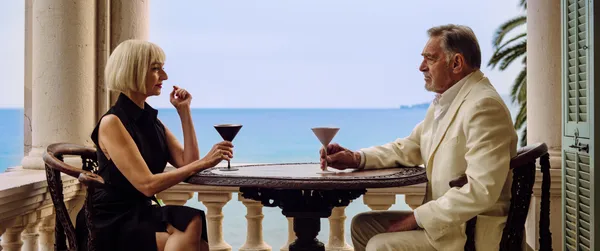
No matter how one looks at it – or whether or not one likes it – it’s impossible to deny that Hélène Cattet and Bruno Forzani’s Reflection In A Dead Diamond is one of the most dazzling films of the year. Like their previous works, Amer, The Strange Colour Of Your Body’s Tears and Let The Corpses Tan, it assails viewers with a tide of vivid imagery that stuns the senses but excites the imagination, and it’s especially delightful for those well versed in the European pulp thrillers of the Sixties and Seventies.
The title reminded me a bit of a William Gibson short story from about 50 years ago called Fragments Of A Hologram Rose, I tell the directors when we meet. In that it seems to me that if one has diamonds that are reflecting in all different directions, one sees many different images of the same thing. Was that the idea that they had?
 |
| Reflection In A Dead Diamond |
“Exactly, yes, totally,” says Bruno excitedly. “Because for us, we have written the script like if it was a diamond. So you can see the movie and depending on the angle you are looking at the movie from, like the diamond, you can find different meanings, different interpretation of the movie. We are very inspired by Satoshi Kon, the Japanese director of Perfect Blue and Millennium Actress. His way to write is called stereoscopic writing, and it's a special way to write with several layers.”
“And each time you watch the movie, you know, it's like a 3D effect, but in the storytelling. And it gets deeper and deeper,” adds Hélène. “In the movie, one of the main themes was illusion. We had that approach with the aesthetic, with op art, the art of optical illusion, like Vasarely, and we wanted to have the same approach for the writing. And so we used that stereoscopic writing. So what you said about the title, it's totally that, yes.”
The central relationship in the film, between an ageing spy and his arch-foe, the glamorous yet chameleon-like Serpentik, is the sort of thing we see in comics and in series all the time, where everything keeps getting reset and events play out over again in a slightly different way. Were they interested in that as a reflection as well, and the different angles that takes, especially across time as those characters are getting older?
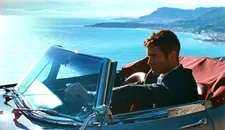
“Yeah,” says Hélène. “One of the first impulses we had it was to have a kind of old James Bond, who was remembering his past. A kind of mix between Death In Venice and James Bond. That was the concept we had in 2011. And before writing, we saw an opera. It was La Tosca, the Italian opera, and it was treated like Sunset Boulevard. It revisits La Tosca in a new way. And we thought ‘If we revisit James Bond in this way, it could be interesting.’ And as for all these memories, you don't know what their identity is. Are they fake? Are they real? It was a way to approach his past like this.
 |
| Reflection In A Dead Diamond |
“More than James Bond, we used the Euro spy. It's the fake James Bond made in the Sixties in Italy and sometimes in Spain too. They were cheaper than James Bond, but they were more psychedelic. And when you watch them you say ‘In the Sixties it was a nice world,’ and in fact it was a fake representation of the world.”
“It was like if the world was limitless, like if you could do what you wanted,” says Bruno. “Yes, everything was easy. So it was really interesting to use that image of the world to contrast with today.”
The violence in the film also looks amazing, but they felt that it was important to give it a brutal edge.
“The thing is that we come from this very pop [sensibility], like a candy universe,” Hélène explains. “But we didn't want the violence to be aestheticised because sometimes you watch a movie with tons of people dying but it's like you killed no one, you know? You don't have feeling. And violence is something very disturbing. And we wanted to have an impact, not to be just a comic book. Because for us it was, as Bruno said, a fake representation of the world and the world was violent and we wanted to keep that. We needed Death In Venice, you know, two opposite kinds of cinema, and we wanted to work on high contrast everywhere.”
We discuss their other inspirations.
“For the Italian influences, Diabolik is the main one, and the fumetti, the Italian comic books,” says Bruno. “It was, yes, a big inspiration.”
“And there was a euro spy that we like,” says Hélène. “It's Operation Kid Brother. It's a fake James Bond with the brother of Sean Connery. And it is set in on the French Riviera with all this crazy dress and things like that. It's really the kind of pop universe we describe, you know? But what was interesting with the fumetti, we used those on the movie because it was a way to speak about this identity with the...” she trails off, struggling to think of the words in English.
 |
| Reflection In A Dead Diamond |
“The falling of reality. You know, the deconstruction of reality, the nature of these memories,” says Bruno helpfully.
Hélène is still struggling, so I suggest that she try in French. She begins, and then realises that she can’t think of the words in French either, and collapses in a fit of laughter. We persevere, and she manages to explain that the fumetti made it possible to create graphic links between the subjects of the film. We go on to talk about the high glamour of the film and the courage they needed to take on something so ambitious with their modest budget.
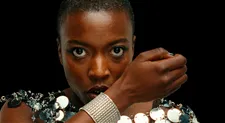
“For us, it's very important because we don't want the costume or the props or the architecture just to be, says Bruno. “We really want them to have meaning or to help to understand – to say something on the character or on the story. Because we are really inspired by the places, by the costumes. For example, the Paco Rabanne dress inspired us, on the character of Pamela, the spy, the partner of John. But don't want it to be just a reference to that period of op art because, you know, it's a big symbol of op art, this dress. And we wanted to use it to tell our story, to begin to become active. And so Hélène had the idea to make it as a gadget, like a video camera and a lethal weapon and all these elements. We tried each time to give them a signification, a meaning, a new way to watch them.”
“But with the budget we had, were a bit scared that we didn't have enough to have good set design and things like that,” says Hélène. “Because, you know, it's in the Sixties and there were a lot of props to do, but we had a very good team and it worked. But at the beginning, were very scared of that as well. The location had a big importance to give credibility to the universe. When you have the location, after the set designer and the costume designer, they go on the stage and we work. We talk about the colours we want to use so that they could accommodate, and things like that. It becomes very practical, very. And with that, we can achieve it. We have achieved it.”
How do they manage to keep on getting away with that in every film?
 |
| Reflection In A Dead Diamond |
“We know that we won't have a lot of money and we try to find solutions inside the scriptwriting,” says Bruno. “For instance, we knew that for the car chase we won't have a lot of time because for James Bond, just the car chase is six weeks of shooting. Here we have one day maybe to shoot. So we had to think in advance during the scriptwriting what this car chase could tell about the character. We had this idea to do it with a fake background, the comic design thing like that. And so we could do something a little bit original, because we can do a real car chase and tell something about the character. So all is done like this. You know, we know that we don't have a lot of money and we try to find a way that our poverty can make the story richer.”
We talk about the idea of an older character looking back on his life, and that draws something from their own experience of ageing and watching their family members age.
“In the movie, as you said, this kind of hero, they have always the same adventure for years and years, and they don't get old because they change actors,” says Bruno. “And so it was interesting because in fact, it can be something very schizophrenic, you know, for the hero to always change his face and in fact to become like Serpentik, who has several faces.
“All these things fit for us. And when were preparing the movie, we saw The Father with Antonio Hopkins and they have this game with memories, and he can tell you don't know what is true, what is fake. It's something about a family, too.”
Hélène nods. “So, you know, it's a mix of a lot of things in your life and in your cinephilia, too, that you try to combine. And I think that this stereoscopic writing from Satoshi Kon allows us to embrace all these themes and to do something special.”