




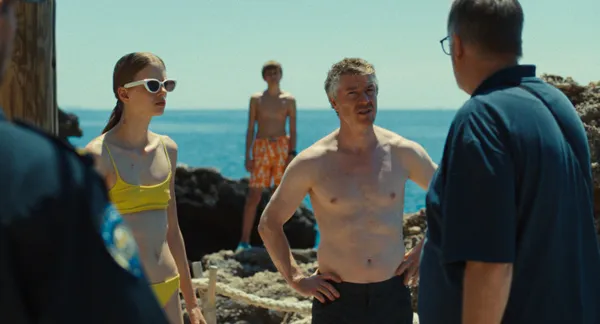
A separated dad finds that communication with his 17-year-old daughter Klara (Dexter Franc) could be a matter of life and death in Olmo Omerzu’s Ungrateful Beings. A cross-cultural and multilingual household, David (Barry Ward) has taken Klara and her younger teenage brother Theo (Antonin Chmela) on a holiday to Croatia, with the family under the cloud of his split from their Czech mother Laura (Barbora Bobulova) and Klara’s eating disorder. A holiday romance with the slightly older Denis (Timon Sturbej) seems to offer an incentive to Klara to eat but a dark turn of events leads to an abrupt separation which, ironically, will bring David and Laura closer together as they try to reach out to their daughter.
Omerzu has previously demonstrated a keen ear and eye for teenagehood, with the likes of Winter Flies and Family Film and here he probes fractured attempts to communicate in the modern world. We caught up with him after his film had premiered at San Sebastian Film Festival to talk about parenthood, technology and his talent for representing the kids’ eye view.
So having shown us the buzzing Winter Flies, this time we see the humming summer cicadas
Olmo Omerzu: It's a bit of a different thing with cicadas. When I was a child with my parents, we were very often staying in those kinds of camps. And my most intense memory is always connected somehow with the sound of cicadas, but there is this paradox that they are so loud, but you never see them. I remember, even as a child, I always liked going around and watching trees and trying to see them, but it was impossible to find them.
 |
| Olmo Omerzu: 'For me it was always an interesting layer to have a broken family that is broken in languages as well' |
Another aspect is that the film is kind of flirting with thriller moments or a thriller atmosphere, even if it's not the thriller genre, but cicadas are atmospherically and tonally very connected with the thriller thing. Also, when they stop making the sound there is always such a contrast in between the fullness and richness of the sound, and the total silence. So, I thought that it could be interesting to use cicadas in the film that dramaturgical way of working with sound atmospheres.
I was speaking to Barry Ward and he was saying that originally this was all in one language but then the actor dropped out, but you had a different version that was in two languages. It’s interesting that you’re playing around with the idea of families not being able to connect, no matter what language, without speaking in a way.
OO: From the beginning, I had the idea that it could be a bilingual family, but then somehow. I realized that it could be problematic to find a British actor with our budget. So I rewrote it into the Czech version of the screenplay, and we were already working with a Czech actor, and then he dropped out because we were postponing the film and, at the same time, I was in a jury with Barry Ward and we got along very well together. A lot of small coincidences helped us in the end, and we worked together.
For me it was always an interesting layer to have a broken family that is broken in languages as well. I know a lot of these kinds of bilingual families and it was always interesting how the dynamic of switching languages works in those kinds of families.
It’s interesting to see which language the family choose to use in what situation. I felt for Bary, though, because Czech is not the easiest language to get your mouth around as an English language speaker.
OO: In the end, we used it in a way that he chooses the Czech language when he wants to be a bit closer to his kids or more intimate, even if he’s lying. He’s trying to manipulate but in a very gentle, father-ish way.
How was working with the kids, I gather you had quite a lot of rehearsal time. It must take a while to build that brother/sister dynamic so that it feels believable?
OO: For sure, but for me, a bigger concern was even if it’s a broken family, somehow families are usually connected through language. This is the first thing that makes the viewer feel it’s authentic. I got quite a big fear that because everyone is speaking different language. It's a kind of an interesting concept, but you need the viewer to really believe they are a family, even if the parents are in the process of separation.
 |
| Olmo Omerzu: 'I think, often, people are looking for shortcuts in their lives rather than concentrating on their concrete problems' |
So, for me, this was actually the biggest fear, because Dexter, and Tonda (Antonin) are speaking the same language, and they even look quite similar. So that wasn’t a problem. We rehearsed and had a classic preparation but, with the family, that was a bigger problem. So we were working on their dynamics or their pre-stories. What happened before. How the kids were connected to situations that were going on before in between the parents. That is something that I was more focused actually than only on the dynamic of the brother and sister.
For Dexter, who has a big part – he uses the ‘he’ pronoun because he is a trans boy – I did a short film with him before as a preparation because I think it’s super-important to have a smaller performance before you start shooting. So he was fully prepared.
It’s funny that the father has to adopt a new language – mobile phone technology – in order to communicate with his daughter. Is that how you feel about mobile phones, that they’re a little bit alien?
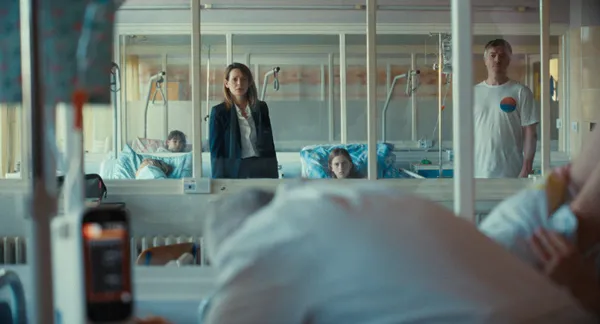
OO: Exactly. Actually, when we were scouting locations in Czech Republic hospitals we went to a hospital for eating disorders, but there were kids from 10 to 15 with different types of problems. And it was a location where there weren't walls, there were windows. So you could see in front of you at least five rooms, and in each room there were at least six or seven kids, and they were all stuck in their mobile phones.
So it struck me that in front of me, I saw, I don't know, 50 kids, and no one was talking to each other. And they all had a kind of a problem that you would say that the most important thing for them is that they start to communicate with each other, and they start talking about their problems and about things that are going on. But they were just stuck in their mobile phones and 50 people weren’t communicating, they were just silently staring at their phones. It really struck me because this is something that is a problem, that this is the most important channel for communication for them, but at the same time they are totally alone in their own world.
Also the dynamic in the family. I think, often, people are looking for shortcuts in their lives rather than concentrating on their concrete problems. In this case, the parents’ shortcuts are based upon lies and manipulation so it’s kind of paradoxical that they solve their problems with the mobile game they are playing.
The character of Denis is very interesting too. You’ve said you went to these sorts of places with your parents. Did you have that kind of summer romance?
OO: Not exactly, because with my parents we were always going to this kind of post-hippie type of camp, with not many children. I was always a bit jealous that these kind of more mainstream camps were always full of children but we were always somewhere, you know, with an abandoned beach. I was really desperate and seeking a normal mainstream life. But anyhow this is something that everyone knows and that's why, in the first part of the film, I wanted to work a bit with this cliche of first summer romance.
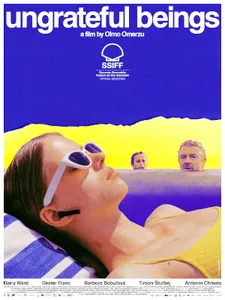 |
| Ungrateful Beings poster |
You’ve continued to be drawn to stories of teenagers and their experiences and the disconnection between adults and teenagers. Do you think that’s going to be something you’ll continue to explore?
OO: For now. I think it's a bit of a closed chapter because the next two scripts that I'm developing are not connected with family or with children. Now I topically moved on to something else but it’s a bit too soon to talk about that.
- Read what Barry Ward and Barbora Bobulova told us on communication and multilingual families in Ungrateful Beings
Share this with others on...