 |
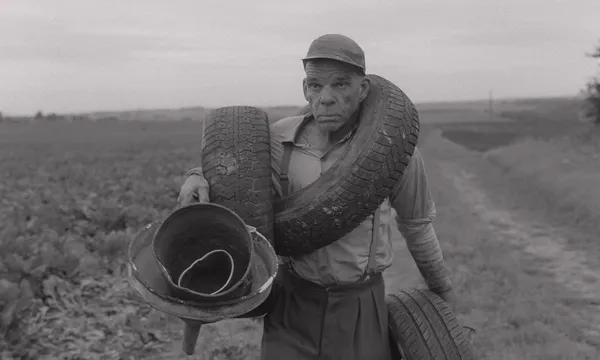
| Denis Lavant: 'All the physical work that this film required was hard, but it's a pleasure at the same time' Photo: Courtesy of San Sebastian Film Festival |
Denis Lavant has built a career out of crafting fascinating characters, which are often physically demanding. His long-term collaborations with Leos Carax on films including Holy Motors have cemented his international reputation with other notable roles including in Claire Denis' Beau Travail and Harmony Korine's Mister Lonely. He's having a busy and high profile year, playing key cameos in Locarno opener In The Land Of Arto, directed by Tamara Stepanyan, and in François Ozon's Albert Camus adaptation The Stranger, which played in San Sebastian's Pearls section.
The Spanish festival also showed him in his meatiest role for the while, personifying Karl-Göran Persson in John Skoog's black and white drama Redoubt - which also screens at London Film Festival this week. Persson became a local legend in his own lifetime when, after being inspired by a Swedish government Cold War leaflet, he spent decades fortifying his own home in anticipation of war. It's a role that was not only physically demaning but also linguistically, as Lavant had to get his tongue around a Swedish dialect. We caught up with the star in San Sebastian to talk about the challenges of bringing a real person to the screen.
The film is all about the construction of a fortress but, for you, it’s also about the construction of a character and a world – using a different language and to physically become Karl-Göran. I wanted to start by asking you about that challenge.
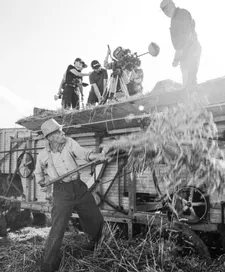 |
| Denis Lavant on the set of Redoubt. 'I was very honoured to be accepted by a foreign community... especially when I was playing the role of one of them as a foreign actor' |
All the physical work that this film required was hard, but it's a pleasure at the same time. For the duration of a film, I like to do these kinds of things. To learn new things that I've never done before and I just try to be available for all the requirements of the character. The most delicate thing was to speak Swedish with the southern accent and this is something that I had to learn, but I have a good ear and we thought yes I can do it. Otherwise, I did the rest practically on site with the advice of the people who were doing the decoration, the decorators who built this house as I went along, who accompanied me during the construction.
Did it help you to connect with the character because you were a stranger in a way in this part of Sweden. I gather from what John was saying you were living near where the house was being built and he said the local children were a little bit fascinated with you. Did that help you in the construction of the character?
Now that I, just yesterday, watched the film, I realised that my face somehow shows the hardness of all this work that I'm doing during the shooting that I'm not used to doing normally. This was something I was doing for two months, that’s how long it took to shoot the film. I don’t remember the name of the village, but it was south of Malmö. I stayed for two months on a large property, with fields stretching to the horizon and air so fresh that every cloud and every bush seemed inhabited and almost zoomorphic. I was in a magical universe. I wasn’t always completely at ease, but it was very quiet. Not uneasy as much about the outside as what went inside my head. And I had to deal with my own solitude every night. And in the day, I had to walk to the place where we were building the house for the film. So it required some discipline. I realise now that it helped me to prepare for this role, which is not just a figment of the imagination, because the character is a real person who existed. There are not many traces of him except for the Redoubt that he built, which is still there. It took him 30 years of his life to build it and it's still there.
You seem quite drawn to intense characters. I saw you recently in In The Land Of Arto as well, which is another incredibly intense character. And you’re again using a different language
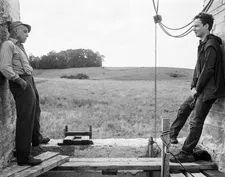 |
| Denis Lavant and John Skoog on the set of Redbout. Lavant: 'I don't think I am so intense in my real life but they do call me for this kind of role' |
I had a lot of time in solitude, I was alone, since they’re onscreen practically all the time and often alone. So it was very nice for me and I really liked the experience. Also I was very honoured to be accepted by a foreign community, in a culture that is foreign to me, especially when I was playing the role of one of them as a foreign actor. That's something that I was very touched by, and I liked it very much. And yesterday, when I was watching the film, I was even nostalgic for the time that I was shooting there.
Can you tell me anything about your role in François Ozon’s The Stranger, which I’m going to be seeing tonight.
Ozon called me in the spring to play Salamano, who's a hero and an anti-hero at the same time. He is a person who hates his dog and treats him really in a horrible way – so there’s a certain parallel to Meursault [the main character]. The dog, at a certain moment, goes away and he complains to Meursault. I love Albert Camus, the writer, and this text. I mostly know La Chute and Le Mythe de Sisyphe, and there’s something very Dostoyevskian about the way he writes, reminiscent of Dostoyevsky’s Notes from Underground, in which he analyses the mechanisms of the human soul. I find this fascinating.This film was shot in Tangiers, not Algeria. In this case, I had no physical material like I did in the other film, but I had a dog in my hands. I had to pretend to hurt the dog, so it was really a huge responsibility to work with the dog. To play the role of being super violent with him and at the same time giving him treats was quite complicated.
- Read what John Skoog told us about the man who prepared for war
- Read what François Ozon told us about adapting Camus
- Read what Benjamin Voisin told us about his journey from extrovert to introvert for The Stranger