





Eye For Film >> Movies >> Sentient (2026) Film Review


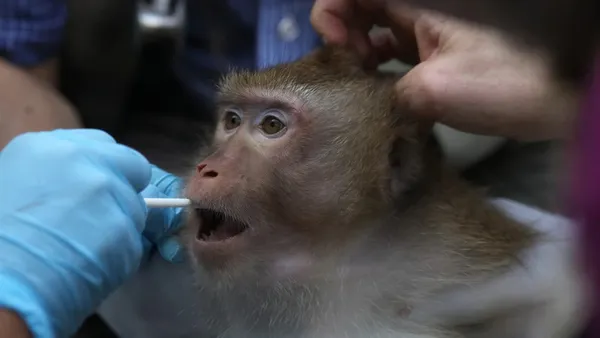

Tony Jones, a 69-year-old Australian veteran journalist making his directorial debut at Sundance, has spent decades reporting on the damage humans do to one another. With Sentient, he pivots toward a different brutality, what humans do to other animals, specifically non-human primates, in the name of medicine and progress. It doesn’t posture about whether primates are sentient. It treats that as the baseline fact, then asks what kind of civilisation keeps behaving as if it isn’t?
Jones builds the story around the non-human primate research establishment in the United States. He follows Dr Lisa Jones-Engel, a primate scientist whose career becomes its moral hinge, someone fluent in the system’s language, now speaking with the sorrowful clarity of a person who has watched the profession rationalise itself into a corner. But this isn’t a tidy conversion story. It is structured more like a hearing, a rolling tribunal in which different figures from the research ecosystem arrive to testify. The effect is that everyone feels implicated, yet the responses span a spectrum, from blank certainty to genuine remorse and disgust at the acts.

Where Sentient gets sharper, and more personal, is in how it presents science not as a method but as an institution, a kind of Ouroboros. Jones isn’t arguing that science doesn’t work. He traces a loop of dissonance and self-justification, an enterprise that, at times, helps cure the very conditions it has caused directly or indirectly through careless research, industry incentives, or a broader technocentric arrogance. The pursuit of holy grails, the ultimate cure, the one-time fix, the single flu vaccine that would end the problem forever, becomes an anatomy of certainty. Here, certainty reads less like confidence than entitlement, the belief that the destination is so noble it can retroactively sanctify whatever happens along the way.
The approach is steady rather than flashy. Built from interviews, archive footage, and present-day material, including undercover recordings, it doesn’t strain for aesthetic novelty. Its power comes from proximity, the way it keeps pulling the conversation back from abstractions to the bodies of the animals. A lot of biomedical ethics lives in the language of models, subjects, necessity, benefit. Sentient understands euphemism as part of the infrastructure. When it forces you to sit with what those terms actually mean, the soothing logic of the system starts to wobble.
It earns that wobble with images that are hard to metabolise. Chimpanzees and macaques sit trapped in cages, cycled through toxicity testing, their primate anatomy and helplessness uncomfortably close to human childhood. The protective instinct between mothers and young is unmistakable, and that makes it hurt. When the focus shifts to breeding factories that supply laboratories, the industrial logic turns grotesque. The cacophony of screams is blood chilling.
But the courtroom set-up has a built-in danger. It can start to resemble balance for its own sake. Jones lets people speak, avoids gotcha editing, and trusts viewers to hear contradictions as they unfold. Some interviewees appear genuinely shaken by what their work requires. Others speak with a polished certainty that feels less like conviction than institutional hypnosis. You can sense the pressure of careers built inside this apparatus, and the psychological cost of admitting, even privately, that the moral arithmetic might not add up.
The most telling imbalance in Sentient is structural. Jones interviews almost exclusively credentialed insiders, people with PhDs, people fluent in rhetoric that turns suffering into regulation and protocol. A revealing figure is one who straddles both worlds, a PhD-holder who now works as a lobbyist for animal experimentation, casually referring to those who advocate for primates as animal rights extremists. It is an accusation designed to end conversation rather than open it, a label that turns moral objection into fanaticism.
And here’s the thing. Jones never allows an “extremist” to defend the charge. If he is going to platform that smear, he also has to show what it is meant to describe, to let someone on the receiving end answer it, or at least to test the term against reality. Instead, the word hangs in the air like a sanctioned dismissal. The work is rightly sceptical of propaganda, but in that moment it risks borrowing one of the system’s most effective tactics, delegitimising dissent by naming it as irrational, then moving on.
That matters because this isn’t mainly about lab procedures. It is about narratives, the stories institutions tell themselves so they can keep operating without moral interruption. At its best, it shows how prestige, careerism, and self-preservation conspire to make ethical discomfort feel like a personal weakness rather than a rational response. It also hints at a hierarchy of cleanliness, public-facing institutions that can maintain an image of care and compliance while the dirtiest work is outsourced, dispersed, made harder to see.
Sentient leaves you with an uneasy recognition. The question isn’t whether primates are sentient. It is whether our institutions are, and whether we can look directly at what we do without retreating into the comfort of necessity, the narcotic of “greater good”, or the promise of some holy grail that will absolve everything in hindsight.
Reviewed on: 27 Jan 2026


