





Eye For Film >> Movies >> H Is For Hawk (2025) Film Review



Grief is not a stranger to cinema. From Julie (Juliette Binoche) grieving the loss of her husband and daughter in Krzysztof Kieślowski's Three Colours: Blue, to Leonard Shelby (Guy Pierce), a man suffering anterograde amnesia who hunts his wife's killer in Christopher Nolan's Memento, and Lee Chandler (Casey Affleck), a man grieving his dead children in Kenneth Lonergan's Manchester By The Sea, grief and loss is a recurring presence. Now, Claire Foy steps into this painful void in director Philippa Lowthorpe and co-writer Emma Donoghue's drama, H Is For Hawk.
Based on British author Emma Macdonald's 2014 memoir about grief, which I have not read, Foy plays Cambridge academic Helen, who is sent spiralling after the sudden death of her father, Alisdair (Brendan Gleeson), a photography journalist with an interest in ornithology. Helen hastily decides to resign from her fellow teaching position, giving little thought to practicalities like what she'll do next and where she'll live.
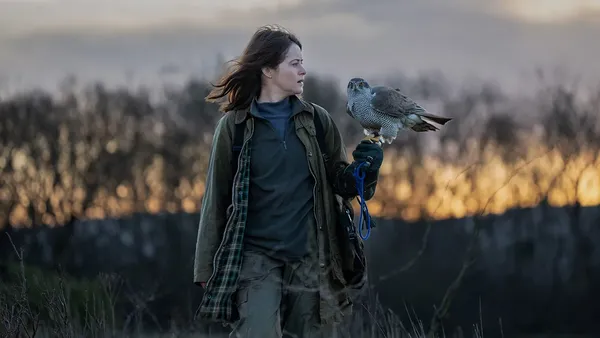
To cope with her grief, she buys a fierce Goshawk to train that she names Mabel, which ironically means lovable. Her mother (Lindsay Duncan), however, sees it as a distraction, and warns her daughter about becoming lost, while her brother James (Josh Dylan) and best friend Christina (Denise Gough) become concerned about her increasing withdrawal from her human world.
H for Hawk is a deeply sensitive film that seeks to humanise rather than dramatise grief and loss. Its ending is more like the end of the beginning, but it's never the intention of the filmmakers to depict grief as a contained narrative, with a clearly defined beginning, middle and end.
In short form, it's a story that can only be told in part. In one scene, Helen gives a public seminar on the subject of extinction and is forced to defend herself from a verbal attack by animal activists about her choice to take Mabel hunting. She reminds the activists that Mabel was born to hunt and while sympathetic to the cruel natural order, she reminds her audience that they will all die. In a strange way, she's speaking indirectly about how we must be ready to say goodbye and wish her well when the film finally ends. And when that moment comes, the sadness it evokes confirms the effectiveness of Lowthorpe and Donoghue's mature and patient vision.
Lowthorpe and Donoghue recognise the necessity for quieter and subtle moments that allow Helen time with her grief, and creates a space for the audience to empathatically enter the film. H Is For Hawk also has a little boisterous side, especially given that Helen and her father Alisdair are mischievous types, even if not everyone else is amused. In one scene, Alisdair, while driving his daughter somewhere, stops and intrudes on a crime scene they happen to come across. Told he must leave by the police officers, he turns it into a comedic "up yours" type of moment. Meanwhile, in another scene, Helen shows that the apple didn't fall far from the tree when she breaches Cambridge's decorum at an invitational dinner with her rambunctious humour.
Peering out from behind Foy and Gleeson's captivating presence is Denise Gough, who infuses the film with charm and humour, sensitivity and compassion. She's there to be whatever Helen needs — a supportive friend that resembles a motherly figure. And when expressing Christine's concerns, Gough will sometimes internalise them and reveal them silently through her body language or facial expressions. This brings a welcome nuance to her performance.
Together, Gough and Foy form a quirky comedic double act — not least in the coffee, croissants and Dad's Army or 'comedy Nazis' scene. And on another occasion, Christina calls in on her friend with an original copy of the Hitch-Hiker's Guide — Radio Scripts, which she humorously asks if Helen wants to smell?
And so, Gough is vital to the balance of humour and pathos that Lowthorpe and Donoghue are pursuing. However, the power of the writing, direction and performances, is that humour and pathos are not mutually exclusive. The comedy might offer levity, but it complements and emphasises the pain at the story's heart.
H Is For Hawk is an emotionally transportive drama. There never feels a moment that space isn't created for us to enter the film, or at least an invitation is not offered. Few superlatives can do justice in describing Foy's quietly impressive and transformative performance — she carries Helen's pain in her bones and soul. Whether still or in motion, her body and eyes, her gestures and expressions are shaped by memory and time, and her father.
Putting Foy's performance to one side, Lowthorpe's direction alongside the work of cinematographer Charlotte Bruus Christensen, editor Nico Leunen, and composer Emilie Levienaise-Farrouch are an example of emotional world building.
An early piece of Levienaise-Farrouch's score profoundly conveys the dance between beauty and sadness or beauty and pain. She anticipates the interaction of humour and sadness, and while the music feels slightly intrusive in an occasional scene, H Is For Hawk utilises existing songs to spiritually define Alisdair and Helen and original music to build the drama's emotional landscape.
Meanwhile, Lowthorpe, Christensen and Leunen capture the sublime presence of Mabel as she hunts — soaring through the air in pursuit of her agile prey that cuts a path through the dense woodland. Then, in contrast, there's the stillness when, in an early scene, Helen runs through a string of memories of her father. The camera frames her eyes in a close-up, as Leunen and Lowthorpe cut back and forth between Helen's present but vacant tearful stare and flashbacks. Throughout the film, flashbacks or memories are well-timed to position Helen as being torn between the past and the present, and genuinely convey memories as autonomous and free flowing.
Lowthorpe and Donoghue take Macdonald's personal source material and turn it into a universal love letter about the relationship between fathers and daughters. Opposite films like Tim Burton's Big Fish, which is about fathers and sons, H Is For Hawk carves out its own place as a special and welcome tale.
H Is For Hawk has more of an emotional than a narrative arc. No doubt guided by the source material, Lowthorpe and Donoghue genuinely and honestly explore the self-destructive behavioural patterns triggered when we emotionally spiral. The filmmakers, however, respect Helen by giving her space and time to reveal herself instead of exposing her deeper motivations for training Mabel. H Is For Hawk is never rushed, and instead, allows Helen's grief, and the steps and processes she must navigate in managing her pain and depression, while learning how to live without a father she dearly loved, to dictate the drama's pace.
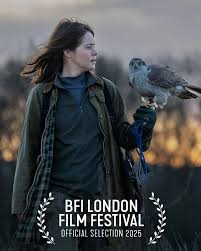
H Is For Hawk played in the Gala section of the 69th BFI London Film Festival.
Reviewed on: 15 Oct 2025



Director: Philippa Lowthorpe
Writer: Emma Donoghue, Philippa Lowthorpe
Starring: Claire Foy, Brendan Gleeson, Denise Gough, Lindsay Duncan, Sam Spruell
Year: 2025
Runtime: 128 minutes
Country: UK
Search database: