





Eye For Film >> Movies >> Ha-Chan, Shake Your Booty! (2026) Film Review


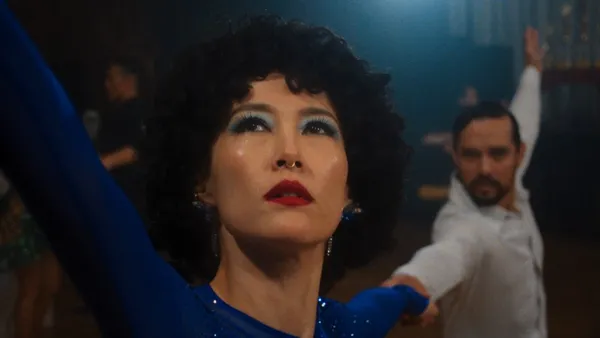

Ha-Chan, Shake Your Body squeals with an barrage of tones and emotions, ping-ponging between slapstick, cringe, surrealism, sentimentalism, grief and fantasy, punctuated with a healthy amount of dance numbers. There are moments when it reaches a sublime balance, and others when it kicks its feet around in search of rhythm. Through it all, there’s one thing that stops the film from ever going completely off the rails, and her name is Rinko Kikuchi.
The inimitable actress slips right into her dance-loving character, Haru (or Ha-Chan), and is a joy to watch throughout the rollercoaster Haru’s life becomes. As the movie begins, our heroine lives an idyllic life in Tokyo with her husband Luis (Alejandro Edda). She bounces around the house in an eternal state of warm-up for dance competitions while Luis tends to the yard and cooks delicious meals. But one day, tragedy strikes during a competition, and Luis dies.
The ensuing story is partly about coping with loss, partly about horniness, and partly about absolutely losing your mind as the result of those first two things. We see things expressionistically from Haru’s point of view, and Luis haunts the house, appearing as some sort of baby crow or other monochrome black chick. Or perhaps it’s Luis in human form, wearing a costume of said black chick. The important thing is she’s depressed and barely leaves the house for months, skipping out on her own birthday party.
Her friends are worried, leading them to aggressively campaign to get her out of the house by joining a dance class. This leads to the dramatic introduction of a third lead, the sexy instructor Fedir (Alberto Guerra), another Latino Haru finds irresistible. The downside is that he’s married to a beautiful celebrity dancer, the upside is that rumour has it they have an open relationship. This prompts Haru to do some googling, as she thinks about returning to the wonderful world of sex, albeit in a different relationship from what she’s used to.
Director Josef Kubota Wladyka, who made 2013’s Dirty Hands and 2021’s Catch The Fair One, has a good eye for filming dance, and often complements the actors’ movements with cinematographer Daniel Satinoff’s dramatic camera. Sometimes the sequences feel a bit underdeveloped, while others come off as confident and virtuoso — especially the closing shot, a lovely ode to finding joy everywhere you look. Wladyka also isn’t afraid to push the limits of gags, including some Día de los Muertos make-up that Haru never quite gets around to washing off.
While Luis’s death starts the story arc, Ha-Chan’s antics are fairly episodic, as indicated by zany chapter titles, displayed and read in both English and Japanese. (The film’s third language, Spanish from Luis’s Mexican heritage, makes this a truly multilingual work.) The story sometimes lacks thrust, but when it isn’t working, something new will be on screen soon enough.
This piecemeal structure results in a rather flat landing for the big emotional pay-offs, especially the material with Luis’s “ghost”. But this is ultimately a film about the joys of moving through life. When the movements are working to the same rhythm, it’s magical.
Reviewed on: 27 Jan 2026


