Desire at a summer camp leads boundaries to be crossed in Weightless, the debut drama from Danish director Emilie Thalund, working from a script by Marianne Lentz. It follows Lea (Marie Helweg Augustsen) as she attends a camp intended to help her lose weight along with a group of other kids with assorted reasons for being there, including her roommate Sasha (Ella Paaske), who has the confidence, especially around boys, that Lea is desperate to gain. But as her flirtations with adult counsellor Rune (Joachim Fjelstrup) meet a positive response danger may lie ahead. The film won the New Directors Award at San Sebastian Film Festival earlier this month and will also screen at the London Film Festival. We spoke to Thalund at the festival and, please note, some of our conversation does concern a key moment in the film so might constitute a spoiler to some people. Like Lea, you should proceed carefully.
Did you go to any sort of summer camp when you were young?
Emilie Thalund: I did go to more regular summer camps. Yes, I've been to a lot of them. I never went to a place like this. I knew people from my school who went there. I was very scared to go there. I used to have a fat body when I was a kid and my sister as well. My sister plays the mother of the main character in the film. So it could be something the school nurse could suggest. Luckily my parents didn't think we should be sent off to a place like that. So I haven't been there but I know people who have been.
Did you do a lot of research or did you just come at it from the perspective of wanting to tell a teenage coming-of-age story?
ET: I guess a little bit of everything. I think often people's first movies happen to be coming-of-age stories. For me, even though I'm 36 now, I still feel very much connected to the girl I was when I was 14 or 15, or at least the idea of that girl or the emotions I felt at that time. Those years are very formative for who you will become. I think that even though my body has changed, the emotions about being told that you are wrong or being looked at in a way or commented on in a way, I think they just move into you. I knew I needed to work with that, at least.
I love girlhood, I love coming-of-age movies. I love that whole environment. I have a big empathy for the young girl and I think it's a tough world to grow up in when you're a young girl. So I wanted to work with that.
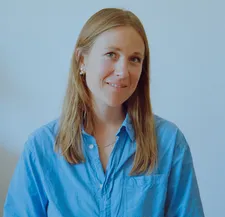 |
| Emilie Thalund: 'Going to those camps had this happy, friendly vibe but there was always this eeriness in a way |
ET: I really like when the arena puts pressure on the character. It has its own rules, it’s own hierarchy in a way, but it's also a micro society. If you can say that, and I think I wanted to work a bit with the body and the softness of that and sexuality and desire [but also] this system and the way you need to eat and exercise is very strict, so you get self-esteem. It’s two worlds that don’t really fit together. Even though it’s trying to be in a beautiful setting in the countryside with the softness of nature and the water, you still meet this strict system. They have the best intentions but they’re still so dated in their way of thinking about the body and weight and being a child.
It’s a fictional place sure but it is inspired by places that happen and they they are really trying to to change the language and the way of talking and looking at these topics but I don't think under the complexity.
We're living at a very strange point as well, in that sort of body positivity movement, if you like, is now hitting this weight loss drug intervention situation. Do you find that a strange moment as well now, seeing people basically taking a jab to do the job?
ET: Yes, I think it's very scary and it's very sad that we're going in that direction now because we were just beginning to think about the body in a broader way. And I think there's always been a lot of fat phobia and now I'm afraid there will be even more because now there's ‘no excuse’, you can just take a jab. I think it's a scary and sad way to grow up. And I think it takes a lot of courage to learn who you are, because everywhere you look, you're kind of told that you are wrong.
Tell me about casting Marie Helweg Augustsen because it’s quite an exposing performance. She really has to go there with her body as well. Is she maybe a little bit older than the character she is playing?
ET: She's 20 now. We wanted to find a girl where we could talk about it, also because it is about language and it's also about having your own journey and I think it takes some time to find out how do I like to talk about my body and how do I like to work with these things? The film is about setting boundaries and crossing boundaries and you're not very good at doing that when you are a young girl and being a young actress and you really want to say yes to everything. I think we found a very healthy, professional and talented person for this role. It was also very much about casting the whole team and making sure it's an inclusive safe space that you can work in and feel good about what you're doing and not being judged or looked at. I can't control how the world will come to the film because unfortunately there's crazy people everywhere taking advantage of material but I really wanted to make her a hero and give her respect and show her as a full person with everything you are and not just your body.
It’s a very ambiguous film and you bring home how easy it is not to see the dangers that are there even as an adult. You also show how close being friendly can be to grooming. Is that something you were keen to show?
ET: Definitely, because I think that’s how it works. It's very rarely a man in a dark alley. It's usually someone you trust and you like and I think it gets very muddy and complex because Rune is kind of hired to make her feel seen and make her feel good about herself. When is the teacher doing his job and when is he crossing that line? I think that’s interesting because he’s clearly not mature enough to have that responsibility. I think it's complex. That’s why it was also important to make her desire important, to make her feel like she has a sexual awakening.
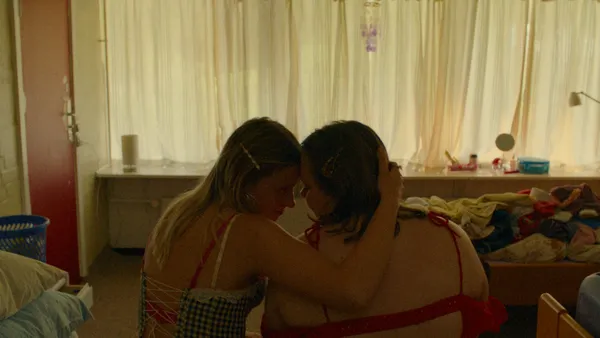 |
| Marie Helweg Augustsen and Ella Paaske as Lea and Sasha in Weightless Photo: Louise McLaughlin |
The Sasha is very interesting too, because she is, you might say, more experienced, but we see how she also falls foul of a situation.
ET: I felt like it was interesting to look at the general vulnerability you have in the world when you're a young girl and I think you're quite often, at least, I had the experience that I was told, you shouldn't take up space – whether its physical space or emotional space. Lea looks at Sasha and envies her for being free in the world because she has a body that she doesn’t feel like she needs to hide and she can be whoever she is. But that is something you can also be punished for. I think that was important to show that side as well or interesting to work with that. They both have something that the other wants, in a way. And also, of course, to work with the hierarchy there is between teenage girls and teenage girls’ bodies.
You shoot the film with attention to the details of childhood. For example, the way that you come back to Lea’s bandaged knee, something that always makes me think of being a kid. Was that because you wanted to keep reminding the audience she’s a teenage girl
ET: Yes. I love that you got that out of it. It’s quite interesting because we were discussing this, you know, what is the line? What age should she be? Is it important that we mention her real age for people to understand it? We had grown up men watching the film and being like, ‘I don't know in what way II'm allowed to look at her’ and I was like, ‘What do you mean by that?’ And also with the Sasha character, they didn't know if they could look at her. They really wanted to know, is she 14 or is 15 and I was like, ‘Why does it matter? And when, when do you lose your protection as a young girl?’
Because we have made a law [in Denmark] saying that when you're 15, it's okay. Who makes those rules and, and, and who are they in favour of. And I think it was important for me to show this. Yes, they are young women. They themselves think they are ready for a lot of things but they are also kids and we need to protect them.
You shot it in a high colour, bright way even though it’s dealing with some dark themes. Why did you decide on that summery approach?
ET: I think it’s because, for me, going to those camps had this happy, friendly vibe but there was always this eeriness in a way. It was scary being away from home being away from your safe place and there would be spiders or there would be dirty floors. I remember my feet going on those floors in the night when you had to go out and the feeling of being away from home. It can be exciting but also a bit scary.
[imagefullwidth id={32918] I always like arenas like that. Also amusement parks. They look so colourful and happy but they are kind of scary when you look into them more.
The same could be said about Rune in a way, from the outside he looks a bundle of fun but when you get close, perhaps it’s the dirty floor situation.
ET: Very true. And how would you know, when you're 15 and it's one of your first meetings with someone like that, with a charming guy. Even as an older woman you can get carried away by charm.
I was thinking your film would make a great double bill with Palm Trees And Power Lines because it also deals with the way you don’t know what to expect as a teenager. You don’t know what the rules are of that situation or how to navigate them. And you really focus on Lea’s face as she has a difficult encounter, you don’t turn away. That’s an interesting choice that makes us really see her.
ET: It was something the writer, director of photography and I would discuss a lot. We wanted to fully take on the young girl’s experience seriously and shot it how it is. We discussed how bad it should be but for me it doesn’t really matter because he definitely crosses a boundary. We wanted to show what happens with this young sweet and smitten woman who is full of desire and ready to meet the world energy meets a very grown-up sexuality. It can be brutal… suddenly they were in one world together and then suddenly he's just taken away by his own pleasure, and she's left out of it. I think that happens quite often.
So are you looking forward to future projects or just hoping to travel with this one for a while?
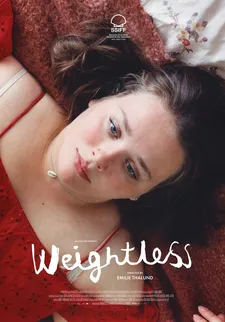 |
| Weightless poster |
ET: I gave birth a week after we closed the film, so I was pregnant when we shot it and she’s five months’ old now. I actually had two kids between starting the film and finishing it. It was very healing actually to have a girl after working with this.I’m working on some new ideas.
Did you find being pregnant played into the environment on set?
ET: Maybe. I was just feeling quite sick on the shoot. That’s a whole other conversation but being a female director – and there’s not so many of us – I didn’t want people to think I couldn’t carry the task of making it. Also because I’ve never done a short film, so this was the first time doing fiction like this so I really didn’t want to make people think I couldn’t handle the job because I was pregnant. I think it’s in me but also because the tradition of film has been so male dominated.