 |
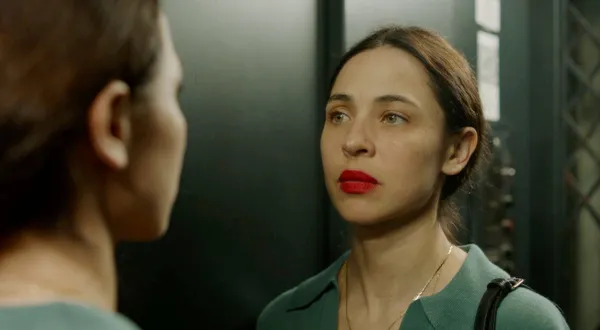
| Isabel Aimé González Sola as Lina in The Currents Photo: Courtesy of San Sebastian Film Festival |
The Currents carries us into the psychological spaces of its lead character Lina (Isabel Aimé González Sola), after she makes a split-second suicide attempt that leaves her with a fear of water. The third feature from Argentinian director Milagros Mumenthaler takes us on what often feels like a stream-of-consciousness exploration of Lina’s experience. The film had its world premiere at Toronto Film Festival before competing in San Sebastian, where we caught up with Mumethaler to talk about it.
You mention in the pressnotes being inspired byVirginia Woolf’s Mrs Dalloway and there are moments of stream-of-consciousness in the film – especially in the moment, when we dip in and out of several lives in Buenos Aires when your lead character is in a sort of reverie in a lighthouse, so can you tell me a bit more about that?
Milagros Mumenthaler: I was thinking about the possible lives of these women. I had read Mrs Dalloway and was actually renting an office in the building where that scene of the lighthouse was filmed [Palacio Barolo] and so I started thinking of the options of making this amalgam.
The idea of water runs through the film, it’s a metaphor but it also refers to the psychological state of mind of Lina and it appears and reappears at so many levels in the film – how did you develop that?
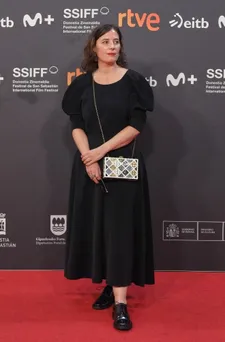 |
| Milagros Mumenthaler in a black dress on the red carpet in San Sebastian Photo: Courtesy of San Sebastian Film Festival/Alex Abril |
MM:Well, at the beginning, there's a woman jumping into the water. And actually, that scene came to me in Geneva, where I return often. So I began thinking about what happens to this woman after she jumps into the water? I began thinking that water is something pleasurable, it makes the body change and water is also a mysterious element, so I was thinking about what happens. In a sense, there’s an element of this woman finding peace in the water and recalling problems from her childhood. There’s a sense in that darkness of being home. The currents are different on top of the water and further down. Also the currents of what she's going through personally and on an emotional level.
She suffers physical symptoms afterwards and is frightened of water. I worked with a psychoanalyst as what happens to Lena is clearly traumatic but actually phobias are hard to categorise – a person can be afraid of lightning or water – so I worked with a psychoanalyst about the different possibilities but i didn’t necessarily want to label what Lena had. I wanted to explore how Lena opts to live through her experience.
There is strong use of costume and colour in the movie – reds and also a watery blue coat when she falls in the water. Can you tell me a bit about working on that?
MM:There was no concept about the colours or outfits but I work at a script level with an image in my head that I want to convey and linking that with actual shooting locations. In respect of the costume design, I had worked with her previously and she has a good knowledge of fashion history. I also wanted an atemporal feel, so the shoes crossing the street are atemporal and classic. In the mother’s house, we also tried different ‘colder’ elements.
It’s also a reflection of the pressures faced by a working mother. How important was it for you to talk about that?
MM:There is something about a woman's role in life in terms of what is expected and you might say that Lena fulfilled all of these roles that were expected of her, bu in fact, in her case, all of these elements didn't necessarily align and didn't gel. So I’m reflecting on the fact that very often in life we don’t have time to stop and think about where we’re going and what we’re doing. In this case, we see Lina opting for this – is it a romantic gesture, her throwing herself into the water. It’s a departure from the established things that are expected of her.
And can you talk a little about the husband’s character, he’s a minor one, but interesting because he could have been an antagonist but he isn’t
MM:I felt that if the husband was an antagonist, you might think that he was to blame for Lina's issues. But as we see, they like each other or there's a fondness. There’s a class element, he’s from a higher class, but she fits in. There’s not one person to blame. There is a crisis and some unresolved issues that Lina is going through. The idea is not to blame one of the characters.