 |
| The Ocean Duck |
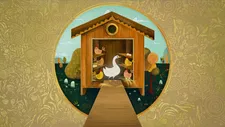
Once upon a time there was a duck. He thought that he was a chicken, because he had been raised in a henhouse, but then he discovered that his true home was the ocean.
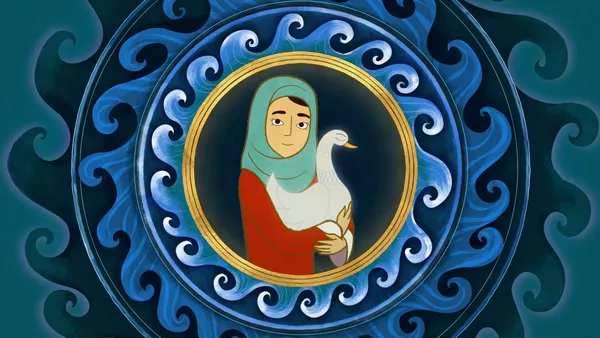
Winner of the award for Best Animated Short at New York International Children’s Film Festival, and now qualified to enter the Oscar race, Huda Razzak's dazzling short film The Ocean Duck uses elements of traditional Arabic and Persian art to tell a story inspired by the Rumi poem which also explores the relationship between a grandmother and granddaughter. It brings together a love of poetry and cooking with deep familial love, and it's visually enchanting. Director Huda Razzak agreed to answer some questions about it, and about the dizzying journey she has found herself on as a result of its unexpected success.
Jennie Kermode: What inspired you to tell this story in this way?
 |
| Visiting the hospital |
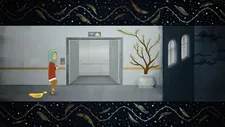
Huda Razzak: After my grandmother passed away a few years ago, I wanted to reconnect to the mixed Arab and Persian culture we shared. I was once going through our family library of poetry and art, and I came across a Rumi poem about a duck who lived among hens because it had forgotten its true home was the ocean, a symbol for the eternal. The metaphor really resonated with me and became the basis for the short. I felt that its message was timeless and wanted to explore how to retell the fable through a personal story of me and my grandmother.
I discovered the poem of the ocean duck after my grandmother passed, but a big part of the short is based on fond memories I have of her, particularly the moment when the characters are baking a cake. When I was sixteen, I wanted to impress my grandmother by baking her a fancy sponge cake, but I misinterpreted the recipe and followed the directions literally, including the instruction to fold the flour into the batter. Well, you can guess what happened when we cut the cake - flour everywhere! But it gave both me and my grandmother the biggest laugh, and I always think back to that moment with her.
JK: The film begins with cooking. Do you feel that this has a connection to stories, in the way that it's passed down through families?
HR: Oh, absolutely, and what a beautiful observation. Besides the language we shared, the food I grew up with in my family is a big part of my history, very much like our personal stories.
JK: Which are your favourite Rumi poems?
HR: It’s hard to choose but I love the parables in Rumi’s Mathnawi, one of his greatest works. One example of a poem that speaks to the universality of his writing is a poem called Elephant In The Dark, in which several people who have never seen an elephant try to describe it from their unique perspectives, a metaphor for respecting each other’s worldviews.
 |
| The duck who grew up in a henhouse |
JK: How did you develop the idea of using traditional artwork to frame the story, and make it a reality?
HR: I wanted the film to closely reflect the mixed Arab and Persian culture I shared with my grandmother, even visually. So I studied the illuminated manuscripts that depicted Rumi’s life and poetry and found visual inspiration for the film. The art of those manuscripts all shared certain traits - a flat two-dimensional perspective with a decorative border that elements crossed - traits that also became a vehicle for the narrative in the film. When studying the use of decorative borders in Middle Eastern manuscripts, I found interpretations that the border represented the ethereal world, and that elements crossing into it from the main art represented the idea of spiritual transcendence. I thought that was beautiful and became inspired to recreate that idea through the framing devices in the film.
JK: The water artwork is wonderfully textured. What led you to choose that style?
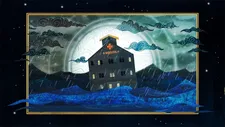
HR: I have to credit Ryen Goebel, our incredible visual effects lead, aka creative wizard! She not only crafted and designed the water artwork in the film but also created the unique altered perspective look of how the water interacted with the world. Our inspiration came again from the illuminated manuscripts we drew upon for the visual aesthetic of the film, but Ryen translated it into her work with such beauty.
JK: How did you find the voice cast?
HR: Before I began casting voice roles for my film, I had my daughter record some scratch for the young girl character. She was six at the time, and she surprised me how much of a natural she was at voice acting. So she remained the voice actress for the young girl character, which was really special because it made the film touch these multiple generations of women in my family. For the grandmother character, I wanted to find someone who had an Iraqi background, and fortunately with the help of some friends in film, I discovered the talented Jeed Saddy, who brought so much warmth in her performance.
 |
| All at sea |
JK: What, to you, is the most important message of the film?
HR: To cherish our relationships with our loved ones and to appreciate how much they make us grow and learn - about ourselves and about each other.
JK: Did you ever expect the film to attract as much attention as it has?
HR: It’s been very humbling for our whole team. It is the best feeling in the world when you get to see people responding to something you pour your heart into. We couldn’t be happier.
JK: What's next for you as a filmmaker?
HR: I would love to continue writing and directing, especially stories that draw from my culture. I recently started developing a new concept that is inspired by my mother’s refugee experience, a story that would build upon the themes, magical realism, and style of animation of The Ocean Duck.