





"We're kind of halfway through pre-production at the moment," says Jamie Fulford when I catch up with him to ask about his new project, The Only Colour Is Black. "The most important thing is the funding, so all our efforts are focused on that."
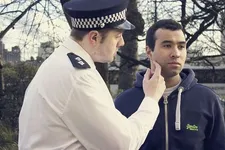 |
| Fulford hopes to humanise the police. |
Funding is always a big issue for filmmakers, but Jamie faces an extra challenge - he's trying to put together the first ever crowd funded full length British feature with a gay central character and theme. It's a wildly ambitious project with a Kickstarter fund still in its early stages, but he's put together a slick trailer and has already cast the main roles - everything is ready to go if the money comes together.
It's partly a true story, Jamie tells me, explaining why he feels so driven in relation to this film. He's not pitching it that way because the second half of the story is heavily embellished, but it started with something that happened to one of his friends. "It was a game changer moment for him that helped to define his sexuality," he explains, recounting how his friend, who is white, found himself smitten at first sight by a black man he encountered, but lacked the courage to go up and talk to him. Moments like this are not all that rare, but what struck Jamie about it was that his friend had spent a month trying to find this man again. It inspired the story of Syd, who has a similar experience but with two major complications: he's married and he's a police officer.
"It was my idea to put it in a police context," he says. "I wanted to explore more than just the story itself and use this to talk about class and race and sexuality... Lots of people don't like the police per se but then again, there are a lot of people who do. This film humanises the police in many ways. it highlights how it's a tricky profession because it's based on authority but no-one likes being told what to do. The film plays with all this but the point is that at the end of the day it doesn't matter how much power you've got - if your heart and ind are captivated by somebody you go through the same experiences as anyone else. There are a lot of experiences we all share."
Through those shared experiences, he also hopes to break down some of the barriers between gay and mass market films. "The film is not just for gay audiences. At the heart of it there's a gay theme but it's so relatable to that anyone can sympathise with Syd. He's questioning our society in a broader sense - questioning his job, his marriage - and he's prepared to renounce all that just to find this guy. Through that exploration he finds out what our society is about, and the film also deals with the divide between rich and poor."
 |
| A moment to hold on to. |
The Only Colour Is Black is Jamie's first feature but he's had some success as a short filmmaker in the past and has written a feature length script which was warmly received by BBC Writer's Room and Creative England - it may form the basis of his next project. At the moment, everything is focused on making this film happen. He's picked up cast and crew members along the way (it's much easier, he notes, having a small cast) and is working with a mixed group of friends and experienced professionals who can help to ensure that things run smoothly during the shoot.
One of the big remaining challenges is location. "We've already checked out a lot of locations and done recces," he says. "Some will charge us, some won't. The film is about 70% location based and there's one very important scene set in Liverpool Street Station. They've got a department set us for this sort of thing so we've been talking to them and it looks like it could cost us about £4,000 just for that shoot."
Can his team rise to the challenge? He hopes so. It's clear that he relates to Syd in many ways. Notably, he says, he's reached an age where he finds himself similarly curious about society and who's pulling the strings. "Is it all all about money? I don't think it is."
You can find out more about The Only Colour Is Black here.