 |
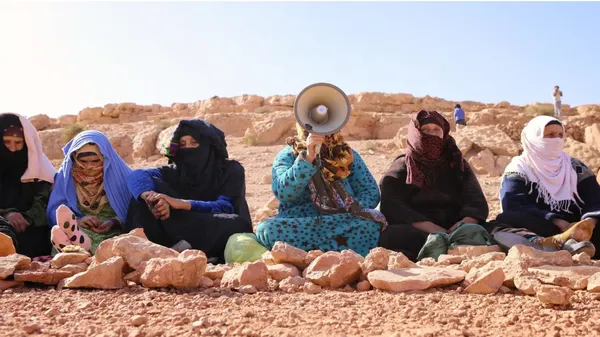
| Amussu will open the festival Photo: Courtesy of Folk Film Gathering |
The festival's programming is bracingly international in scope, with films from Morocco, Czechia, Poland, Ireland, Lebanon, Slovakia, Ukraine, Italy, Kurdish Rojava, and Scotland. Themes of community resistance, oral tradition, endangered culture, and folk mythology run throughout the programme, offering a welcome respite, and reminder of the power of the collective, to the recent miseries of geo-political events.
Opening with Nadir Bouhmouch’s groundbreaking collaborative documentary Amussu (2019), on Wednesday, 29 April, each event is paired with live music or performance, including Eastern European folk tales to accompany the Polish horror Lokis (Janusz Majewski, Poland, 1970); Scotland-based Kurdish musicians Rengê Welat introducing the Rojava Film Commune double bill; Leila And The Wolves (Heiny Srour, Lebanon, 1984), which is introduced by the Scottish-Palestinian poet Nada Shawa; and the Edinburgh Ukrainian Choir opening visionary director Sergei Parajanov’s, Andriesh (1954).
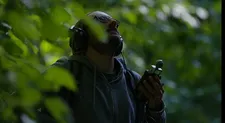 |
| Psalms Of The People follows Scottish-Gaelic psalm precentor Rob MacNeacail Photo: Hopscotch Films |
We spoke to the curator of the film festival, Jamie Chambers, to learn more about this year’s programme.
Several of the films features communities in struggle against larger corporate and global forces, do you think there is a particular theme that unites this year’s selection of films and events?
Jamie Chambers: Our theme this year is ‘stories that change in the telling’: which, of course, any folk tale does as soon as you start thinking of it as a film. We have a really great strand this year in particular exploring the beauty, horror and strangeness of folk tales on screen, and Eastern European folk tales in particular – with films from Czechia, Poland Slovakia and Ukraine – exploring how the visual magic of cinema can transform folk tales when they are brought to the big screen.
In that strand we have the tale of a fated nobleman who is part-man, part-fish in Hastrman, the classic Polish horror film Lokis, about a man who may be the son of a bear, the spellbindingly beautiful cinematic fantasia Perinbaba about the Mother Winter, the feather fairy who lives in the sky, and Andriesh, the first film to be made by the great Sergei Parajanov, about a shepherd boy who must learn to play a magic flute in order to defeat an evil wizard. I think that when we take a folk tale and rethink it as cinema, it is like an act of translation: something of the original is brought across, but equally what is brought across is somehow changed. All of these films do that in really interesting, different ways, and I think really make the case for the idea that folk culture can be articulated not just through song, storytelling, dance and crafts – but through modern forms like cinema as well.
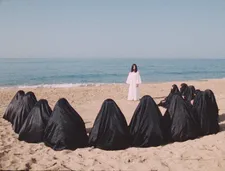 |
| Leila And The Wolves |
An incredible amount of work must go into organising a festival like this, focusing on stories less told. While I’m sure you’re proud of the entire programme, is there any particular screening or event that has been a real labour of love?
JC: I’m particularly proud of our programme as a whole this year. Given the titles we show tend to be quite rare, it is always a bit of a hunt to track them down in screenable formats, but this year some of the titles proved particularly tricky to track down. So from there to looking at what for me is a really rich programme of rich cinema, with Scottish cinema placed at the core of that, is really thrilling.
In terms of events I’m particularly excited about, however, I’m really looking forward to out special event celebrating the work of the Rojava Film Commune. I have been really inspired by the work of the Commune and, in particular, the way in which their collectively-made work is so frequently tends to be led by women, and given what is happening in Rojava at the moment, it seems like a moment when it is more important than ever to pay attention to what they are saying. We also have the amazing, Scottish-based Kurdish musicians Rengê Welat with us to introduce the event with a special concert of music, so I think that is going to be a really import event.
I’d say what I’m most excited about is our Bill Douglas: Rare Glimpses screening, with the new score we have commissioned from Dalhous. For me, Bill Douglas is one of the most important filmmakers Scotland has ever had, and so to see these rare, early films of his, as interpreted by the music of Dalhous is going to be a real one-off. Marc Dall of Dalhous is such a visionary musician, and I think there is something in his creative DNA that is shared with Bill Douglas somehow – difficult to say exactly what that is, but I think the coming together of Douglas and Dalhous is going to be something special.
I’m also thrilled that we are able to host the UK Premiere of the Canone Effimero, a really gorgeous, poetic film and one that is really important I think in terms of thinking about how folk culture is depicted on screen. We’re honoured to have the Gianluca and Massimiliano De Serio, the twin brothers who directed the film, with us to talk about how it all came together, so that is going to be another really special evening.
As the name implies, the festival seems to celebrate people coming together (to gather?), both in oral storytelling traditions and in the hallowed space of a cinema or other screening venue. Is that something that you feel is increasingly at risk?
JC:There is something really special about the experience of watching a film together. The great American independent filmmaker John Sayles once said that, ‘When the lights go down, everyone is the same". When someone sings a folk song, I think the audience is complexly part of that performance. How it feels to be in a room becomes part of the song, and to an extent the ultimate experience is something that is made together. While cinema comes bottled in a fixed form, I think something similar can be said about watching a film together, and I think that’s another way in which cinema can meaningful claim itself to be a part of folk culture. I’ve watched the same film in different rooms with different people and it totally changes how I experience it.
We’re particularly interested in what happens in a cinema when someone gets up first and tells you a story or sings you a song live, and how that then impacts how we experience the film that comes afterwards. I definitely feel the cinema-going experience is at risk, as its get so easy and cosy to watch films on our sofas at home. If we lose the experience of watching films together – and frequently I do feel that is a real risk, as often when I go to the cinema I am one of maybe three or four people in the audience – then we will losing something of intense value as a society.
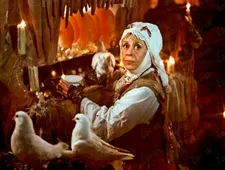 |
| Perinbaba Photo: Courtesy of Folk Film Gathering |
JC:We take a lot of energy from the work of the poet, activist and folklorist Hamish Henderson during the so-called Scottish folk revival from the 1950s. Hamish saw Scottish working class and community culture as being the equal of any culture in the world, and very consciously sought to put Scotland on the world stage, as a nation that faced outwards towards the world. His conception of the ‘folk revival’ was, I believe, based on the value of establishing solidarities and friendship with communities and cultures elsewhere in the world, and that is always what we have sought to do with our programming, in thinking of the ways in which Scotland can look outwards at this point in term to establish solidarities with what is happening elsewhere in the world.
The programme also boasts several premieres and rare screenings, such as the UK premiere of Italian documentary Canone Effimero (Gianluca and Massimiliano De Serio, Italy, 2025), the world premiere of Trad Treasures: Jimmy Hutchison ((Joseph Matheson, Scotland, 2026), and the much admired Celtic Utopia (Dennis Harvey and Lars Lovén, Ireland, 2025), winner of the Grand Prix at the 2025 Locarno Film Festival [read our interview with the directors]. The festival also has a welcome approach to accessibility, with closed captions, BSL interpretation, induction loops, and a free tickets scheme with no questions asked.
The programme runs across three Edinburgh venues (Cameo Picturehouse, Scottish Storytelling Centre, and North Edinburgh Arts), as well as its online screenings. For programme information and tickets, visit folkcinemas.com/folkfilmgathering
The Folk Film Gathering is supported by Screen Scotland and Film Hub Scotland.