





Eye For Film >> Movies >> Wardriver (2026) Film Review



After a string of TV movies, in Michael Mann’s first theatrical feature, Thief (1981), the main character, Frank, delivers a line that would later be immortalised by another of Mann’s films, and which encapsulates the ethos of a certain kind of character type. “You gotta be ready to walk out on everything in 30 seconds flat if you feel the heat around the corner.” Whether it’s out of fear for others, or because they view society as a weakness, the main strength of such heroes, or rather “antiheroes”, is exactly their lack of attachment to people and material things. But how does this translate to our times of screen alienation? In her sophomore feature, after years of working on television, Rebecca Thomas seems to have found the answer.
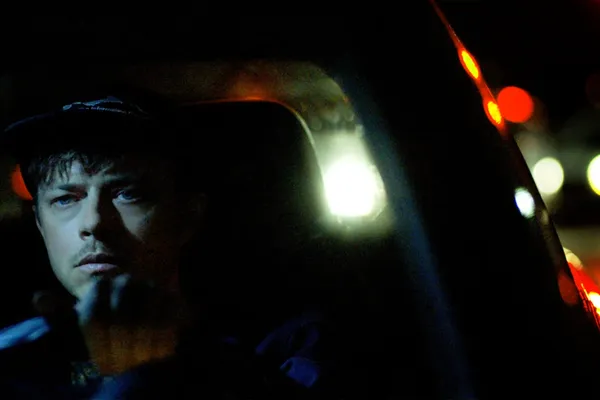
Wardriving is the practice of moving through an area with a device to detect and map nearby wi-fi networks, typically to uncover security vulnerabilities. Cole (Dane DeHaan), a weary young hacker with a severe vaping habit, is one such wardriver, targeting ATMs in low-traffic locations where he’s less likely to attract attention. He doesn’t steal money for wealth; most of the money he takes he gives away. However, after he’s made during a restaurant stakeout, Oskar (Mamoudou Athie) – a doorman with an MMA past and a criminal record – storms into his home in fury with a different plan. He forces Cole to empty the account of a specific regular: Sarah (Sasha Calle), a young woman who often dines there with an older man. Once the job is done, Cole is wracked with guilt at having endangered her life, and becomes determined to make things right; a decision that pulls him deeper into a web of lies he’s not aware of.

The screenplay is by Daniel Casey, whose most prominent credit is F9: The Fast Saga (2021), a movie in a franchise not exactly known for its subtleties. However, with Wardriver, Casey proves himself not just as a screenwriter on automatic, but as someone very comfortable in manual mode, shifting gears with ease. The story not only calls back to the before mentioned neo-noirs, and an even older lineage of westerns feautring the so called "professional" plot, but mainly, the story manages to enter a really niche topic that isn’t necessarily cinematic, as in, a profession that’s mostly a passive action, and create cinematic tension around it. Hacking is a calculated and precise calling, making Cole a character whose transgressions are always virtual and in line: never sticking out or attracting attention. However, once the plot kicks into motion, the safety of virtual transgressions will soon get replaced with the tangible real-world risks and consequences to match.
One of the best parts of the story is the way it is structured, which is also probably the aspect that will feel the most gimmicky to most. Let’s just say that this type of restructuring of a story for dramatic effect hasn’t been common since the Usual Suspects/Reservoir Dogs era, and for a good reason. Out of order restructuring and convenient shortcutting of scenes makes for a lazy storytelling way of surprising your audience. However, here it’s not only pulled off with great conviction, but also, it plays on the audience's expectation and presupposed notions about this film genre itself.
In more recent iterations of these types of characters, they are treated as a symptom of society gone wrong, where we’re expected either to reflect on that fact or to root for an act of rebellion through transgression. In other words, they are all antiheroes who either end up being consumed by vengeance or violence in general. Even in Winding Refn’s Drive, where the silent Ryan Gosling is presented as an ambivalent force of good that’s merely a mediator between criminals, even he always gives off the impression that he hides something dark deep inside him and that he is a ticking time bomb, ready to explode. These are the expectations placed on the main character of Wardriver as well, and the structure of the story not only works as a way of surprising viewers, but also as a way of subverting those expectations as well.
However all of this could have simply come off bland, generic and misguided if it weren’t for the great screen direction by Rebecca Thomas, and the rest of the cast who have risen to the occasion. One of the best aspects of Drive (2011) is that it captured the less known parts of LA: its dark underbelly, rundown motels etc, almost as though the camera was making love to the ugliest parts of the urban setting. Wardriver (2026) has that same quality to it, while also adding to it in a way by setting most of the film at night, giving it a unique noir feeling in a contemporary setting. Hackers are nocturnal animals after all, so the choices feel quite natural. Furthermore, Thomas approaches the story with verve and gut, executing quite a few suspenseful, as well as quiet, more subdued, moments within a narrative that maintains its constant forward momentum, without the stationary meandering we’ve grown ostensibly used to in this “post-everything” era. So while this film has the undeniable oldschool sensibility, it never feels archaic or out of joint with its time.
All of this would have amounted to nothing without the cast to match, and the key players pull through. Athie, who just recently broke out with The Drama, by Kristoff Borgly, manages to play a thuggish character with subtlety. While DeHaan hasn’t remained on the top of Hollywood callsheets, here he reminds us once again why he always belonged there by giving us a mesmerising performance of a lonely hacker who longs for company. And lastly, but certainly not least, Calle adds layers to the role that could have easily fallen into the femme fatale type, imbuing her with an emotional core.
Reviewed on: 28 Apr 2026


Director: Rebecca Thomas
Writer: Daniel Casey
Starring: Dane DeHaan, Sasha Calle, Mamoudou Athie, Jeffrey Donovan
Year: 2026
Runtime: 93 minutes
BBFC: 
Country: US
Festivals:
Search database: