 |
| The Blue Trail |
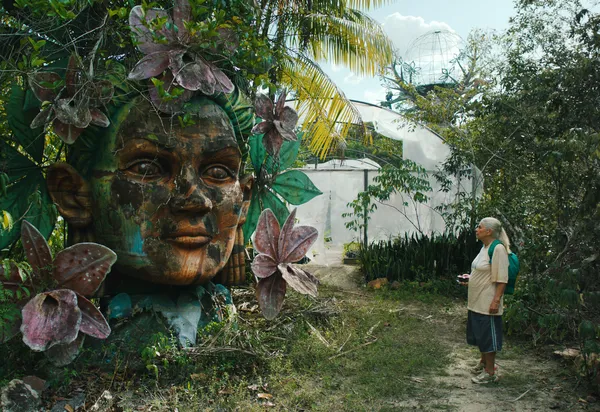
Brazilian director Gabriel Mascaro’s The Blue Trail (O Último Azul), tells the story of 77-year-old Tereza (Denise Weinberg), who receives an official government order requiring her to relocate to a remote senior housing colony to live out her final years. This is a mandated practice to allow the younger generations to solely focus their energies on economic growth. Not ready to surrender her freedom, Tereza decides to leave her small, industrialised town in the Amazon, and take a journey of self-discovery along the great river.
Mascaro began his feature filmmaking career co-directing the 2008 documentary The Beetle KFZ-1348. He then directed the documentary High-Rise (Um Lugar Ao Sol), about the mindset of the elite residents in three of Brazil’s cities. He shifted from documentary to narrative drama in 2014 with August Winds (Ventos De Agosto), which he followed up with Neon Bull (Boi Neon), about a bull handler who dreams of a different future, and Divine Love (Divino Amor), where wholesome conservative and spiritual values intertwine with the swinging lifestyle.
In conversation with Eye For Film, Mascaro discussed the personal roots of his film, seeing dreams come true and subverting narrative expectations. He also reflected on the seductive landscape, difficult choices, and micro-transformations.
The following has been edited for clarity.
PR: Were you always drawn to the allure of filmmaking?
GM: I initially worked in visual arts, then the documentary field before fiction. Being a filmmaker wasn't something that I’d always planned on being, but then, you become a part of this community, and it’s the way you pay the bills.
I’m not from Rio de Janeiro or São Paulo where cinema is commonplace — I'm from Recife. Luckily, at the moment, we have a strong film community presence in different regions across the country. It has become exciting to be a filmmaker. Kleber de Mendonça, who directed The Secret Agent, is from Recife as well. It’s special for these regions to receive international recognition, and for Brazil to be recognised as a diverse country.
PR: Coming from a place that doesn’t offer the kind of exposure to cinema the bigger cities do, what films and filmmakers have been important in your creative journey.
GM: I remember watching Madame Satã by Karim Aïnouz and Pixote by Héctor Babenco, both of which are great Brazilian movies. When I was 18 years old, I was at university and I was hired to be a trainee on a movie called Cinema Aspirins and Vultures. It was selected to play Cannes. When you work on something that is recognised, it makes you feel dreams are possible.
So, those three movies were important for my career because of their influence, and I sought out more Brazilian cinema so I could experience other kinds of films, including more experimental works and visual arts.
PR: What was the genesis of the idea for The Blue Trail, and what compelled you to believe in this film and decide to tell this story at this particular point in time?
GM: The script development took nearly ten years. The seed of the project came when my grandfather passed away and my grandmother started painting. It was wonderful to see her find new meaning and this led me to think about how I’d like to make a movie about an elderly woman.
I started investigating movies about elderly protagonists and I discovered there are not many. And when there are, they are about terminal illness, death or nostalgic views of the past — it’s never about the present moment.
In The Blue Trail, I wanted to capture the feeling my grandmother inspired, and to tell a story from this perspective, I had to set out to create my own journey. I also investigated different genres that discuss experiencing a new life flourishing. Generally, they are associated with youth, like coming-of-age and dystopian stories. Here, I tried to be playful by subverting those expectations. Instead, I had an elderly woman as the protagonist, who, experiencing her own self-discovery, is able to be a rebel in a dystopian narrative. And as well as blending together dystopia and coming-of-age, it’s a story where the road trip meets the boat trip.
PR: Picking up on your point about these stories never being set in the present, to what extent is The Blue Trail a reflection of our present-day?
GM: It's very important to be able to use storytelling tools to fictionalise new futures that are a displacement of our reality. In The Blue Trail, I tried not to set the movie in the past, present or future. Instead, time is displaced. For me, it was more important to think about the cultural changes that normalise these wrinkle-wagons that take people away, rather than high-tech gadgets and flying cars.
What we are facing nowadays is subtler forms of violence that sometimes you don't even see. That's why I tried to avoid these caricature tourist dystopias where you see guns and the police. In this movie, the violence can be very subtle and simple. It can be an act of forcing you to use your diapers, and double check if you put them on properly, or taking you away from society in a humiliating wrinkle-wagon that looks like a stray dog car. And instead of classical camera surveillance, here everyone is a surveillance tool, and everyone is able to snitch on each other.
Modern autocracies are everywhere, and when you think about ICE in the US or what’s happening in other parts of the world, we see examples of forced displacement. This is a subject I’m talking about in this movie, but not from the perspective of immigration or climate crisis refugees. Instead, it’s forced displacement to the colony just because you are older.
Nowadays, we are normalising violence. For example, the prejudicial way we speak about minorities. While empathy is disappearing in the news and politics, movies are able to generate empathy. The Blue Trail is like a utopian tool, whose magical elements in the forest offer us the capacity to see a new future. It’s slow in its movement but infinite in its possibilities.
PR: The setting of the Amazon rainforest affords you the opportunity to capture some striking imagery. At times, there’s almost a lightness to the cinematography. With that in mind, how did you approach the film’s visual language?
GM: We had a challenge because you can imagine how beautiful and seductive the landscape of the Amazon rainforest can be. We chose to be very precise to avoid being seduced by the forest’s beauty, making the movie in the classical 4:3 aspect ratio, instead of cinemascope. This meant we could be seduced by its beauty and not lose our characters, because using this default aspect ratio forces us to connect with Tereza and her wrinkled face.
At the beginning of the movie, when she’s in her domestic setting, we shoot on the tripod. Then, when she begins her trip and goes in search of her dream, we switch to handheld, so it’s more fluid, like we are discovering what's happening at the same time she's discovering for herself.
These concepts for the visual style are not necessarily something the audience will think about, but these concepts will still help to somehow create meaning through the choices or feelings the audience may not be conscious of.
PR: Does the audience experience a film on different levels of consciousness?
GM: Oh, of course, and different audiences will have different perceptions. Some will just be watching the story, and others will be thinking about how the story was made. So, it depends on their individual selves that will play a part in forming their visual perception.
A few people have even asked me if in Brazil people are being taken away in these wrinkle-wagons. It’s always fascinating how the audience has the capacity to believe and to trust in what they’re watching, but also to fantasise while navigating the film’s absurdist world building.
PR; Have you noticed ways in which audiences are responding differently to the film?
GM: Yes, and it's curious because, for example, in Europe, the majority of the audience that go to watch art house movies are retired people. So, it was beautiful releasing this in France, because there was a lot of white hair in the audience [laughs]. I'm not sure about the US market, but in Brazil, it's not common for retired people to go to the cinema. Elderly people stay at home more than in France, and so, we had to do a lot of work on the campaign to recommend that young people take their elderly relatives to the cinema. But it's actually beautiful to see young people watching a movie in which the reference to freedom comes from an old lady. It's really subverting expectations because, again, when you think about dystopia in general, you imagine a young rebel, and when you see a coming-of-age story, you see a young person.
PR: Is filmmaking a transformative experience?
GM: I believe in micro-transformations. So, while I'm not sure that movies can change society, they are able to create these micro-transformational shifts in our lives through our sensitivity and how we observe and feel about the world.
I’m more focused on the belief that we are able to be emotionally transformed by a movie, and that's very important when we are facing a society with a lack of emotional preservation.
The Blue Trail opened theatrically in New York and Los Angeles on Friday 3rd April. A national expansion will follow. The film is in UK and Irish cinemas on Friday 17 April.