 |
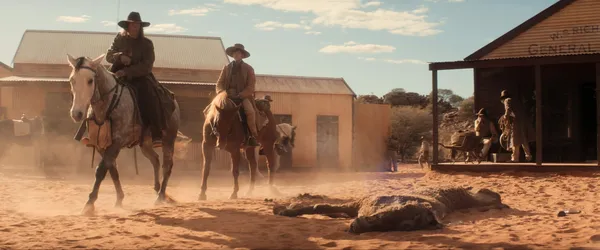
| Warwick Thornton on Wolfram: 'My job as a filmmaker is to retell history through cinema to tell the truth of what actually happened' Photo: Bunya Productions |
He says that because of that, he wasn’t initially sold on making a sequel of sorts. He explains: “That film is a beautiful entity and a foundation of indigenous storytelling but if we’re going to go down that path again, do we really want to?”
But then he read it and was sold because “it has redemption in it”. He adds: “The characters are not victims, they're survivors.”
“My great-great-grandmother worked down those mines, picking at tin and wolfram and we have an oral history of those stories. As an indigenous person, I have to tell the truth. We come from a country where the coloniser had the pen and they wrote their version of what happened and their version was we literally weren't there. They moved through the country and they created fields of wheat and they created ranches full of cattle and sheep. Look, hang on, there was 400 different language groups across Australia. ‘Oh no, they weren't there’. We have our own oral history. So my job as a filmmaker is to retell history through cinema to tell the truth of what actually happened.”
At the heart of Wolfram is the story of two kids, who have been separated from their mother (Deborah Mailman) and the family’s attempts to find one another in a landscape littered with very bad men, including the racist and misogynistic Casey (Erroll Shand).
“I’m kind of forgetful Jones,” Thornton adds. “But David has this amazing memory of what he's been told by his mother and his grandmothers about where they worked and who they worked for and how they were stolen. He remembers all these stories. I can't remember anything about my grandmother, so that was really empowering to me that David had those memories that oral history that was given to him from his mother and his grandmothers. He had that inside him and could actually turn that into a script and that’s a really special thing
“Indigenous people, we have an oral history, we don't have a written history, so memory’s really important to us and he kept those memories alive, and then he turned it into a script and then we turned it into a film. It was a beautiful transition, a beautiful process for me.”
Thornton talks about growing up in Alice Springs, where there were two cinemas, both open-air – a walk-in and a drive-in. He says it was only commercial cinema, which essentially meant “someone told you what you were watching”.
He adds: “The greatest breakthrough in our house was VHS because you weren't given one movie every night at the cinema, you were given a book library of movies. As soon as you walked into a VHS store, you controlled your narrative and you chose what you wanted.
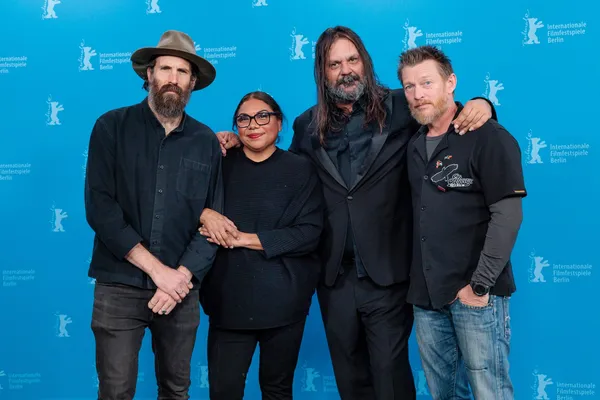 |
| Thomas M Wright, Deborah Mailman, Warwick Thornton and Erroll Shand at the Berlinale photocall Photo: Courtesy of Berlinale |
“Alice Springs is in the desert, so we just loved Westerns. So we watched The Good, The Bad And The Ugly, How The West Was Won, Soldier Blue – what an insane film, really hardcore. Soldier Blue was one of those films where we realised that, ‘Actually, we’re the Indians’. We always wanted to be the cowboys but actually we’re the Indians. It’s an evil epiphany that you have as a teenager but it’s a ‘serving’ of where you stand – are you at the front of the bus or are you at the back of the bus? We’re always at the back of the bus… but we like the back of the bus.”
The filmmaker notes that films like these and others like The Searchers were “in a strange way lamenting a past and something that had actually probably disappeared in their lives.
“But we were living in Alice Springs where the Western was still real. There were still people riding horses up and down the street, drunk. There were still guns and there was still a lot of racism.”
He adds: “I had an epiphany a couple of years ago about what a western would be from an indigenous point of view. The Searchers is all about the veranda and looking out at the wild lawlessness and the savages who are over the hill or in that forest? You stay on your veranda on the ranch and the veranda is a barrier. It's where you stand. Because if you step off that veranda, you're into a different territory and you're in a dangerous place and it's evil and scary and it's full of savages and they have no law. As an indigenous filmmaker making a Western, my point of view is in the forest or on the mountains, looking at that veranda, going, ‘That's very dangerous. It's really scary. We're looking from the forest at the house and going, ‘This is strange, this is scary, we don't do it that way. It looks like there's not a law there’. So it’s a different perspective of the same world.”
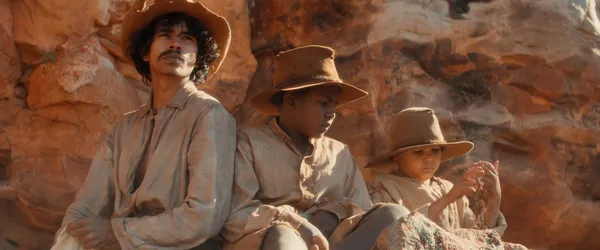 |
| Warwick Thornton: 'Some people are victims. Some people are survivors, and my people survivors, and I like to portray them as survivors, not victims' Photo: Bunya Productions |
One of the most authentic elements has to be the flies, which are buzzing about right through the film. They came free, apparently.
Thornton explains: “We had a fly plague and 40,000 blow flies can’t be wrong. They helped toughen up the film. The irony is, even flies need a backlight. We swallowed about 15 files a day. For the first couple of days you kind of spit them out … by about the fourth day it was just too hard to cough them up so you just swallowed them and got on with it.
“They were crawling all over the lens and if they crawled they were okay because they were moving on the glass but if they stop still they look like a dirty lens. The poor old focus-pullers and loaders would just be mortified because the lens looks like it's really dirty. I said, ‘Let the Flies crawl all over the lens and we'll roll but tell me if you see one that's standing still and we'll do another take just because of the fly’.
“But I embraced them. We’re not making a commercial for butter, we’re making a hard-arsed film about this groups’ survival and struggle, so bring the flies on.”
“Every time a horse would shit, another billion flies would come. And there was one scene, I remember clearly, that none of the horses did a shit. And then I’m like, ‘The continuity of the flies is wrong’. So we actually went and got some horse shit and put it in the scene so we could get the flies in.”
Thornton previously told me that he was trying to declutter his filmmaking experience with The New Boy so I asked if he had continued that process, given how spare the scoring is. He says he used two cameras and sometimes three but also noted he was working again with children and animals.
He says: “The writers wrote a donkey in it. One day the donkey will wake up, and he'll think he's a donkey and then the next day, the donkey will wake up and he'll think he's not a donkey.
“I felt that I was getting this very important theory of decluttering. But the script should dictate to you what you should be doing. Ydo Not, this is how I make movies. There was a bit of laziness from me, the lens pack – there’s certain vintage panavision lenses I always use…
“But I should imagine that I’m a cinematographer who had no idea about anything. I've got to a point now where I need to stop bringing the director I thought to the film and start being almost like the short filmmaker who has no idea and being that person again, even though the films are bigger and have more famous actors.”
“It's a part of history and a part of the country that I was born in and I've grown up in, and I will die in but it’s just tough. Some people are victims. Some people are survivors, and my people survivors, and I like to portray them as survivors, not victims.”
Thornton talks about the way that racism and prejudice have morphed down the decades.
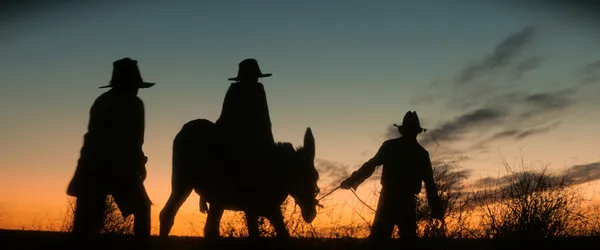 |
| Warwick Thornton: 'One day the donkey will wake up, and he'll think he's a donkey and then the next day, the donkey will wake up and he'll think he's not a donkey' Photo: Bunya Productions |
He added: “Every 15 years we see it in most countries. This right-wing thing rises using words like ‘nationalism’, ‘immigration’. They come in, they change all the policies, they destroy a country. It’s absolutely horrific. And then the country wakes up and realises they’ve been abused and nothing actually happened, bar the rich got richer. Then suddenly we kick them out… Liberal… then spend another 20 years building the respect of the people and building the respect of other countries. We just keep doing that. That’s my country. At the moment, we’ve got a beautiful government in. A government that knows its wrongs and knows its failures in history, who are Labour. But, at the moment, the rise of the ‘one nation’ kind of concept and anti-immigration is getting more and more powerful by the day and they’ll get in one day and we’ll have to work with it.”
The Kaytetye filmmaker also believes in listening to his audience, re-cutting the film after it premiered at Adelaide Film Festival and before it screened in Berlin.
He said: “We re-cut it. We screened it in Adelaide and I sat there with the audience. And, you know, that’s the power of cinema. It's the collective Soul. There's this Aura of energy in an audience that just sort of feeds and bubbles and it rises at certain points and you can feel when you're traumatising the audience, it just gets flatter and flatter. The director in you is, like, ‘Fuck, they’re really flat at the moment. They’re just about to all walk out. If they just hang in there for five more minutes, I’ll give them what they need at this moment’. All that is happening at your premiere. At Adelaide, I felt that and I felt where it didn’t work and I didn’t give them what they needed – as humans, not as indigenous or white people – at the right place. So we went back and re-cut it. So this is a different version than what was in Adelaide.”