 |
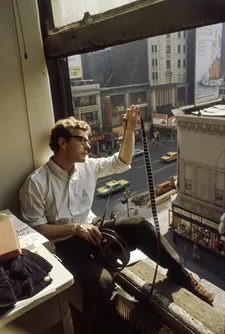
| Being Bo Widerberg Photo: courtesy of TriArt Film |
Screening as part of the 2026 Glasgow Film Festival, Jon Asp’s portrait of perhaps Sweden’s greatest maverick filmmaker, Being Bo Widerberg, is a bold documentary which doesn’t pander to its audience in the least but nevertheless provides a great introduction to the country’s cinematic history. It’s a tremendously detailed film focused on Widerberg’s film shoots, the experiences of cast and crew, and what active engagement in film meant to a man who struggled in some other aspects of life. The Glasgow audience is famous for its willingness to try new things, and is likely to love this. I was grateful to the film’s co-director, Jon Asp, for taking the time to discuss it.
“I've been studying Ingmar Bergman a lot, but as many people know a lot about Bergman, we thought about Bo Widerberg,” he says. “He is not the opposite, not the antagonist, but somehow he's been a bit forgotten because he died almost 30 years ago. So we thought it would be appropriate to make a documentary about him, to remind about his works, because he was very creative director during the Sixties. And we also wanted to nuance the picture of Widerberg, because among Swedish contemporary directors he is very well known and lots of people are inspired by him, by his works, but for the general people he's less known. And abroad there's only the UK and France, perhaps the ‘States, where he's still remembered.
“We thought it would be apt to remind about him and to update also the image of Bo Widerberg, because he was quite a hard person to work with. During the Sixties he had an easy time, because at the time you didn't have to write proper manuscripts. You didn't have to apply the same way you have to do today, or later during the Seventies. So Bo Widerberg pretty much sums up Swedish film in a way as well, because during the Sixties it was very creative and lots of people could make their début features, but during the Seventies and further on, it became harder to make films. There was much more of a system, much more of applications. And as Bo Widerberg didn't have the talent to preserve his friends, to preserve his close crew, he wasn't able to make as many films as he wanted to make.”
It seems like he could only really have existed within that period, in between the formality of the work that went before him and the systems which developed later, I suggest, and Jon agrees. I ask if he thinks it was because of Bo’s manic depression that he had that kind of chaos around him all the time.
“Yeah, I believe that was one of the issues,” he says. “I mean, as he wasn't interested at the time to take medications or to really dig into that problem. His only method of handling his manic phase was to be creative, to make films, to go to shooting. That was his only goal, in a way. Of course he had relationships, but he wasn't really happy there. Either he wanted to make rehearsals or to do shooting.”
We talk about Bo’s early ambition to become a writer.
“That's quite surprising in a way,” says Jon, “because when you see those old images and when you read documents, he's much more like a proper writer who really wants to be this serious person. He seems to be a bit restrained, actually. It's only when he goes into filmmaking, through criticism, that he really finds his proper self, I would say – inspired by the French New Wave and Godard. And he not only takes inspiration from their works, he also creates his new persona, which is much more outspoken and much more eccentric.”
He must have been conscious of how people were talking about him and writing about him at the time. Did he enjoy being seen like that, and maybe exaggerate it sometimes?
“Yeah, yeah, that's what I think. I think that he wasn't really happy with only being a writer.. Working class people had the time, had the opportunity to actually make films. But before that, during the Fifties, cinema wasn't really the working class medium, so he wasn't exposed to that; so he thought more of writing all the time. But I would say that he enjoyed creating that persona, that he felt more at home with the continental directors than the Swedish literary scene.
“Bo Widerberg is pretty much the same age as the Swedish public service archive, so we have all that material from the very start, from the Fifties and the Sixties, digitised as well. That's also a good thing when you make films from the Sixties, because that's an interesting, obviously creative era and you have all those documents. But of course you also have lots of problems because this was before ‘68, before MeToo, so we didn't want to romanticise the Sixties, saying that there were good things all the way. But still we find it inspirational to remember this time as a creative era. We believe that the audience are that intelligent, so they can make their own conclusions.
“If Bo Widerberg should have made more films, he would have stuck to his close crew, but there were small things which made him burn those bridges and then it became impossible for him to make films. Even after Man On The Roof, which became a huge success in Sweden, but also in the ‘States, in ‘76. And after that there were no people in Sweden, not the Swedish Film Institute, not the Swedish Film industry, who wanted to work with him, so he had to go abroad to find foreign producers.
“One could say that there are three parts in his career. The first period is like the Swedish nouvelle vague – I mean, where he depicts Malmö, his hometown town, in Raven’s End and his début The Baby Carriage, and I want to say that Love 65 is among those three. Then he made historical dramas because he had a failure with Love 65 and he really wanted to make something bigger, to make an international success. So he made Elvira Madigan and used colour for the first time and with a very special light from Jörgen Persson.
“This old story, set in a new context, became a hit, especially in the ‘States. So he had a talent for making popular films as well. I think it’s what his skill is, to combine small, important details, but also to put them in a more accessible setting, or a new setting. That made him, at his best, quite popular as well. So then you have that historical period, Adalen 31 and Joe Hill, all period pieces. And then he went into Swedish crime, making Man On The Roof and The Man From Majorca. So even if he was an auteur, he pretty much changed genre all the time.
“But then he made Victoria. It’s quite a hard watch. Perhaps he wanted to do an Elvira Madigan 2, to repeat his success. And then he had this German producer who wasn't really into filmmaking at all. And when he lost those close people, he had a hard time to navigate the landscape. And then he sat there at Cannes for the première, completely messed up – almost in a psychosis. It's very strange to explain.
“What we're not very much depicting in the film is his time at Swedish television drama, which meant he took Ibsen, he took Steenberg, he took other classics, but he wanted to make them accessible for the people who watched television. He was quite successful there. And he also took quite popular Swedish comedy actors and put them in a serious setting, so he was quite revolutionary there as well.”
We talk about the structure of the documentary.
“We had an ambition to make it quite classical,” he says. “Quite chronological. Because there hadn't been like a documentary about Bo Widerberg before which covered all his films. Because you have the Sixties and you have the Seventies, so there's so much natural dramaturgy in that arc. The main ambition was not to analyse his work, his method, but to bring the audience to the shooting. That we have the impression of what happens during the shootings, because they didn't look the same.
“For example, Love 65, he had two successes before then. He was playing Fellini. He wanted to bring a model from Stockholm, he wanted to bring Anita Ekberg from Italy and he wanted to bring Benito Carrados from Casavetes’ film. And he didn't have a clue what to make of them there, but he wanted to collect them there, he wanted to bring those energies and to see what would arise there. And sometimes it succeeded, other times not. But we wanted to show the behind the scenes material and to also have this audio material that you can hear from the shooting of Raven's End, where at first he is very angry with the people who lives in those old buildings, and then he gets another idea: to bring them into the picture instead. That's typical for Widerberg at the time. He wanted to have those small details to make his films larger in a way.
“That's why we made it chronological and really based on the shootings, but that became harder in a way, because it was easier to make those stories around the early Sixties shootings, because they are more like going to summer vacation or going to a specific site and specific times. So it became more like for old people who go to summer camps.”
As a documentary maker, does he find it more satisfying to make a film about a director who doesn't get everything right and has failures as well as successes?
“Yeah. I mean, if you look at the Swedish directors, I mean, our big names like Jan Troell, Bergmann and Widerberg, I mean, they all had their issues, obviously. For example, Bergman was very much controlled, especially when he did interviews and stuff like that. With Widerberg, it's all over the place. Sometimes it's very many words and sometimes it's very short. So we have different energies, and of course that's quite grateful material to have as a documentary filmmaker, to have those ups and downs, highs and lows. If you're interested in making nuanced documentary, you can see all the benefits from having his temperament, but you can also see the back side from it. I would say that it's interesting material to work with because it's very human, in a way. We're all human, but some directors are very restrained. But of course it's possible to make interesting documentaries about other people as well, because they have their nervousness as well.
“He had four children with three different women, but it was only the last one, the third one, Johan Widerberg, who also became an actor, who he had like during the Seventies; and at the time he had a hard time to make films for the first time in his career. And then he had Johan. So instead of working a lot with cinema, he put a lot of effort into Johan and became very present with him. First he wanted him to become an actor and he brought him to cinemas at an early age. And he also wanted him to become a football player, as you can see in the film. So he strived to make this kid successful in football or cinema. It's very strong in a way.
“That probably made his days easier, that he had opportunity to put a lot of effort into the kid instead of putting it into the shooting or the rehearsal. So that was quite strong material to watch, actually. But unlike that, as you can see, Martin Wederberg, his second son, who was for the first time present for his dad when he became a part of the shooting, that was the only time that he really felt a connection. I believe that's strong material. Obviously lots of filmmakers have those problems, that they're more present during their work. There's similar issues today, even if people handle it better.”
He was able to get a lot of people who knew Bo personally to participate in the film.
“They were all very enthusiastic, I would say, as with Bergman before. People in Sweden don't have a natural way of talking about Bergman. It's more like scandals and stuff like that. He's only interested in God and the metaphysics stuff. So I would say that people are much more keen on talking about Widerberg because they have a more vivid relation to him and they also want to remind about his person. So, yeah, it was really easy.
“The only one who didn't want to take part was that third son. But I wasn't that sad about that because we had such good archive material with him. I didn't want him to analyse the situation now, in retrospect. I think it's more interesting and more accurate to have archive material from during the process. I had a problem a bit with Stellan Skarsgård at the beginning. He said they were such old memories...but when we talked more and more about Bo, he was reminding himself about those old shootings and those old memories. So after we had two coffees together, he was like, ‘Yeah, I will do it. I will say the things before camera as well.’ He was really professional. He had this very close relationship to Bo. And Stellan is obviously a pro and he brings all this energy to the film.
“There's not so many international directors who are very much into Bowie de Burg. But the ones we asked, like Olivier Assayas and Mia Hansen-Løve, they've been aficionados of Widerberg for decades, so they were very eager to participate.”
It seems very fortunate that there is this Swedish strand at the Glasgow Film Festival this year, which this fits into so neatly, I remark, and he nods.
“Yeah, agreed. We really wanted to screen the film somewhere in the UK and this is the perfect spot. I mean, we premièred in Cannes last year and were in New York this autumn, so of course we wanted to make people in the UK discover the film as well. We hope that the Glasgow venue will bring other venues as well, because obviously there's a intelligent audience in the UK and we believe that this is an intelligent film about filmmaking. So even if you're not super acquainted to Bo, I would say that also people who make film today can sense things, similarities, which are still valid.”
They have some other festivals lined up for later in the year, he says, though he can’t reveal all the details yet. Then he will be going on to work on another project about a different Swedish giant.
Being Bo Widerberg screens at the Glasgow Film Festival on 3 March.